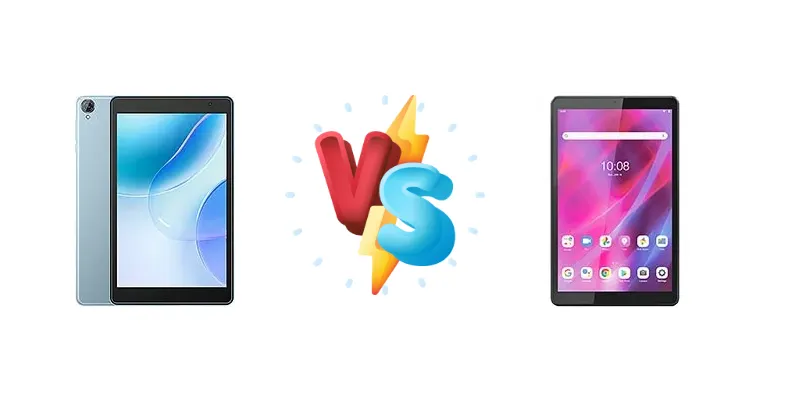
The budget tablet market is fiercely competitive, and the Blackview Tab 50 WiFi and Lenovo Tab M8 (3rd Gen) represent compelling options for users seeking affordable Android experiences. This comparison dives deep into their specifications, focusing on how the core hardware differences – specifically the CPU architecture – translate into real-world performance and battery life.
🏆 Quick Verdict
For the average user prioritizing longevity and basic tasks, the Blackview Tab 50 WiFi emerges as the better choice. Its reported 89:18h endurance significantly outweighs the Lenovo Tab M8’s performance advantage, making it ideal for extended reading, streaming, or travel. However, the Lenovo Tab M8 is a better option for those needing more responsive multitasking.
| Network |
|---|
| 2G bands | N/A | GSM 850 / 900 / 1800 / 1900 |
| 3G bands | N/A | HSDPA 850 / 900 / 1700(AWS) / 1900 / 2100 - International |
| 4G bands | N/A | 1, 2, 3, 4, 5, 19, 7, 8, 20, 26, 28, 38, 40, 41 - International |
| EDGE | No | - |
| GPRS | No | - |
| Speed | - | HSPA, LTE - cellular model only |
| Technology | No cellular connectivity | GSM / CDMA / HSPA / LTE |
| | - | 1, 3, 5, 7, 8, 34, 38, 39, 40, 41 - China |
| Launch |
|---|
| Announced | 2023, September | 2021, June 28 |
| Status | Available. Released 2023, September | Available. Released 2022, February |
| Body |
|---|
| Build | - | Glass front, aluminum back, aluminum frame |
| Dimensions | 211.2 x 126.2 x 9.7 mm (8.31 x 4.97 x 0.38 in) | 199.1 x 121.8 x 8.2 mm (7.84 x 4.80 x 0.32 in) |
| SIM | No | Nano-SIM (cellular model only) |
| Weight | 355 g (12.52 oz) | 305 g (10.76 oz) |
| Display |
|---|
| Protection | Mohs level 6 | - |
| Resolution | 800 x 1280 pixels, 16:10 ratio (~189 ppi density) | 800 x 1280 pixels, 16:10 ratio (~189 ppi density) |
| Size | 8.0 inches, 185.6 cm2 (~69.6% screen-to-body ratio) | 8.0 inches, 185.6 cm2 (~76.5% screen-to-body ratio) |
| Type | IPS LCD | TDDI IPS LCD, 350 nits (typ) |
| Platform |
|---|
| CPU | Quad-core | Octa-core (4x2.3 GHz Cortex-A53 & 4x1.8 GHz Cortex-A53) |
| Chipset | - | Mediatek MT8768T Helio P22T (12 nm) |
| GPU | - | PowerVR GE8320 |
| OS | Android 13, DokeOS_P 3.0 | Android 11 (Go edition) - 2 GB RAM versionAndroid 11 - 3 GB RAM version |
| Memory |
|---|
| Card slot | microSDXC | microSDXC (dedicated slot) |
| Internal | 128GB 4GB RAM | 32GB 2GB RAM, 32GB 3GB RAM |
| | - | eMMC 5.1 |
| Main Camera |
|---|
| Features | LED flash | - |
| Single | 2 MP | 5 MP, AF |
| Video | Yes | 1080p |
| Selfie camera |
|---|
| Single | 0.3 MP | 2 MP |
| Video | Yes | 720p |
| Sound |
|---|
| 3.5mm jack | - | Yes |
| 35mm jack | Unspecified | Yes |
| Loudspeaker | Yes, with stereo speakers | Yes |
| Comms |
|---|
| Bluetooth | 5.0, A2DP, LE | 5.0, A2DP, LE |
| NFC | No | No |
| Positioning | No | GPS, GLONASS, BDS - cellular model only |
| Radio | No | FM radio |
| USB | USB Type-C, OTG | USB Type-C 2.0, OTG |
| WLAN | Wi-Fi 802.11 a/b/g/n/ac/6, tri-band | Wi-Fi 802.11 a/b/g/n, dual-band, Wi-Fi Direct |
| Features |
|---|
| Sensors | Accelerometer | Accelerometer, proximity |
| Battery |
|---|
| Type | 5580 mAh | Li-Po 5100 mAh |
| Misc |
|---|
| Colors | Twilight Blue, Space Grey | Iron Grey, Platinum Grey |
| EU LABEL |
|---|
| Battery | 89:18h endurance, 800 cycles | - |
| Energy | Class D | - |
| Free fall | Class C (112 falls) | - |
| Repairability | Class B | - |
Blackview Tab 50 WiFi
- Exceptional battery life (89:18h endurance)
- Potentially longer battery lifespan (800 cycles)
- Lower price point (likely)
- Slower performance for multitasking
- Limited information on display quality
Lenovo Tab M8 (3rd Gen)
- Octa-core processor for smoother multitasking
- More responsive app launching
- 12nm process for improved efficiency
- Significantly shorter battery life
- Lower battery cycle count (estimated)
- Potentially higher price
Display Comparison
Neither device boasts a standout display. Given the lack of display specifications for the Blackview Tab 50 WiFi, we can assume it utilizes a standard IPS LCD panel common in this price bracket. The Lenovo Tab M8 (3rd Gen) also features an IPS LCD, but its resolution is likely 800x1280. The key difference lies in processing power impacting UI smoothness, not display quality. Both will likely suffer from narrow viewing angles and limited color accuracy, making them suitable for individual use but not ideal for collaborative viewing.
Camera Comparison
Camera performance is unlikely to be a deciding factor for either tablet. Both are positioned as budget devices, and camera quality is typically sacrificed. Without specific camera specs for the Blackview Tab 50 WiFi, it’s safe to assume a basic sensor configuration. The Lenovo Tab M8 (3rd Gen) typically features a 5MP rear camera and a 2MP front camera. These sensors are adequate for basic video calls and occasional snapshots, but image quality will be limited, especially in low-light conditions. The 2MP front camera is unlikely to provide detailed selfies.
Performance
The core difference between these tablets is the CPU. The Blackview Tab 50 WiFi utilizes a quad-core processor, while the Lenovo Tab M8 (3rd Gen) is powered by the Mediatek MT8768T Helio P22T, an octa-core chip built on a 12nm process. This means the Lenovo Tab M8 has twice the number of cores, split into four Cortex-A53 cores clocked at 2.3 GHz and four at 1.8 GHz. While the Blackview’s core count is lower, the efficiency of its architecture and potential software optimization could mitigate the performance gap for basic tasks. The 12nm process of the Helio P22T offers a degree of power efficiency, but the octa-core configuration will inherently draw more power under load. Users who frequently switch between apps or play graphically demanding games will find the Lenovo Tab M8 more responsive.
Battery Life
Battery life is where the Blackview Tab 50 WiFi truly shines. Its reported endurance of 89:18h is exceptional for a tablet in this price range, and the stated 800 cycles suggest long-term battery health. The Lenovo Tab M8 (3rd Gen) has a smaller battery (typically around 4850mAh) and, due to its more powerful processor, will likely offer significantly less endurance. While charging wattage isn’t specified for either device, the Blackview’s superior battery capacity will translate to fewer charging cycles and longer usage between charges.
Buying Guide
Buy the Blackview Tab 50 WiFi if you need a tablet primarily for media consumption, e-reading, or as a secondary device where battery life is paramount. Its 89:18h endurance ensures it can last through long flights or extended periods away from a charger. Buy the Lenovo Tab M8 (3rd Gen) if you prioritize smoother multitasking and responsiveness for light gaming or running multiple apps simultaneously, as its octa-core processor offers a performance edge, albeit at the cost of battery life.
Frequently Asked Questions
❓ Will the Mediatek Helio P22T in the Lenovo Tab M8 overheat during extended gaming sessions?
While the Helio P22T is a relatively efficient chip, prolonged gaming on the Lenovo Tab M8 could lead to thermal throttling, reducing performance to prevent overheating. The tablet's passive cooling system is unlikely to effectively dissipate heat during intensive tasks.
❓ How does the quad-core processor in the Blackview Tab 50 WiFi handle multiple apps simultaneously?
The Blackview Tab 50 WiFi’s quad-core processor will struggle with heavy multitasking. Switching between numerous apps may result in noticeable lag and app reloading. It’s best suited for running one or two apps at a time.
❓ Is the Blackview Tab 50 WiFi suitable for video streaming?
Yes, the Blackview Tab 50 WiFi is well-suited for video streaming, particularly due to its exceptional battery life. While the display quality may not be exceptional, the long endurance allows for extended viewing sessions without needing to recharge.
❓ What type of storage does the Lenovo Tab M8 (3rd Gen) use, and is it expandable?
The Lenovo Tab M8 (3rd Gen) typically comes with eMMC storage, which is slower than UFS storage found in higher-end tablets. It also features a microSD card slot for storage expansion, allowing users to add up to 128GB of additional storage.