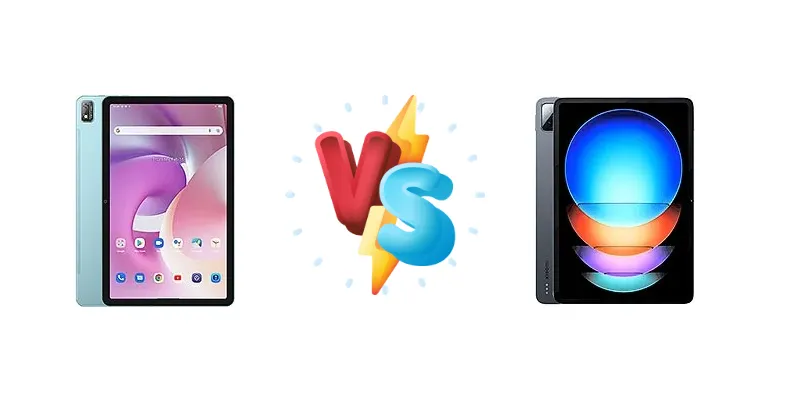
The Android tablet market is heating up, with options ranging from budget-friendly contenders to premium powerhouses. We pit the Blackview Tab 16, a value-focused device, against the Xiaomi Pad 6S Pro 12.4, a flagship boasting the Snapdragon 8 Gen 2, to determine which tablet delivers the best experience for different users.
🏆 Quick Verdict
For the average user prioritizing raw performance and a premium experience, the Xiaomi Pad 6S Pro 12.4 is the clear winner. Its Snapdragon 8 Gen 2 chipset and impressive 120W charging significantly outperform the Blackview Tab 16, justifying the price difference. However, the Tab 16 remains a viable option for those on a tighter budget.
| Network |
|---|
| 2G bands | GSM 850 / 900 / 1800 / 1900 | N/A |
| 3G bands | HSDPA 900 / 2100 | N/A |
| 4G bands | 1, 3, 7, 8, 20, 40 | - |
| EDGE | - | N/A |
| GPRS | - | N/A |
| Speed | HSPA, LTE | - |
| Technology | GSM / HSPA / LTE | No cellular connectivity |
| Launch |
|---|
| Announced | 2023, February 28 | 2024, February 22 |
| Status | Available. Released 2023, March 20 | Available. Released 2024, February 22 |
| Body |
|---|
| Build | - | Glass front (Gorilla Glass 5), aluminum frame, aluminum back |
| Dimensions | 260.1 x 164.7 x 8 mm (10.24 x 6.48 x 0.31 in) | 278.7 x 191.6 x 6.3 mm (10.97 x 7.54 x 0.25 in) |
| SIM | Nano-SIM + Nano-SIM | No |
| Weight | 533 g (1.18 lb) | 590 g (1.30 lb) |
| Display |
|---|
| Protection | - | Corning Gorilla Glass 5 |
| Resolution | 1200 x 2000 pixels, 5:3 ratio (~212 ppi density) | 2032 x 3048 pixels, 3:2 ratio (~295 ppi density) |
| Size | 11.0 inches, 344.4 cm2 (~80.4% screen-to-body ratio) | 12.4 inches, 457.8 cm2 (~85.7% screen-to-body ratio) |
| Type | IPS LCD | IPS LCD, 68B colors, 144Hz, HDR10, Dolby Vision, 900 nits (peak) |
| Platform |
|---|
| CPU | Octa-core (2x2.0 GHz Cortex-A75 & 6x1.8 GHz Cortex-A55) | Octa-core (1x3.2 GHz Cortex-X3 & 2x2.8 GHz Cortex-A715 & 2x2.8 GHz Cortex-A710 & 3x2.0 GHz Cortex-A510) |
| Chipset | Unisoc Tiger T616 (12 nm) | Qualcomm SM8550-AB Snapdragon 8 Gen 2 (4 nm) |
| GPU | Mali-G57 MP1 | Adreno 740 |
| OS | Android 12, Doke OS_P 3.0 | Android 14, up to 3 major Android upgrades, HyperOS |
| Memory |
|---|
| Card slot | microSDXC (uses shared SIM slot) | No |
| Internal | 128GB 8GB RAM, 256GB 8GB RAM | 256GB 8GB RAM, 256GB 12GB RAM, 512GB 12GB RAM, 1TB 16GB RAM |
| | eMMC 5.1 | - |
| Main Camera |
|---|
| Dual | - | 50 MP, f/1.8, (wide), 1/2.76", 0.64µm, PDAF
Auxiliary lens |
| Features | LED flash | LED flash, HDR, panorama |
| Single | 13 MP | - |
| Video | 1080p@30fps | 4K@30/60fps, 1080p@30/60fps |
| Selfie camera |
|---|
| Single | 8 MP | 32 MP, f/2.2, (wide), 1/3.6", 0.61µm |
| Video | Yes | 1080p@30fps |
| Sound |
|---|
| 3.5mm jack | No | - |
| 35mm jack | No | No |
| Loudspeaker | Yes, with stereo speakers | Yes, with stereo speakers (6 speakers) |
| Comms |
|---|
| Bluetooth | 5.0, A2DP | 5.3, A2DP, LE, LHDC |
| NFC | No | Yes (file transfer only) |
| Positioning | GPS, GLONASS, GALILEO, BDS | No |
| Radio | FM Radio | No |
| USB | USB Type-C, OTG | USB Type-C 3.2, accessory connector |
| WLAN | Wi-Fi 802.11 a/b/g/n/ac, dual-band | Wi-Fi 802.11 a/b/g/n/a/6/7, dual-band, Wi-Fi Direct |
| Features |
|---|
| Sensors | Accelerometer | Fingerprint (side-mounted), accelerometer, gyro, proximity (accessories only), compass |
| Battery |
|---|
| Charging | - | 120W wired, PD3.0, QC4, 45% in 10 min, 100% in 35 min |
| Type | 7680 mAh | 10000 mAh |
| Misc |
|---|
| Colors | Meteorite Gray, Twilight Blue, Mint Green | Black, Blue, Green |
| Models | - | 24018RPACG |
| Price | About 170 EUR | About 700 EUR |
| SAR EU | - | 0.99 W/kg (body) |
Blackview Tab 16
- More affordable price point
- Large display for media consumption
- Potentially longer battery life due to less powerful chipset (speculation)
- Significantly weaker performance
- Likely lower display quality
- Slower charging speeds (speculation)
Xiaomi Pad 6S Pro 12.4
- Exceptional performance with Snapdragon 8 Gen 2
- Bright and high-contrast display
- Ultra-fast 120W charging
- Higher price tag
- Potentially shorter battery life under heavy load
- May require accessories like a keyboard and stylus for full productivity
Display Comparison
The Xiaomi Pad 6S Pro 12.4 boasts a significantly brighter display, reaching a measured 848 nits, compared to the Blackview Tab 16 (brightness data unavailable). This higher brightness translates to better visibility outdoors. While both feature large displays, the Xiaomi’s 1378:1 contrast ratio suggests deeper blacks and more vibrant colors. The absence of refresh rate data for the Blackview Tab 16 suggests it likely operates at a standard 60Hz, while the Xiaomi Pad 6S Pro 12.4 is expected to offer a smoother experience with a higher refresh rate (likely 120Hz or 144Hz, based on market positioning).
Camera Comparison
Camera performance is likely a secondary consideration for both tablets, but the Xiaomi Pad 6S Pro 12.4 is expected to have a more capable camera system due to its flagship status. While specific sensor details are missing, Xiaomi typically equips its Pro tablets with larger sensors and more advanced image processing. The Blackview Tab 16’s camera specifications are unknown, and it’s reasonable to assume a more basic setup focused on casual photography. Without detailed specs, a direct comparison is difficult, but the Xiaomi is expected to deliver superior image quality.
Performance
The performance gap between these tablets is substantial. The Xiaomi Pad 6S Pro 12.4’s Snapdragon 8 Gen 2 (4nm) is a flagship chipset featuring a Cortex-X3 prime core clocked at 3.2 GHz, alongside Cortex-A715 and A710 performance cores. This architecture delivers a massive leap in CPU and GPU performance compared to the Blackview Tab 16’s Unisoc Tiger T616 (12nm). The T616, with its Cortex-A75 and A55 cores, is geared towards efficiency and basic tasks. The 4nm process of the Snapdragon 8 Gen 2 also provides superior thermal efficiency, minimizing throttling during sustained workloads. The Xiaomi’s likely LPDDR5x RAM further enhances performance, while the Blackview’s RAM specification is unknown.
Battery Life
The Xiaomi Pad 6S Pro 12.4 demonstrates impressive battery life, achieving 11 hours and 14 minutes of active use. Crucially, it supports 120W wired charging, capable of reaching 45% charge in just 10 minutes and a full charge in 35 minutes. The Blackview Tab 16’s battery capacity and charging speed are unknown, but given its lower price point, it’s likely to have a slower charging rate and potentially shorter battery life. The Xiaomi’s support for PD3.0 and QC4 charging standards adds to its versatility.
Buying Guide
Buy the Blackview Tab 16 if you need a large-screen Android tablet for basic productivity, media consumption, and light gaming, and prioritize affordability above all else. Buy the Xiaomi Pad 6S Pro 12.4 if you demand top-tier performance for demanding tasks like video editing, graphic design, or gaming, and value fast charging and a superior display experience.
Frequently Asked Questions
❓ Is the Snapdragon 8 Gen 2 in the Xiaomi Pad 6S Pro 12.4 prone to overheating during extended gaming sessions?
While the Snapdragon 8 Gen 2 is a powerful chip, its 4nm process and Xiaomi’s thermal management solutions are designed to mitigate overheating. Expect some warmth during prolonged gaming, but significant throttling is unlikely. The larger chassis of the tablet also aids in heat dissipation.
❓ How does the Unisoc Tiger T616 in the Blackview Tab 16 handle multitasking and demanding apps?
The Unisoc Tiger T616 is sufficient for basic multitasking and everyday apps like web browsing and video streaming. However, it will struggle with demanding applications like video editing or graphically intensive games. Expect noticeable slowdowns and potential lag when running multiple resource-heavy apps simultaneously.
❓ Does the Xiaomi Pad 6S Pro 12.4 support stylus input and keyboard accessories?
Yes, the Xiaomi Pad 6S Pro 12.4 is compatible with Xiaomi’s Smart Pen (sold separately) and a range of keyboard accessories, transforming it into a versatile productivity device. These accessories enhance its functionality for note-taking, drawing, and document editing.