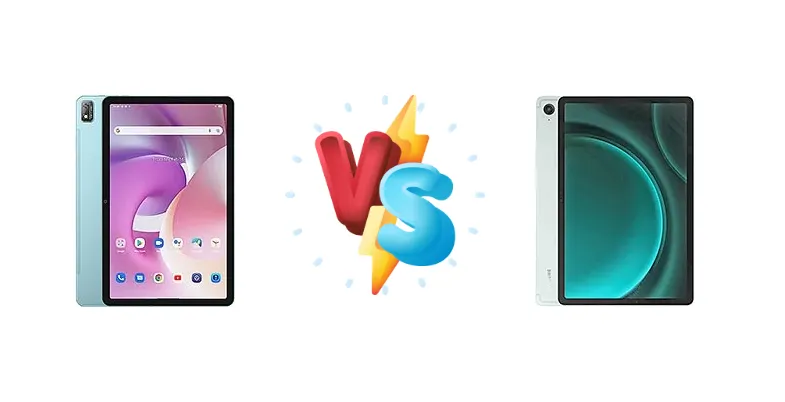
The Android tablet market offers a wide range of options, but finding the right balance between price and performance can be challenging. We pit the Blackview Tab 16, a budget-focused contender, against the Samsung Galaxy Tab S9 FE, a more refined offering from a market leader, to determine which tablet best suits your needs.
🏆 Quick Verdict
For the average user prioritizing a smooth, responsive experience and long-term software support, the Samsung Galaxy Tab S9 FE is the clear winner. Its Exynos 1380 chipset delivers significantly better performance than the Blackview Tab 16’s Unisoc T616, justifying the price difference.
| Network |
|---|
| 2G bands | GSM 850 / 900 / 1800 / 1900 | GSM 850 / 900 / 1800 / 1900 |
| 3G bands | HSDPA 900 / 2100 | HSDPA 850 / 900 / 1700(AWS) / 1900 / 2100 |
| 4G bands | 1, 3, 7, 8, 20, 40 | 1, 2, 3, 4, 5, 7, 8, 12, 13, 17, 20, 26, 28, 32, 38, 40, 41, 66 |
| 5G bands | - | 1, 3, 5, 7, 8, 20, 28, 38, 40, 41, 66, 77, 78 SA/NSA/Sub6 |
| Speed | HSPA, LTE | HSPA, LTE, 5G - cellular model only |
| Technology | GSM / HSPA / LTE | GSM / HSPA / LTE / 5G |
| Launch |
|---|
| Announced | 2023, February 28 | 2023, October 04 |
| Status | Available. Released 2023, March 20 | Available. Released 2023, October 16 |
| Body |
|---|
| Build | - | Glass front, aluminum back, aluminum frame |
| Dimensions | 260.1 x 164.7 x 8 mm (10.24 x 6.48 x 0.31 in) | 254.3 x 165.8 x 6.5 mm (10.01 x 6.53 x 0.26 in) |
| SIM | Nano-SIM + Nano-SIM | Nano-SIM + eSIM (cellular model only) |
| Weight | 533 g (1.18 lb) | 523 g or 524 g (1.15 lb) |
| Display |
|---|
| Resolution | 1200 x 2000 pixels, 5:3 ratio (~212 ppi density) | 1440 x 2304 pixels, 16:10 ratio (~249 ppi density) |
| Size | 11.0 inches, 344.4 cm2 (~80.4% screen-to-body ratio) | 10.9 inches, 344.5 cm2 (~81.7% screen-to-body ratio) |
| Type | IPS LCD | IPS LCD, 90Hz |
| Platform |
|---|
| CPU | Octa-core (2x2.0 GHz Cortex-A75 & 6x1.8 GHz Cortex-A55) | Octa-core (4x2.4 GHz Cortex-A78 & 4x2.0 GHz Cortex-A55) |
| Chipset | Unisoc Tiger T616 (12 nm) | Exynos 1380 (5 nm) |
| GPU | Mali-G57 MP1 | Mali-G68 MP5 |
| OS | Android 12, Doke OS_P 3.0 | Android 13, up to 4 major Android upgrades, One UI 6 |
| Memory |
|---|
| Card slot | microSDXC (uses shared SIM slot) | microSDXC (dedicated slot) |
| Internal | 128GB 8GB RAM, 256GB 8GB RAM | 128GB 6GB RAM, 128GB 8GB RAM, 256GB 8GB RAM |
| | eMMC 5.1 | - |
| Main Camera |
|---|
| Features | LED flash | - |
| Single | 13 MP | 8 MP, (wide) |
| Video | 1080p@30fps | 4K@30fps, 1080p@30fps |
| Selfie camera |
|---|
| Single | 8 MP | 12 MP, (ultrawide) |
| Video | Yes | Yes |
| Sound |
|---|
| 3.5mm jack | No | - |
| 35mm jack | No | No |
| Loudspeaker | Yes, with stereo speakers | Yes, with stereo speakers |
| Comms |
|---|
| Bluetooth | 5.0, A2DP | 5.3, A2DP, LE |
| NFC | No | No |
| Positioning | GPS, GLONASS, GALILEO, BDS | GPS, GALILEO, GLONASS, BDS, QZSS - cellular model only |
| Radio | FM Radio | No |
| USB | USB Type-C, OTG | USB Type-C 2.0, magnetic connector |
| WLAN | Wi-Fi 802.11 a/b/g/n/ac, dual-band | Wi-Fi 802.11 a/b/g/n/ac/6, dual-band, Wi-Fi Direct |
| Features |
|---|
| Sensors | Accelerometer | Fingerprint (side-mounted), accelerometer, gyro, compass, proximity (accessories only) |
| Battery |
|---|
| Charging | - | 45W wired, QC2.0 |
| Type | 7680 mAh | Li-Po 8000 mAh |
| Misc |
|---|
| Colors | Meteorite Gray, Twilight Blue, Mint Green | Mint, Silver, Gray, Lavender |
| Models | - | SM-X510, SM-X516B |
| Price | About 170 EUR | About 300 EUR |
| SAR | - | 1.55 W/kg (body) |
| SAR EU | - | 0.59 W/kg (body) |
Blackview Tab 16
- Potentially larger battery capacity (unconfirmed)
- More affordable price point
- Large display for media consumption
- Significantly weaker processor performance
- Likely slower software updates
- Lower build quality and materials
Samsung Galaxy Tab S9 FE
- Faster and more efficient Exynos 1380 chipset
- Samsung S Pen support for enhanced productivity
- Guaranteed software updates and long-term support
- Higher price tag
- May have slightly shorter battery life under heavy load
- Charging brick not included
Display Comparison
While both tablets likely feature LCD panels (data unavailable for Blackview Tab 16), the Samsung Galaxy Tab S9 FE benefits from a more advanced chipset capable of driving a higher resolution and potentially better color accuracy. The Tab S9 FE’s display is likely to offer superior viewing angles and brightness. The Blackview Tab 16’s display specs are unknown, but given its price point, it’s reasonable to expect a lower peak brightness and potentially wider bezels. The S9 FE’s 90Hz refresh rate, while not LTPO, will provide a smoother scrolling experience than the likely 60Hz panel on the Blackview.
Camera Comparison
Camera performance is unlikely to be a deciding factor for most tablet buyers, but the Samsung Galaxy Tab S9 FE likely holds an advantage. While specific sensor details are unavailable for both, Samsung’s image processing algorithms are generally more refined. The Blackview Tab 16’s camera setup is likely to be more basic, focusing on functionality rather than image quality. Any 2MP macro camera on the Blackview is unlikely to deliver usable results, serving primarily as a spec-sheet filler.
Performance
The core difference lies in the chipsets. The Samsung Galaxy Tab S9 FE’s Exynos 1380, fabricated on a 5nm process, offers a substantial performance advantage over the Blackview Tab 16’s 12nm Unisoc Tiger T616. The Exynos 1380’s CPU configuration – 4x2.4 GHz Cortex-A78 & 4x2.0 GHz Cortex-A55 – is significantly faster than the T616’s 2x2.0 GHz Cortex-A75 & 6x1.8 GHz Cortex-A55. This translates to quicker app loading times, smoother multitasking, and a more responsive user interface on the Samsung. The 5nm process also contributes to better thermal efficiency, reducing the likelihood of performance throttling during sustained workloads. The Tab S9 FE also benefits from potentially faster RAM (likely LPDDR4x or LPDDR5) compared to the Blackview.
Battery Life
Battery life will depend heavily on usage patterns. While the Blackview Tab 16 may have a larger battery capacity (spec unavailable), the Samsung Galaxy Tab S9 FE’s more efficient Exynos 1380 chipset and optimized software could result in comparable or even better real-world battery life. The Tab S9 FE’s 45W wired charging with QC2.0 support is a significant advantage, allowing for much faster charging times compared to the Blackview Tab 16, which likely supports slower charging speeds.
Buying Guide
Buy the Blackview Tab 16 if you need a large-screen tablet for basic tasks like media consumption, light web browsing, and occasional note-taking, and are on a very tight budget. Buy the Samsung Galaxy Tab S9 FE if you prioritize performance for multitasking, gaming, and creative applications, and value Samsung’s ecosystem, S Pen support, and guaranteed software updates.
Frequently Asked Questions
❓ Does the Exynos 1380 in the Samsung Galaxy Tab S9 FE get hot during extended gaming sessions?
The Exynos 1380’s 5nm process and Samsung’s thermal management solutions are designed to mitigate overheating. While some warmth is expected during prolonged gaming, the Tab S9 FE is unlikely to experience significant throttling, maintaining consistent performance for longer periods compared to the Blackview Tab 16’s less efficient chipset.
❓ Is the Blackview Tab 16 suitable for running demanding apps like video editing software?
The Blackview Tab 16’s Unisoc Tiger T616 chipset is not well-suited for demanding applications like video editing. The processor’s limited processing power and slower RAM speeds will result in sluggish performance and potential crashes. The Samsung Galaxy Tab S9 FE, with its Exynos 1380, is a much better choice for such tasks.
❓ How long will Samsung support the Galaxy Tab S9 FE with software updates?
Samsung typically provides several years of software updates for its tablets. The Galaxy Tab S9 FE is expected to receive at least 4 years of OS updates and 5 years of security updates, ensuring long-term usability and security. Blackview’s update commitment is typically shorter and less predictable.
❓ Can I use the S Pen with other tablets besides the Samsung Galaxy Tab S9 FE?
The S Pen is optimized for Samsung tablets and its features, like Air Actions, may not function correctly on other devices. While the S Pen is physically compatible with some other tablets, you won't get the full experience without Samsung's software integration.