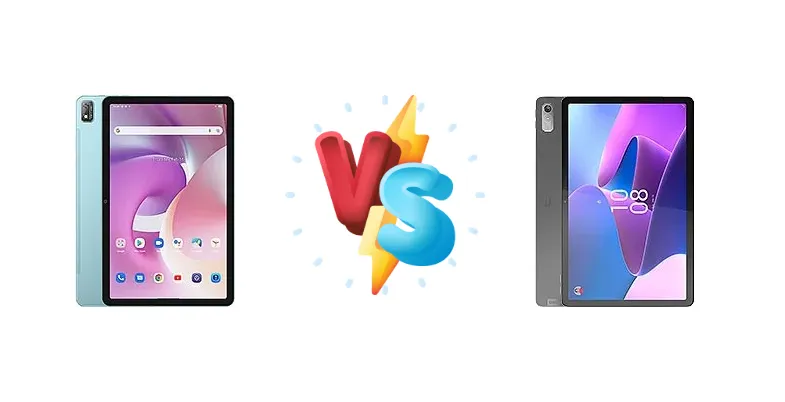
The budget tablet market is heating up, with options like the Blackview Tab 16 and Lenovo Tab P11 Gen 2 offering compelling features at accessible price points. Both aim to deliver a solid Android experience without breaking the bank, but they take different approaches to achieving that goal. This comparison dives deep into their core components to determine which tablet provides the best value for your money.
🏆 Quick Verdict
For most users, the Lenovo Tab P11 Gen 2 emerges as the better choice. Its Mediatek Helio G99 chipset, built on a more efficient 6nm process, delivers noticeably improved performance over the Blackview Tab 16’s Unisoc Tiger T616, translating to smoother multitasking and gaming. While the Blackview offers a larger screen, the Lenovo’s overall refinement and processing power provide a superior user experience.
| Network |
|---|
| 2G bands | GSM 850 / 900 / 1800 / 1900 | GSM 850 / 900 / 1800 / 1900 |
| 3G bands | HSDPA 900 / 2100 | HSDPA 800 / 850 / 900 / 1700(AWS) / 1900 / 2100 |
| 4G bands | 1, 3, 7, 8, 20, 40 | 1, 2, 3, 4, 5, 7, 8, 12, 13, 18, 19, 20, 25, 26, 28, 38, 40, 41, 66 |
| Speed | HSPA, LTE | HSPA, LTE - cellular model only |
| Technology | GSM / HSPA / LTE | GSM / HSPA / LTE |
| Launch |
|---|
| Announced | 2023, February 28 | 2022, September 01 |
| Status | Available. Released 2023, March 20 | Available. Released 2023, January |
| Body |
|---|
| Dimensions | 260.1 x 164.7 x 8 mm (10.24 x 6.48 x 0.31 in) | 269.1 x 169.4 x 7.4 mm (10.59 x 6.67 x 0.29 in) |
| SIM | Nano-SIM + Nano-SIM | Nano-SIM (cellular model only) |
| Weight | 533 g (1.18 lb) | 520 g (1.15 lb) |
| | - | Stylus support |
| Display |
|---|
| Resolution | 1200 x 2000 pixels, 5:3 ratio (~212 ppi density) | 1200 x 2000 pixels, 5:3 ratio (~203 ppi density) |
| Size | 11.0 inches, 344.4 cm2 (~80.4% screen-to-body ratio) | 11.5 inches, 376.4 cm2 (~82.6% screen-to-body ratio) |
| Type | IPS LCD | IPS LCD, 120Hz, 400 nits (typ) |
| Platform |
|---|
| CPU | Octa-core (2x2.0 GHz Cortex-A75 & 6x1.8 GHz Cortex-A55) | Octa-core (2x2.2 GHz Cortex-A76 & 6x2.0 GHz Cortex-A55) |
| Chipset | Unisoc Tiger T616 (12 nm) | Mediatek Helio G99 (6 nm) |
| GPU | Mali-G57 MP1 | Mali-G57 MC2 |
| OS | Android 12, Doke OS_P 3.0 | Android 12L |
| Memory |
|---|
| Card slot | microSDXC (uses shared SIM slot) | microSDXC (dedicated slot) |
| Internal | 128GB 8GB RAM, 256GB 8GB RAM | 64GB 4GB RAM, 128GB 4GB RAM, 128GB 6GB RAM |
| | eMMC 5.1 | - |
| Main Camera |
|---|
| Features | LED flash | LED flash |
| Single | 13 MP | 13 MP, f/2.4, (wide), AF |
| Video | 1080p@30fps | 1080p@30fps |
| Selfie camera |
|---|
| Single | 8 MP | 8 MP, f/2.0 |
| Video | Yes | 1080p@30fps |
| Sound |
|---|
| 3.5mm jack | No | Yes |
| 35mm jack | No | Yes |
| Loudspeaker | Yes, with stereo speakers | Yes, with stereo speakers (4 speakers) |
| Comms |
|---|
| Bluetooth | 5.0, A2DP | 5.2, A2DP, LE |
| NFC | No | No |
| Positioning | GPS, GLONASS, GALILEO, BDS | GPS, GLONASS, BDS - cellular model only |
| Radio | FM Radio | No |
| USB | USB Type-C, OTG | USB Type-C 2.0, OTG, magnetic connector |
| WLAN | Wi-Fi 802.11 a/b/g/n/ac, dual-band | Wi-Fi 802.11 a/b/g/n/ac/6e, dual-band, Wi-Fi Direct |
| Features |
|---|
| Sensors | Accelerometer | Accelerometer, gyro, proximity |
| Battery |
|---|
| Type | 7680 mAh | Li-Po 7700 mAh |
| Misc |
|---|
| Colors | Meteorite Gray, Twilight Blue, Mint Green | Storm Grey, Sage |
| Models | - | TB350FU |
| Price | About 170 EUR | About 350 EUR |
Blackview Tab 16
- Potentially larger display for immersive viewing.
- May offer a lower price point.
- Unisoc chipset provides adequate performance for basic tasks.
- Less powerful Unisoc Tiger T616 chipset.
- 12nm process is less efficient than 6nm.
- Likely to exhibit more thermal throttling under sustained load.
Lenovo Tab P11 Gen 2
- More powerful Mediatek Helio G99 chipset.
- 6nm process offers better efficiency and performance.
- Faster CPU cores for smoother multitasking.
- May have a smaller display.
- Potentially higher price compared to the Blackview Tab 16.
- Camera performance likely similar to the Blackview Tab 16.
Display Comparison
While both tablets likely feature IPS LCD panels (data not provided), the size difference is notable. The Blackview Tab 16’s larger screen will be more immersive for video playback, but without knowing the resolution or brightness levels of either display, it’s difficult to declare a clear winner. The absence of information regarding refresh rates or panel technology (like LTPO) suggests both are standard 60Hz displays. Bezels are also unknown, but typically, budget tablets have larger bezels than premium models.
Camera Comparison
Neither tablet is likely to excel in photography. Without specific sensor details, it’s safe to assume both feature basic camera setups geared towards casual snapshots. The focus should not be on camera quality when considering these devices. Any claims of advanced features like OIS or high-resolution sensors should be viewed with skepticism given the price point.
Performance
The core difference lies in the chipsets. The Lenovo Tab P11 Gen 2’s Mediatek Helio G99, fabricated on a 6nm process, offers a significant advantage over the Blackview Tab 16’s Unisoc Tiger T616 (12nm). The 6nm node allows for greater transistor density and improved power efficiency, resulting in better performance and reduced heat generation. The Helio G99’s CPU, with 2x2.2 GHz Cortex-A76 cores, also boasts higher clock speeds and a more modern architecture compared to the Tab 16’s 2x2.0 GHz Cortex-A75 cores. This translates to faster app loading times, smoother multitasking, and a more responsive overall experience. The GPU within the Helio G99 will also provide a better gaming experience.
Battery Life
Battery life will depend heavily on usage patterns and software optimization. While the exact battery capacities are unknown, the Mediatek Helio G99’s superior power efficiency could allow the Lenovo Tab P11 Gen 2 to achieve comparable or even better battery life despite potentially having a smaller battery. Charging wattage is also a critical factor, but without that information, it’s impossible to determine which tablet will charge faster. The 6nm process of the Helio G99 will contribute to lower power consumption during both active use and standby.
Buying Guide
Buy the Blackview Tab 16 if you prioritize a larger display for media consumption and don't anticipate demanding tasks. It's a good option for casual users who primarily browse the web, watch videos, and use basic apps. Buy the Lenovo Tab P11 Gen 2 if you value performance and responsiveness. Its more powerful chipset makes it ideal for multitasking, light gaming, and users who want a tablet that feels snappy and future-proofed.
Frequently Asked Questions
❓ Will the Unisoc Tiger T616 in the Blackview Tab 16 struggle with demanding games like Genshin Impact?
Yes, the Unisoc Tiger T616 is a budget-oriented chipset and will likely struggle to run graphically intensive games like Genshin Impact smoothly, even on low settings. Expect significant frame rate drops and potential lag. The Lenovo Tab P11 Gen 2’s Helio G99 will offer a noticeably better gaming experience, though still not ideal for high-end titles.
❓ Does the Mediatek Helio G99 in the Lenovo Tab P11 Gen 2 get excessively hot during prolonged use?
The Mediatek Helio G99 is designed with efficiency in mind, thanks to its 6nm fabrication process. While it will generate heat under sustained load (like gaming or video editing), it's less prone to overheating and thermal throttling compared to the Blackview Tab 16’s Unisoc Tiger T616, which uses a less efficient 12nm process.
❓ Which tablet is better for video streaming and media consumption?
While the Blackview Tab 16 may offer a larger screen, the Lenovo Tab P11 Gen 2’s smoother performance and potentially better display quality (depending on specs not provided) will likely result in a more enjoyable streaming experience. The faster processor will ensure videos load quickly and playback is uninterrupted.