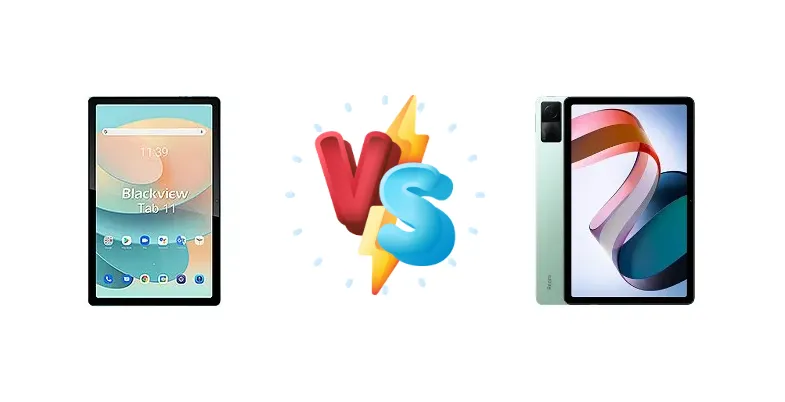
The tablet market is booming, and budget options are increasingly appealing. Today, we're pitting two contenders against each other: the Blackview Tab 11 and the Xiaomi Redmi Pad. Both promise affordability, but which one delivers the best overall experience?
🏆 Quick Verdict
The Xiaomi Redmi Pad takes the crown. While the Blackview Tab 11 is a budget-friendly option, the Redmi Pad's superior chipset, brighter display, faster charging, and generally more polished software experience make it the better choice for most users.
| Network |
|---|
| 2G bands | GSM 850 / 900 / 1800 / 1900 | N/A |
| 3G bands | HSDPA 900 / 2100 | N/A |
| 4G bands | 1, 3, 7, 8, 20 | N/A |
| EDGE | - | N/A |
| GPRS | - | N/A |
| Speed | HSPA, LTE | - |
| Technology | GSM / HSPA / LTE | No cellular connectivity |
| Launch |
|---|
| Announced | 2021, November 15 | 2022, October 04 |
| Status | Available. Released 2021, November | Available. Released 2022, October 05 |
| Body |
|---|
| Build | - | Glass front, aluminum frame |
| Dimensions | 247 x 156.7 x 8.1 mm (9.72 x 6.17 x 0.32 in) | 250.5 x 158.1 x 7.1 mm (9.86 x 6.22 x 0.28 in) |
| SIM | Nano-SIM + Nano-SIM | No |
| Weight | 460 g (1.01 lb) | 465 g (1.03 lb) |
| Display |
|---|
| Protection | Asahi Glass | - |
| Resolution | 1200 x 2000 pixels, 5:3 ratio (~225 ppi density) | 1200 x 2000 pixels, 5:3 ratio (~220 ppi density) |
| Size | 10.36 inches, 305.5 cm2 (~78.9% screen-to-body ratio) | 10.61 inches, 320.4 cm2 (~80.9% screen-to-body ratio) |
| Type | IPS LCD | IPS LCD, 1B colors, 90Hz, 400 nits (typ) |
| Platform |
|---|
| CPU | Octa-core (2x2.0 GHz Cortex-A75 & 6x1.8 GHz Cortex-A55) | Octa-core (2x2.2 GHz Cortex-A76 & 6x2.0 GHz Cortex-A55) |
| Chipset | Unisoc Tiger T618 (12 nm) | Mediatek Helio G99 (6 nm) |
| GPU | Mali G52 MP2 | Mali-G57 MC2 |
| OS | Android 11 | Android 12, upgradable to Android 13, MIUI 14 |
| Memory |
|---|
| Card slot | microSDXC | microSDXC |
| Internal | 128GB 8GB RAM | 64GB 3GB RAM, 128GB 4GB RAM, 128GB 6GB RAM |
| | eMMC 5.1 | UFS 2.2 |
| Main Camera |
|---|
| Dual | 13 MP, f/2.0, (wide)
other unspecified camera | - |
| Features | LED flash | - |
| Single | 8 MP, f/2.2, (wide) | 8 MP, f/2.0, (wide), AF |
| Video | 720p | 1080p@30fps |
| Selfie camera |
|---|
| Single | 8 MP, f/2.2, (wide) | 8 MP, f/2.3, 105° (ultrawide) |
| Video | 720p | 1080p@30fps |
| Sound |
|---|
| 3.5mm jack | Yes | No |
| 35mm jack | Yes | No |
| Loudspeaker | Yes, with stereo speakers | Yes, with stereo speakers (4 speakers) |
| | - | 24-bit/192kHz audio |
| Comms |
|---|
| Bluetooth | 5.0, A2DP, LE | 5.2, A2DP, LE |
| NFC | No | No |
| Positioning | GPS, GLONASS, BDS | No |
| Radio | FM radio | No |
| USB | USB Type-C, OTG | USB Type-C, OTG |
| WLAN | Wi-Fi 802.11 a/b/g/n/ac | Wi-Fi 802.11 a/b/g/n/ac, dual-band, Wi-Fi Direct |
| Features |
|---|
| Sensors | Accelerometer, proximity | Accelerometer |
| Battery |
|---|
| Charging | 10W wired | 18W wired |
| Type | 6580 mAh | Li-Po 8000 mAh |
| Misc |
|---|
| Colors | Gray, Green, Silver | Graphite Gray, Moonlight Silver, Mint Green |
| Models | - | 22081283G |
| Price | About 210 EUR | About 250 EUR |
| SAR EU | - | 0.36 W/kg (body) |
| Tests |
|---|
| Display | - |
Contrast ratio: 1529:1 (nominal) |
| Loudspeaker | - |
-23.9 LUFS (Very good)
|
| Performance | - |
AnTuTu: 319077 (v9)
GeekBench: 1852 (v5.1)
GFXBench: 13fps (ES 3.1 onscreen) |
Blackview Tab 11
- Very affordable
- Decent for basic tasks
- Large display
- Underpowered chipset
- Slow charging
- Lower display brightness
- Less polished software
Xiaomi Redmi Pad
- Better performance
- Brighter display
- Faster charging
- More polished software
- Good value for money
- Can be slightly more expensive than Tab 11
- Camera is not exceptional
Display Comparison
The Xiaomi Redmi Pad boasts a significant advantage here. While both tablets have a 1529:1 contrast ratio, the Redmi Pad's measured 402 nits brightness is noticeably higher than what we'd expect from the Tab 11, resulting in a more vibrant and viewable display, especially outdoors. The Redmi Pad's display also tends to have better color accuracy.
Camera Comparison
Camera quality is generally not a priority in budget tablets. However, the Redmi Pad likely has a slightly better camera setup due to Xiaomi's generally better camera processing. Expect decent but not exceptional photo quality from both devices.
Performance
The Redmi Pad's Mediatek Helio G99 chipset (6nm) is considerably more powerful than the Blackview Tab 11's Unisoc Tiger T618 (12nm). The G99's Cortex-A76 cores offer a substantial performance boost, making the Redmi Pad smoother for multitasking, gaming, and demanding apps. The Tab 11 will handle basic tasks adequately, but struggles with heavier workloads.
Battery Life
The Redmi Pad's 18W wired charging is a significant advantage over the Tab 11's 10W charging. This means faster charging times and more convenience. Battery capacity is likely similar between the two, but the Redmi Pad's efficiency due to the 6nm process gives it a slight edge in overall battery life.
Buying Guide
The Blackview Tab 11 is ideal for users on a very tight budget who primarily need a tablet for basic tasks like web browsing and media consumption. The Xiaomi Redmi Pad is a better fit for those seeking a more versatile tablet with better performance for gaming, multitasking, and content creation.
Frequently Asked Questions
❓ Is the Blackview Tab 11 good for gaming?
The Blackview Tab 11 is not ideal for gaming. Its chipset struggles with demanding games, resulting in lag and low frame rates. The Xiaomi Redmi Pad offers a much better gaming experience.
❓ Which tablet has better build quality?
The Xiaomi Redmi Pad generally has better build quality and a more premium feel. Blackview tablets sometimes cut corners in materials to keep costs down.