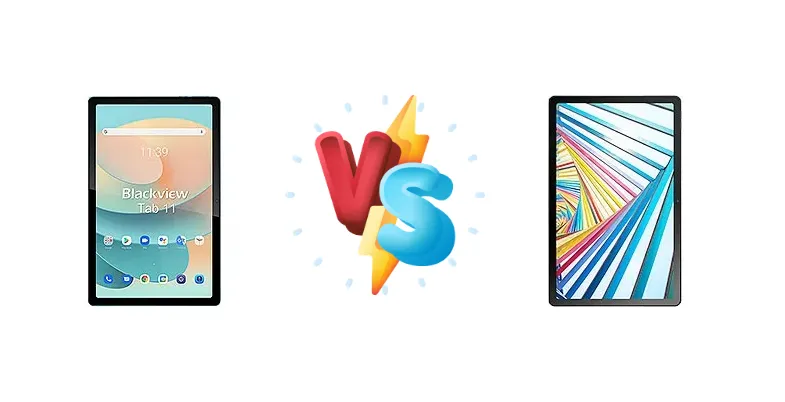
The budget tablet market is fiercely competitive, with options like the Blackview Tab 11 and Lenovo Tab M10 Plus (3rd Gen) vying for attention. Both aim to deliver a capable Android experience without breaking the bank, but they take different approaches to achieving this. This comparison dives deep into their specifications to determine which tablet offers the best blend of performance, features, and value.
🏆 Quick Verdict
For most users, the Lenovo Tab M10 Plus (3rd Gen) with the Snapdragon 680 chipset offers a more refined experience. Its 6nm process and potentially faster CPU cores (depending on the model) translate to better sustained performance and efficiency, while the 20W charging is a significant advantage. However, the Blackview Tab 11 remains a viable option for those prioritizing a lower initial cost.
| Network |
|---|
| 2G bands | GSM 850 / 900 / 1800 / 1900 | GSM 850 / 900 / 1800 / 1900 |
| 3G bands | HSDPA 900 / 2100 | HSDPA 800 / 850 / 900 / 1900 / 2100 |
| 4G bands | 1, 3, 7, 8, 20 | 1, 2, 3, 4, 5, 7, 8, 19, 20, 26, 28, 28, 38, 40, 41 |
| Speed | HSPA, LTE | HSPA 42.2/5.76 Mbps, LTE Cat13 390/75 Mbps - cellular model only |
| Technology | GSM / HSPA / LTE | GSM / HSPA / LTE |
| Launch |
|---|
| Announced | 2021, November 15 | 2022, May |
| Status | Available. Released 2021, November | Available. Released 2022, May |
| Body |
|---|
| Dimensions | 247 x 156.7 x 8.1 mm (9.72 x 6.17 x 0.32 in) | 251.2 x 158.8 x 7.5 mm (9.89 x 6.25 x 0.30 in) |
| SIM | Nano-SIM + Nano-SIM | Nano-SIM (cellular model only) |
| Weight | 460 g (1.01 lb) | 465 g (1.03 lb) |
| | - | Stylus support |
| Display |
|---|
| Protection | Asahi Glass | - |
| Resolution | 1200 x 2000 pixels, 5:3 ratio (~225 ppi density) | 1200 x 2000 pixels, 5:3 ratio (~220 ppi density) |
| Size | 10.36 inches, 305.5 cm2 (~78.9% screen-to-body ratio) | 10.61 inches, 320.4 cm2 (~80.3% screen-to-body ratio) |
| Type | IPS LCD | IPS LCD, 400 nits (typ) |
| Platform |
|---|
| CPU | Octa-core (2x2.0 GHz Cortex-A75 & 6x1.8 GHz Cortex-A55) | Octa-core (4x2.4 GHz Kryo 265 Gold & 4x1.9 GHz Kryo 265 Silver) - LTE model Octa-core (2x2.0 GHz Cortex-A75 & 6x1.8 GHz Cortex-A55) - Wi-Fi only model |
| Chipset | Unisoc Tiger T618 (12 nm) | Qualcomm SM6225 Snapdragon 680 4G (6 nm) - LTE model Mediatek MT6769V/CU Helio G80 (12 nm) - Wi-Fi only model |
| GPU | Mali G52 MP2 | Adreno 610 - LTE model Mali-G52 MC2 - Wi-Fi only model |
| OS | Android 11 | Android 12 |
| Memory |
|---|
| Card slot | microSDXC | microSDXC (dedicated slot) |
| Internal | 128GB 8GB RAM | 32GB 3GB RAM, 64GB 4GB RAM, 128GB 4GB RAM, 128GB 6GB RAM |
| | eMMC 5.1 | eMCP/uMCP |
| Main Camera |
|---|
| Dual | 13 MP, f/2.0, (wide)
other unspecified camera | - |
| Features | LED flash | - |
| Single | 8 MP, f/2.2, (wide) | 8 MP, AF |
| Video | 720p | 1080p |
| Selfie camera |
|---|
| Single | 8 MP, f/2.2, (wide) | 8 MP |
| Video | 720p | - |
| Sound |
|---|
| 3.5mm jack | Yes | Yes |
| 35mm jack | Yes | Yes |
| Loudspeaker | Yes, with stereo speakers | Yes, with stereo speakers (4 speakers) |
| Comms |
|---|
| Bluetooth | 5.0, A2DP, LE | 5.0, A2DP, LE |
| NFC | No | No |
| Positioning | GPS, GLONASS, BDS | GPS, GLONASS, BDS - cellular model only |
| Radio | FM radio | FM Radio |
| USB | USB Type-C, OTG | USB Type-C 2.0 |
| WLAN | Wi-Fi 802.11 a/b/g/n/ac | Wi-Fi 802.11 a/b/g/n/ac, dual-band, Wi-Fi Direct |
| Features |
|---|
| Sensors | Accelerometer, proximity | Accelerometer, proximity, gyro |
| Battery |
|---|
| Charging | 10W wired | 20W wired |
| Type | 6580 mAh | Li-Po 7700 mAh |
| Misc |
|---|
| Colors | Gray, Green, Silver | Storm Grey, Frost Blue |
| Price | About 210 EUR | About 260 EUR |
Blackview Tab 11
- Lower price point makes it accessible.
- Decent performance for basic tasks.
- Suitable for casual users.
- Slower 10W charging.
- Unisoc T618 chipset is less efficient than Snapdragon 680.
- Potentially lower sustained performance.
Lenovo Tab M10 Plus (3rd Gen)
- Faster 20W charging.
- Snapdragon 680 (or Helio G80) offers better performance and efficiency.
- LTE connectivity option available.
- Generally more expensive than the Blackview Tab 11.
- Display specs are not exceptional.
- Camera performance is likely average.
Display Comparison
Neither tablet boasts a particularly standout display. Both likely feature IPS LCD panels, common in this price bracket. However, detailed display specs like resolution, brightness, and color gamut are missing. The key difference lies in the chipset's ability to drive the display smoothly. While both are 10-inch tablets, the Lenovo's potentially more powerful GPU could offer a slightly more fluid experience during video playback and scrolling. Bezels are expected to be similar on both devices, reflecting their budget positioning.
Camera Comparison
Camera performance is unlikely to be a deciding factor for either tablet. Both will likely feature basic camera setups suitable for casual snapshots and video calls. Detailed camera specs are unavailable, but it's safe to assume both will have a primary rear camera and a front-facing camera for video conferencing. Focusing on megapixel counts alone would be misleading; image processing and sensor size play a more crucial role, and information on these aspects is lacking. Expect similar image quality from both devices in good lighting conditions.
Performance
The performance gap is the most significant differentiator. The Lenovo Tab M10 Plus (3rd Gen) offers two chipset options: the Qualcomm Snapdragon 680 (6nm) and the MediaTek Helio G80 (12nm). The Snapdragon 680, built on a 6nm process, provides a clear advantage in power efficiency and sustained performance compared to the Blackview Tab 11’s Unisoc Tiger T618 (12nm). The Snapdragon 680’s Kryo 265 Gold cores, clocked at 2.4 GHz, have a theoretical performance edge over the T618’s Cortex-A75 cores at 2.0 GHz. The Wi-Fi only model of the Lenovo Tab M10 Plus (3rd Gen) uses the Helio G80, which is comparable to the T618 in CPU performance, but the Snapdragon 680's Adreno 610 GPU is superior to the T618's Mali-G52 MC2, offering better graphics performance for gaming and video decoding.
Battery Life
Battery capacity is not specified for either device, making a direct comparison difficult. However, the Lenovo Tab M10 Plus (3rd Gen) has a clear advantage in charging speed with its 20W wired charging support, compared to the Blackview Tab 11’s slower 10W charging. This means the Lenovo will reach a full charge significantly faster, reducing downtime. While a larger battery capacity on the Blackview Tab 11 might offset the slower charging, the Snapdragon 680’s superior power efficiency in the Lenovo could result in comparable or even better real-world battery life.
Buying Guide
Buy the Blackview Tab 11 if you need a highly affordable tablet for basic tasks like web browsing, video calls, and light media consumption, and are willing to accept slower charging and potentially less demanding performance. Buy the Lenovo Tab M10 Plus (3rd Gen) if you prioritize smoother multitasking, faster charging, and a more responsive user experience, especially if you opt for the 4G LTE model for on-the-go connectivity.
Frequently Asked Questions
❓ Will the Snapdragon 680 in the Lenovo Tab M10 Plus handle demanding games like PUBG Mobile?
The Snapdragon 680 is capable of running PUBG Mobile, but you'll likely need to lower the graphics settings to achieve a smooth frame rate. It's not a gaming powerhouse, but it offers a significantly better gaming experience than the Unisoc T618 in the Blackview Tab 11.
❓ Does the Lenovo Tab M10 Plus (3rd Gen) support expandable storage via microSD card?
Yes, the Lenovo Tab M10 Plus (3rd Gen) does support microSD card expansion, allowing you to increase the storage capacity beyond the internal storage options. This is a valuable feature for users who plan to store a lot of media files or apps on their tablet.
❓ Is the difference between the Snapdragon 680 and Helio G80 versions of the Lenovo Tab M10 Plus significant?
Yes, the Snapdragon 680 version offers a noticeable performance advantage, particularly in graphics processing. The 6nm process also contributes to better power efficiency. If gaming or demanding applications are a priority, the Snapdragon 680 model is worth the extra cost.