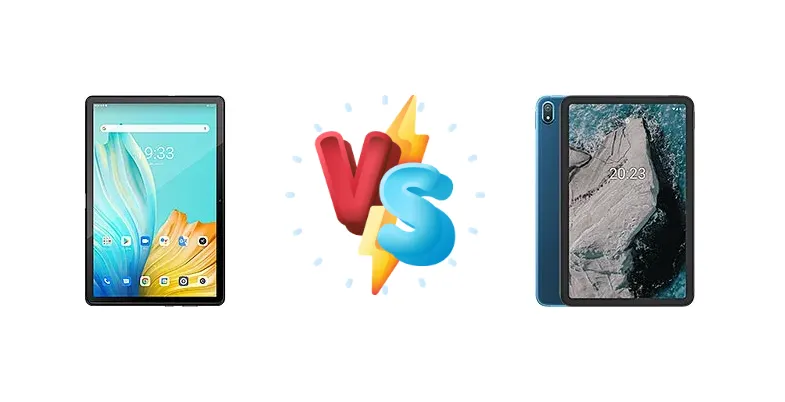
The budget tablet market is fiercely competitive, and the Blackview Tab 10 and Nokia T20 represent compelling options for users seeking affordable Android experiences. While both aim to deliver functionality without breaking the bank, they take different approaches to chipset selection and feature prioritization. This comparison dives deep into the specifics to determine which tablet offers the best value.
🏆 Quick Verdict
For most users, the Nokia T20 emerges as the better choice. Its Unisoc T610 chipset, while not a powerhouse, utilizes a more modern CPU architecture (Cortex-A75) offering a smoother experience than the Blackview Tab 10’s older Mediatek MT8768. The Nokia T20’s brighter display further enhances usability, making it ideal for media consumption.
| Network |
|---|
| 2G bands | GSM 850 / 900 / 1800 / 1900 | GSM 850 / 900 / 1800 / 1900 |
| 3G bands | HSDPA 900 / 2100 | HSDPA 850 / 900 / 1700(AWS) / 1900 / 2100 - US, LATAM |
| 4G bands | 1, 3, 7, 8, 20, 40 | 1, 2, 3, 4, 5, 7, 8, 12, 13, 17, 20, 28, 40, 66 - US, LATAM |
| Speed | HSPA, LTE | HSPA, LTE Cat4 150/50 Mbps - cellular model only |
| Technology | GSM / HSPA / LTE | GSM / HSPA / LTE |
| | - | 1, 3, 5, 7, 8, 20, 28, 38, 40, 41 - International |
| Launch |
|---|
| Announced | 2021, June 08 | 2021, October 06 |
| Status | Available. Released 2021, June | Available. Released 2021, November 02 |
| Body |
|---|
| Build | - | Glass front, aluminum back |
| Dimensions | 243 x 162 x 8.4 mm (9.57 x 6.38 x 0.33 in) | 247.6 x 157.5 x 7.8 mm (9.75 x 6.20 x 0.31 in) |
| SIM | Nano-SIM + Nano-SIM | Nano-SIM (cellular model only) |
| Weight | 523 g (1.15 lb) | 465 g (Wi-Fi), 470 g (LTE) (1.03 lb) |
| | - | Splash resistant |
| Display |
|---|
| Protection | Rainbow Glass | Scratch-resistant glass |
| Resolution | 1200 x 1920 pixels, 16:10 ratio (~224 ppi density) | 1200 x 2000 pixels, 5:3 ratio (~224 ppi density) |
| Size | 10.1 inches, 295.8 cm2 (~75.1% screen-to-body ratio) | 10.4 inches, 307.9 cm2 (~78.9% screen-to-body ratio) |
| Type | IPS LCD | IPS LCD, 400 nits (typ) |
| Platform |
|---|
| CPU | Octa-core 2.0 GHz Cortex-A53 | Octa-core (2x1.8 GHz Cortex-A75 & 6x1.8 GHz Cortex-A55) |
| Chipset | Mediatek MTK8768 | Unisoc T610 (12 nm) |
| GPU | PowerVR GE8320 | Mali-G52 MP2 |
| OS | Android 11 | Android 11, upgradable to Android 13 |
| Memory |
|---|
| Card slot | microSDXC | microSDXC (dedicated slot) |
| Internal | 64GB 4GB RAM | 32GB 3GB RAM, 64GB 4GB RAM |
| | eMMC | eMMC 5.1 |
| Main Camera |
|---|
| Features | LED flash | LED flash |
| Single | 13 MP, f/2.2, (wide) | 8 MP, AF |
| Video | 1080p@30fps | 1080p@30fps |
| Selfie camera |
|---|
| Single | 8 MP, f/2.2, (wide) | 5 MP |
| Video | 1080p@30fps | Yes |
| Sound |
|---|
| 3.5mm jack | No | Yes |
| 35mm jack | No | Yes |
| Loudspeaker | Yes | Yes, with stereo speakers |
| Comms |
|---|
| Bluetooth | 5.0, A2DP, LE | 5.0, A2DP, LE |
| NFC | No | No |
| Positioning | GPS, GLONASS, GALILEO, BDS | GPS - cellular model only |
| Radio | FM radio | FM radio |
| USB | USB Type-C, OTG | USB Type-C 2.0 |
| WLAN | Wi-Fi 802.11 a/b/g/n/ac, dual-band | Wi-Fi 802.11 a/b/g/n/ac, dual-band |
| Features |
|---|
| Sensors | Accelerometer, gyro, proximity | Accelerometer |
| Battery |
|---|
| Charging | 18W wired | 15W wired |
| Type | 7480 mAh | Li-Po 8200 mAh |
| Misc |
|---|
| Colors | Gray, Gold, Silver | Deep Ocean |
| Models | - | TA-1397, TA-1394, TA-1392 |
| Price | About 180 EUR | About 200 EUR |
| SAR | - | 1.34 W/kg (body) |
| SAR EU | - | 1.35 W/kg (body) |
Blackview Tab 10
- Potentially faster peak CPU clock speed (2.0 GHz)
- Higher charging wattage (18W)
- May be more readily available in certain regions
- Older CPU architecture (Cortex-A53)
- Likely lower display brightness and contrast
- Less efficient chipset
Nokia T20
- More modern CPU architecture (Cortex-A75)
- Brighter display with higher contrast ratio
- More efficient chipset (Unisoc T610, 12nm)
- Stronger brand reputation for software support
- Slower charging wattage (15W)
- Potentially lower peak CPU clock speed
- May be slightly more expensive
Display Comparison
The Nokia T20 boasts a significant advantage in display quality, achieving a measured peak brightness of 422 nits and a 1786:1 contrast ratio. This translates to a more vibrant and readable experience, especially outdoors or in brightly lit environments. The Blackview Tab 10’s display specifications are not provided, suggesting a likely lower brightness and contrast, potentially resulting in a washed-out image. While both likely utilize IPS LCD panels, the Nokia’s superior metrics make it the clear winner for media consumption and general usability.
Camera Comparison
Neither tablet is positioned as a photography powerhouse, and detailed camera specifications are lacking. Given the budget nature of both devices, image quality is likely to be similar – adequate for casual snapshots but not competitive with smartphones. Without specific sensor details, it’s difficult to declare a winner; however, Nokia generally prioritizes image processing even on its lower-end devices, potentially giving it a slight edge.
Performance
The core difference lies in the chipsets. The Blackview Tab 10 utilizes the Mediatek MT8768 with an octa-core 2.0 GHz Cortex-A53 CPU. While octa-core sounds impressive, the Cortex-A53 architecture is older and less efficient than the Unisoc T610 found in the Nokia T20. The T610 features a hybrid configuration with 2x 1.8 GHz Cortex-A75 cores and 6x 1.8 GHz Cortex-A55 cores. The A75 cores provide a substantial performance boost in single-threaded tasks and overall responsiveness. The Unisoc T610’s 12nm process node also contributes to better power efficiency compared to the MT8768’s likely larger node size, potentially leading to longer battery life under load.
Battery Life
The Blackview Tab 10 supports 18W wired charging, while the Nokia T20 is limited to 15W. While 18W appears faster on paper, the actual charging time difference will depend on battery capacity (which is not provided for either device). The more efficient Unisoc T610 in the Nokia T20 could offset the slower charging speed by extending overall battery life. Without knowing the battery capacities, it’s difficult to definitively say which tablet offers better real-world battery performance, but the Nokia’s chipset efficiency is a significant factor.
Buying Guide
Buy the Blackview Tab 10 if you prioritize a slightly faster clock speed on paper and are comfortable with a potentially less refined software experience. It may appeal to users who need basic tablet functionality and aren't heavily reliant on demanding applications. Buy the Nokia T20 if you value a more responsive user interface, a brighter and more viewable display with a superior contrast ratio, and a brand known for software stability and updates.
Frequently Asked Questions
❓ Will the Unisoc T610 in the Nokia T20 struggle with demanding games like PUBG?
While the Unisoc T610 isn't a gaming powerhouse, it's capable of running PUBG Mobile at medium settings with reasonable frame rates. The Cortex-A75 cores provide a performance boost over the Blackview Tab 10’s chipset, resulting in a smoother gaming experience. Expect some frame drops during intense action, but it's playable.
❓ Is the 18W charging on the Blackview Tab 10 significantly faster than the 15W charging on the Nokia T20?
The difference in charging speed will depend on the battery capacity of each tablet, which isn't specified. However, the more efficient Unisoc T610 in the Nokia T20 may mean you won't notice a huge difference in overall charging time, as it consumes less power during use and potentially during charging as well.
❓ Does the Nokia T20 receive regular software updates?
Nokia is known for providing relatively consistent software updates, even for its budget devices. While the update schedule isn't as frequent as flagship phones, you can expect security patches and potentially Android version upgrades, offering a longer software lifespan compared to some other budget brands.