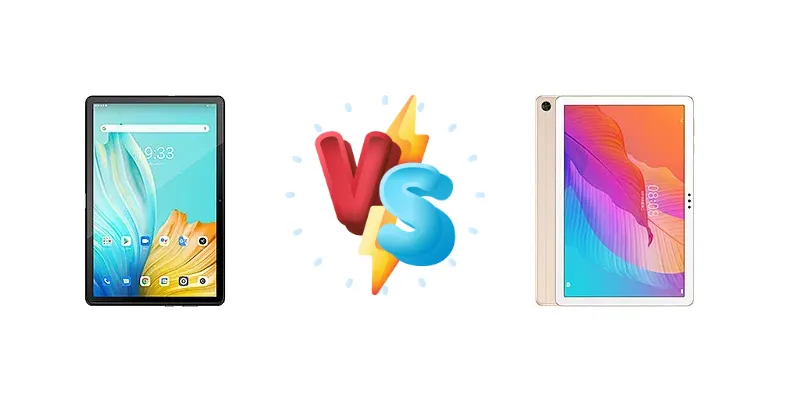
The budget tablet market is fiercely competitive, and the Blackview Tab 10 and Huawei MatePad T 10s represent compelling options for users seeking affordable entertainment and productivity. This comparison dives deep into their core specifications, focusing on the performance differences stemming from their respective chipsets and the implications for everyday use.
🏆 Quick Verdict
For most users, the Huawei MatePad T 10s offers a slightly more refined experience thanks to its Kirin 710A chipset, which utilizes more efficient Cortex-A73 cores. While the Blackview Tab 10 boasts faster 18W charging, the MatePad’s overall performance edge makes it the better choice for multitasking and demanding applications.
| Network |
|---|
| 2G bands | GSM 850 / 900 / 1800 / 1900 | GSM 850 / 900 / 1800 / 1900 |
| 3G bands | HSDPA 900 / 2100 | HSDPA 850 / 900 / 1700(AWS) / 1900 / 2100 |
| 4G bands | 1, 3, 7, 8, 20, 40 | 1, 3, 5, 7, 8, 18, 19, 20, 26, 28, 38, 40, 41 |
| Speed | HSPA, LTE | HSPA, LTE - cellular model only |
| Technology | GSM / HSPA / LTE | GSM / HSPA / LTE |
| Launch |
|---|
| Announced | 2021, June 08 | 2020, September 09. Released 2020, September 09 |
| Status | Available. Released 2021, June | Discontinued |
| Body |
|---|
| Dimensions | 243 x 162 x 8.4 mm (9.57 x 6.38 x 0.33 in) | 240.2 x 159 x 7.9 mm (9.46 x 6.26 x 0.31 in) |
| SIM | Nano-SIM + Nano-SIM | Nano-SIM (cellular model only) |
| Weight | 523 g (1.15 lb) | 450 g (0.99 lb) |
| | - | Stylus support |
| Display |
|---|
| Protection | Rainbow Glass | - |
| Resolution | 1200 x 1920 pixels, 16:10 ratio (~224 ppi density) | 1200 x 1920 pixels, 16:10 ratio (~224 ppi density) |
| Size | 10.1 inches, 295.8 cm2 (~75.1% screen-to-body ratio) | 10.1 inches, 295.8 cm2 (~77.4% screen-to-body ratio) |
| Type | IPS LCD | IPS LCD |
| Platform |
|---|
| CPU | Octa-core 2.0 GHz Cortex-A53 | Octa-core (4x2.0 GHz Cortex-A73 & 4x1.7 GHz Cortex-A53) |
| Chipset | Mediatek MTK8768 | Kirin 710A (14 nm) |
| GPU | PowerVR GE8320 | Mali-G51 MP4 |
| OS | Android 11 | Android 10, EMUI 10.1, no Google Play Services |
| Memory |
|---|
| Card slot | microSDXC | microSDXC |
| Internal | 64GB 4GB RAM | 16GB 2GB RAM, 32GB 2GB RAM, 64GB 3GB RAM, 64GB 4GB RAM, 128GB 4GB RAM |
| | eMMC | eMMC 5.1 |
| Main Camera |
|---|
| Features | LED flash | HDR, panorama |
| Single | 13 MP, f/2.2, (wide) | 5 MP, f/2.2, PDAF |
| Video | 1080p@30fps | 1080p@30fps |
| Selfie camera |
|---|
| Single | 8 MP, f/2.2, (wide) | 2 MP, f/2.4 |
| Video | 1080p@30fps | - |
| Sound |
|---|
| 3.5mm jack | No | Yes |
| 35mm jack | No | Yes |
| Loudspeaker | Yes | Yes, with stereo speakers |
| | - | Tuned by Harman Kardon |
| Comms |
|---|
| Bluetooth | 5.0, A2DP, LE | 5.0, A2DP, LE |
| NFC | No | No |
| Positioning | GPS, GLONASS, GALILEO, BDS | GPS, GLONASS, BDS - cellular model only |
| Radio | FM radio | No |
| USB | USB Type-C, OTG | USB Type-C 2.0, OTG |
| WLAN | Wi-Fi 802.11 a/b/g/n/ac, dual-band | Wi-Fi 802.11 a/b/g/n/ac, dual-band, Wi-Fi Direct |
| Features |
|---|
| Sensors | Accelerometer, gyro, proximity | Accelerometer, proximity |
| Battery |
|---|
| Charging | 18W wired | 10W wired |
| Type | 7480 mAh | Li-Po 5100 mAh |
| Misc |
|---|
| Colors | Gray, Gold, Silver | Gold, Deepsea Blue |
| Models | - | AGS3-L09, AGS3-W09, AGS3K-W09 |
| Price | About 180 EUR | About 200 EUR |
Blackview Tab 10
- Faster 18W charging for quicker top-ups.
- Potentially lower price point.
- Suitable for basic tasks like video streaming.
- Less powerful chipset compared to the Kirin 710A.
- May struggle with demanding applications and multitasking.
Huawei MatePad T 10s
- More powerful Kirin 710A chipset for smoother performance.
- More efficient CPU architecture for better multitasking.
- Potentially better image processing.
- Slower 10W charging.
- May be slightly more expensive.
Display Comparison
Neither device boasts a particularly standout display. Given the context data focuses on internals, we can infer both likely utilize IPS LCD panels common in this price bracket. The absence of specifications like resolution or peak brightness suggests a focus on cost-effectiveness over visual fidelity. Bezels are likely to be substantial on both, typical of budget tablets. Color accuracy is expected to be standard, suitable for general consumption but not professional color work.
Camera Comparison
Given the target market, camera performance is unlikely to be a key differentiator. Without specific sensor details, it’s safe to assume both tablets feature basic camera setups geared towards casual snapshots. Image quality will likely be acceptable in good lighting conditions but suffer in low light. The absence of OIS or advanced image processing features is expected. Focusing on the chipset difference, the Kirin 710A’s ISP (Image Signal Processor) *may* offer slightly better image processing capabilities, but the impact will be minimal.
Performance
The core difference lies in the chipsets. The Blackview Tab 10’s Mediatek MTK8768 utilizes an octa-core configuration of Cortex-A53 cores clocked at 2.0 GHz. The Huawei MatePad T 10s, however, features the Kirin 710A, a 14nm chip with a more sophisticated arrangement: four Cortex-A73 cores at 2.0 GHz paired with four Cortex-A53 cores at 1.7 GHz. The A73 cores are significantly more powerful than the A53, offering a noticeable performance boost in CPU-intensive tasks. While both have eight cores, the architectural difference means the MatePad T 10s will handle multitasking and app loading more smoothly. The MTK8768 is likely to show more strain under sustained load.
Battery Life
Battery capacity isn’t specified, but both tablets likely house batteries in the 5000-6000 mAh range, typical for 10-inch tablets. The Blackview Tab 10’s 18W wired charging is a clear advantage over the MatePad T 10s’ 10W charging. This translates to significantly faster charging times, reducing downtime. While the MatePad T 10s might offer slightly better battery *life* due to the more efficient Kirin 710A chipset, the faster charging of the Blackview Tab 10 is a practical benefit for users who frequently use their tablet on the go.
Buying Guide
Buy the Blackview Tab 10 if you prioritize faster charging speeds and are primarily focused on basic tasks like video playback and light web browsing. Its 18W charging will minimize downtime. Buy the Huawei MatePad T 10s if you value a more responsive user experience, particularly when multitasking or running slightly more demanding apps, and appreciate the benefits of the Kirin 710A’s architecture.
Frequently Asked Questions
❓ Will the Mediatek MTK8768 in the Blackview Tab 10 struggle with graphically intensive games?
Yes, the MTK8768, while capable of handling basic games, will likely struggle with demanding titles at higher settings. Frame rates may be inconsistent, and you may experience lag or stuttering. The Kirin 710A in the MatePad T 10s offers a more stable gaming experience, though neither tablet is a dedicated gaming device.
❓ Does the Huawei MatePad T 10s support Google Mobile Services (GMS)?
This is a crucial consideration. Huawei has faced restrictions on using GMS. The MatePad T 10s typically ships with Huawei’s AppGallery and Huawei Mobile Services (HMS) instead of the Google Play Store. While many popular apps are available through HMS or alternative app stores, some Google-dependent apps may not function correctly or require workarounds.
❓ How much does the slower charging of the Huawei MatePad T 10s impact daily use?
The 10W charging on the MatePad T 10s means a full charge will take considerably longer than the Blackview Tab 10’s 18W charging. If you frequently use your tablet throughout the day and need quick top-ups, this is a significant drawback. However, if you primarily charge overnight, the slower charging is less of a concern.