
Blackview Shark 9 vs. Ulefone Armor 9E: A Deep Dive into Rugged Smartphone Performance
| Phones Images | |||||
|---|---|---|---|---|---|
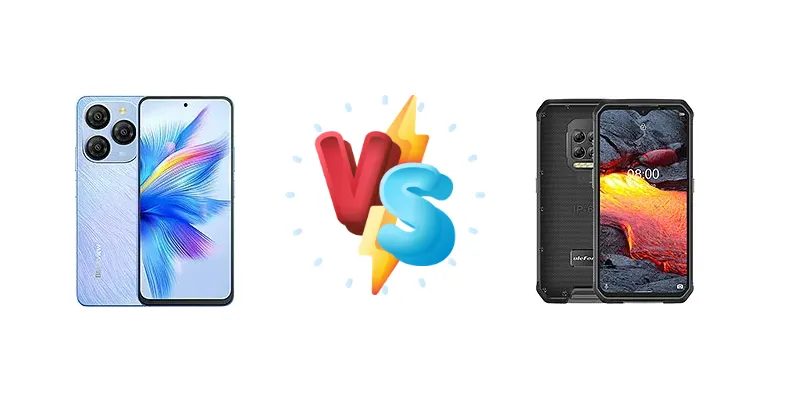
|
🏆 Quick Verdict
For the average user prioritizing longevity and consistent performance, the Blackview Shark 9 emerges as the winner. Its exceptional 49-hour battery life and 800 charge cycles significantly outweigh the Ulefone Armor 9E’s slightly faster processor, especially considering both devices share the same 18W charging.
| PHONES | ||
|---|---|---|
| Phone Names | Blackview Shark 9 | Ulefone Armor 9E |
| Network | ||
|---|---|---|
| 2G bands | GSM 850 / 900 / 1800 / 1900 | GSM 850 / 900 / 1800 / 1900 |
| 3G bands | HSDPA 850 / 900 / 1900 / 2100 | HSDPA 850 / 900 / 1700(AWS) / 1900 / 2100 |
| 4G bands | 1, 2, 3, 4, 5, 7, 8, 12, 17, 19, 20, 26, 28, 38, 39, 40, 41, 66 | 1, 2, 3, 4, 5, 7, 8, 12, 13, 17, 18, 19, 20, 25, 26, 28, 34, 38, 39, 40, 41, 66 |
| 5G bands | 1, 2, 3, 5, 7, 8, 20, 26, 28, 38, 40, 41, 66, 77, 78 SA/NSA | - |
| Speed | HSPA, LTE, 5G | HSPA 42.2/11.5 Mbps, LTE Cat12 600/150 Mbps |
| Technology | GSM / HSPA / LTE / 5G | GSM / CDMA / HSPA / EVDO / LTE |
| - | CDMA2000 1xEV-DO | |
| Launch | ||
|---|---|---|
| Announced | 2024, October | 2020, September 08. Released 2020, September 08 |
| Status | Available. Released 2024, November | Discontinued |
| Body | ||
|---|---|---|
| Build | - | Front glass, aluminum back with rubber, aluminum frame |
| Dimensions | 164.8 x 75.6 x 8.7 mm (6.49 x 2.98 x 0.34 in) | 168.2 x 82 x 15 mm (6.62 x 3.23 x 0.59 in) |
| SIM | Nano-SIM + Nano-SIM | Nano-SIM + Nano-SIM |
| Weight | 200 g (7.05 oz) | 324 g (11.43 oz) |
| - | IP68/IP69K dust/water resistant (up to 1.5m for 30 min) Drop-to-concrete resistance from up to 1.2m MIL-STD-810G compliant | |
| Display | ||
|---|---|---|
| Protection | Mohs level 7 | Scratch-resistant glass, oleophobic coating |
| Resolution | 720 x 1604 pixels, 20:9 ratio (~264 ppi density) | 1080 x 2340 pixels, 19.5:9 ratio (~409 ppi density) |
| Size | 6.67 inches, 107.2 cm2 (~86.1% screen-to-body ratio) | 6.3 inches, 97.4 cm2 (~70.6% screen-to-body ratio) |
| Type | IPS LCD, 90Hz, 700 nits | IPS LCD |
| Platform | ||
|---|---|---|
| CPU | - | Octa-core (2x2.2 GHz Cortex-A75 & 6x2.0 GHz Cortex-A55) |
| Chipset | Unisoc T820 | Mediatek MT6779 Helio P90 (12 nm) |
| GPU | - | PowerVR GM9446 |
| OS | Android 14, Doke OS 4.0 | Android 10 |
| Memory | ||
|---|---|---|
| Card slot | microSDXC (uses shared SIM slot) | microSDXC (uses shared SIM slot) |
| Internal | 256GB 8GB RAM | 128GB 8GB RAM |
| - | UFS 2.1 | |
| Main Camera | ||
|---|---|---|
| Features | LED flash, HDR, panorama | Quad-LED flash, HDR, panorama |
| Quad | - | 64 MP, f/1.9, 26mm (wide), 1/1.72", 0.8µm, PDAF 8 MP, f/2.4, 100˚ (ultrawide), 1/4.0", 1.12µm 2 MP (macro) Auxiliary lens |
| Triple | 50 MP, (wide), PDAF 2 MP (macro) Auxiliary lens | - |
| Video | 4K@30fps, 1080p@30fps | 4K@30fps, 1080p@30fps |
| Selfie camera | ||
|---|---|---|
| Features | - | HDR, panorama |
| Single | 8 MP, (wide) | 8 MP, f/2.2 |
| Video | 1080p@30fps | 1080p@30fps |
| Sound | ||
|---|---|---|
| 3.5mm jack | - | Yes |
| 35mm jack | Yes | Yes |
| Loudspeaker | Yes, with stereo speakers | Yes |
| Comms | ||
|---|---|---|
| Bluetooth | 5.0, A2DP, LE | 5.0, A2DP, LE |
| NFC | Yes | Yes |
| Positioning | GPS, GLONASS, GALILEO, BDS | GPS, GLONASS, GALILEO, BDS |
| Radio | FM radio | FM radio, RDS, recording |
| USB | USB Type-C 2.0, OTG | USB Type-C 2.0, OTG, accessory connector |
| WLAN | Wi-Fi 802.11 a/b/g/n/ac, dual-band | Wi-Fi 802.11 a/b/g/n/ac, Wi-Fi Direct |
| Features | ||
|---|---|---|
| Sensors | Fingerprint (side-mounted), accelerometer, proximity | Fingerprint (side-mounted), accelerometer, gyro, proximity, compass, coulombmeter |
| - | Endoscope mount (camera sold separately) | |
| Battery | ||
|---|---|---|
| Charging | 18W wired | 18W wired |
| Type | 5000 mAh | Li-Po 6600 mAh |
| Misc | ||
|---|---|---|
| Colors | Starry Rock Black, Azure Wave Blue | Black |
| Price | - | About 290 EUR |
| EU LABEL | ||
|---|---|---|
| Battery | 49:06h endurance, 800 cycles | - |
| Energy | Class B | - |
| Free fall | Class C (138 falls) | - |
| Repairability | Class B | - |
Blackview Shark 9
- Exceptional battery life (49:06h endurance)
- High charge cycle count (800 cycles)
- Potentially better sustained performance due to efficient chipset
- Unisoc T820 chipset is less powerful than Helio P90
- Display specs are unknown, potentially average quality
Ulefone Armor 9E
- More powerful Mediatek Helio P90 processor
- Octa-core CPU with Cortex-A75 cores for faster performance
- Potentially better gaming performance
- Shorter battery life compared to Blackview Shark 9
- Less efficient 12nm process may lead to throttling
Display Comparison
Neither device’s display specifications are provided, so a direct comparison is limited. However, given their price points, we can assume both utilize IPS LCD panels. The Ulefone Armor 9E, being slightly older, may have lower peak brightness. Rugged phones often prioritize durability over display quality, so color accuracy and viewing angles are likely similar, leaning towards functional rather than exceptional.
Camera Comparison
Without detailed camera specs, a comprehensive comparison is difficult. Both phones likely feature multi-camera setups geared towards versatility. However, the inclusion of a 2MP macro camera on either device suggests limited utility; these sensors often produce low-quality images. The Ulefone Armor 9E’s older chipset may have less advanced image signal processing (ISP) capabilities, potentially resulting in less refined image quality compared to the Shark 9, assuming the Shark 9 benefits from newer ISP technology within the Unisoc T820.
Performance
The core difference lies in the chipsets. The Ulefone Armor 9E’s Mediatek Helio P90 (12nm) features an octa-core configuration with two Cortex-A75 cores clocked at 2.2 GHz and six Cortex-A55 cores at 2.0 GHz. This architecture provides a noticeable performance boost over the Blackview Shark 9’s Unisoc T820. While the Unisoc T820 is a capable chip, the Helio P90’s Cortex-A75 cores offer superior single-core performance, translating to snappier app launches and smoother multitasking. However, the 12nm process of the Helio P90 is less efficient than modern chipsets, potentially leading to more heat generation under sustained load. The Shark 9’s T820 will likely offer better sustained performance due to its more efficient design, even if peak performance is lower.
Battery Life
The Blackview Shark 9 dominates in battery endurance with a reported 49 hours and 6 minutes of usage, coupled with an impressive 800 charge cycles. This suggests a larger battery capacity and optimized power management. While both devices support 18W wired charging, the Shark 9’s superior battery capacity means it will take longer to fully charge, but the extended runtime more than compensates. The Ulefone Armor 9E, while still offering respectable battery life, simply cannot compete with the Shark 9’s exceptional longevity.
Buying Guide
Buy the Blackview Shark 9 if you need a phone that can reliably last for days on a single charge, making it ideal for extended trips, fieldwork, or anyone who dislikes frequent charging. Buy the Ulefone Armor 9E if you prioritize raw processing power for demanding applications or gaming, and are willing to accept a shorter battery life in exchange for the Helio P90’s performance capabilities.