
Blackview Shark 9 vs. Samsung Galaxy XCover Pro: A Rugged Reliability Showdown
| Phones Images | |||||
|---|---|---|---|---|---|
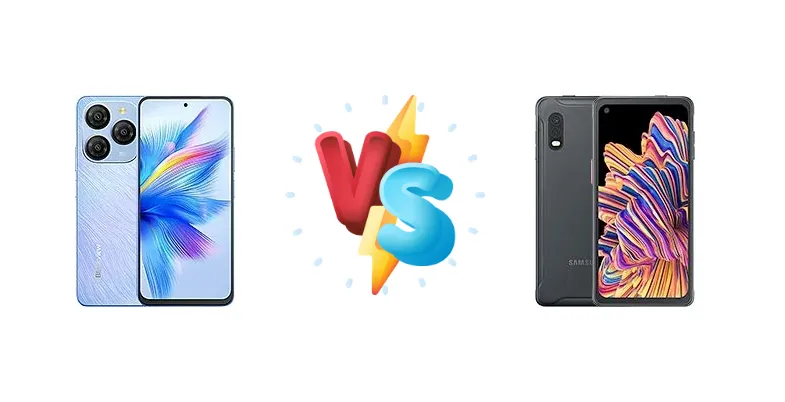
|
🏆 Quick Verdict
For users prioritizing all-day (and multi-day) battery life and aren't heavily invested in the Samsung ecosystem, the Blackview Shark 9 is the clear winner. Its 49:06h endurance significantly outpaces what the XCover Pro can offer. However, Samsung’s software and established support network make the XCover Pro a safer bet for enterprise deployments.
| PHONES | ||
|---|---|---|
| Phone Names | Blackview Shark 9 | Samsung Galaxy XCover Pro |
| Network | ||
|---|---|---|
| 2G bands | GSM 850 / 900 / 1800 / 1900 | GSM 850 / 900 / 1800 / 1900 |
| 3G bands | HSDPA 850 / 900 / 1900 / 2100 | HSDPA 850 / 900 / 1900 / 2100 - International |
| 4G bands | 1, 2, 3, 4, 5, 7, 8, 12, 17, 19, 20, 26, 28, 38, 39, 40, 41, 66 | 1, 2, 3, 5, 7, 8, 20, 28, 38, 40, 41 - International |
| 5G bands | 1, 2, 3, 5, 7, 8, 20, 26, 28, 38, 40, 41, 66, 77, 78 SA/NSA | - |
| Speed | HSPA, LTE, 5G | HSPA 42.2/5.76 Mbps, LTE (3CA) Cat11 600/50 Mbps |
| Technology | GSM / HSPA / LTE / 5G | GSM / HSPA / LTE |
| - | 1, 2, 3, 4, 5, 7, 12, 13, 14, 20, 29, 38, 40, 41, 66 - Canada | |
| Launch | ||
|---|---|---|
| Announced | 2024, October | 2020, January |
| Status | Available. Released 2024, November | Available. Released 2020, January |
| Body | ||
|---|---|---|
| Dimensions | 164.8 x 75.6 x 8.7 mm (6.49 x 2.98 x 0.34 in) | 159.9 x 76.7 x 10 mm (6.30 x 3.02 x 0.39 in) |
| SIM | Nano-SIM + Nano-SIM | · Nano-SIM· Nano-SIM + Nano-SIM |
| Weight | 200 g (7.05 oz) | 218 g (7.69 oz) |
| - | IP68 dust/water resistant (up to 1.5m for 35 min) Drop-to-concrete resistance from up to 1.5m MIL-STD-810G compliant* *does not guarantee ruggedness or use in extreme conditions | |
| Display | ||
|---|---|---|
| Protection | Mohs level 7 | Corning Gorilla Glass 5 |
| Resolution | 720 x 1604 pixels, 20:9 ratio (~264 ppi density) | 1080 x 2340 pixels, 19.5:9 ratio (~409 ppi density) |
| Size | 6.67 inches, 107.2 cm2 (~86.1% screen-to-body ratio) | 6.3 inches, 97.4 cm2 (~79.4% screen-to-body ratio) |
| Type | IPS LCD, 90Hz, 700 nits | IPS LCD |
| Platform | ||
|---|---|---|
| CPU | - | Octa-core (4x2.3 GHz Cortex-A73 & 4x1.7 GHz Cortex-A53) |
| Chipset | Unisoc T820 | Exynos 9611 (10 nm) |
| GPU | - | Mali-G72 MP3 |
| OS | Android 14, Doke OS 4.0 | Android 10, upgradable to Android 13, One UI 5 |
| Memory | ||
|---|---|---|
| Card slot | microSDXC (uses shared SIM slot) | microSDXC (dedicated slot) |
| Internal | 256GB 8GB RAM | 64GB 4GB RAM |
| Main Camera | ||
|---|---|---|
| Dual | - | 25 MP, f/1.7, 26mm (wide), PDAF 8 MP, f/2.2, 123˚ (ultrawide), 1/4.0", 1.12µm |
| Features | LED flash, HDR, panorama | Dual-LED flash, HDR, panorama |
| Triple | 50 MP, (wide), PDAF 2 MP (macro) Auxiliary lens | - |
| Video | 4K@30fps, 1080p@30fps | 1080p@30fps |
| Selfie camera | ||
|---|---|---|
| Features | - | HDR |
| Single | 8 MP, (wide) | 13 MP, f/2.0, (wide), 1/3.1", 1.12µm |
| Video | 1080p@30fps | 1080p@30fps |
| Sound | ||
|---|---|---|
| 3.5mm jack | - | Yes |
| 35mm jack | Yes | Yes |
| Loudspeaker | Yes, with stereo speakers | Yes |
| Comms | ||
|---|---|---|
| Bluetooth | 5.0, A2DP, LE | 5.0, A2DP, LE |
| NFC | Yes | Yes |
| Positioning | GPS, GLONASS, GALILEO, BDS | GPS, GLONASS, GALILEO, BDS |
| Radio | FM radio | FM radio (market/region dependent) |
| USB | USB Type-C 2.0, OTG | USB Type-C 2.0 |
| WLAN | Wi-Fi 802.11 a/b/g/n/ac, dual-band | Wi-Fi 802.11 a/b/g/n/ac/k/v/r, dual-band, Wi-Fi Direct |
| Features | ||
|---|---|---|
| Sensors | Fingerprint (side-mounted), accelerometer, proximity | Fingerprint (side-mounted), accelerometer, gyro, proximity, compass |
| - | ANT+ | |
| Battery | ||
|---|---|---|
| Charging | 18W wired | 15W wired |
| Type | 5000 mAh | Li-Po 4050 mAh, removable |
| Misc | ||
|---|---|---|
| Colors | Starry Rock Black, Azure Wave Blue | Black |
| Models | - | SM-G715FN/DS, SM-G715FN, SM-G715F, SM-G715W, SM-G715U, SM-G715U1 |
| Price | - | About 120 EUR |
| SAR EU | - | 0.47 W/kg (head) 1.23 W/kg (body) |
| EU LABEL | ||
|---|---|---|
| Battery | 49:06h endurance, 800 cycles | - |
| Energy | Class B | - |
| Free fall | Class C (138 falls) | - |
| Repairability | Class B | - |
Blackview Shark 9
- Exceptional 49:06h battery endurance
- 800 charge cycles for extended battery lifespan
- Potentially more efficient Unisoc T820 chipset
- Limited brand recognition
- Unspecified display details and camera specs
Samsung Galaxy XCover Pro
- Established Samsung brand and ecosystem
- Samsung Knox security platform
- Potential for longer software support
- Significantly lower battery endurance
- Older and less efficient Exynos 9611 chipset
- Slower 15W charging
Display Comparison
Neither device boasts a cutting-edge display. Details on panel type (IPS vs AMOLED) and resolution are missing for the Shark 9, but given the price point, it's likely a standard IPS LCD. The XCover Pro also utilizes an IPS LCD. The focus here isn't on visual fidelity, but on readability in direct sunlight and durability. The XCover Pro’s Gorilla Glass 5 offers some scratch resistance, while the Shark 9’s display protection is unspecified. Both prioritize function over form.
Camera Comparison
Camera details are sparse for the Shark 9, making a direct comparison difficult. The XCover Pro features a standard camera setup, but lacks details on sensor size and image stabilization. Given the target audience, image quality isn’t the primary concern; functionality and reliability are. Both phones likely prioritize capturing usable images in challenging conditions rather than delivering flagship-level photography. The absence of detailed camera specs for the Shark 9 suggests a more basic imaging experience.
Performance
The chipset is where a significant difference emerges. The Blackview Shark 9’s Unisoc T820 is a relatively recent chip designed for efficiency, while the Samsung Galaxy XCover Pro relies on the older Exynos 9611 (10nm). The Exynos 9611’s octa-core configuration (4x2.3 GHz Cortex-A73 & 4x1.7 GHz Cortex-A53) suggests a focus on burst performance, but the 10nm process is less efficient than modern designs. The Unisoc T820, while potentially less powerful in raw benchmarks, likely offers better sustained performance due to its more efficient architecture. The XCover Pro’s performance will be adequate for everyday tasks, but may struggle with demanding applications or multitasking.
Battery Life
Battery life is the defining characteristic of this comparison. The Blackview Shark 9’s 49:06h endurance is exceptional, indicating a highly optimized power management system and efficient chipset. This translates to multi-day usage for typical users. The Samsung Galaxy XCover Pro, with its 15W charging, will require more frequent charging. While the exact battery capacity of the XCover Pro isn’t specified, the lower endurance suggests a smaller capacity and/or less efficient power consumption. The Shark 9’s 800 charge cycles also suggest a longer lifespan before battery degradation becomes noticeable.
Buying Guide
Buy the Blackview Shark 9 if you need extreme battery life for fieldwork, construction, or extended travel, and value a lower price point. You'll benefit from a phone that can easily last two days on a single charge. Buy the Samsung Galaxy XCover Pro if you prefer a familiar Android experience with Samsung’s Knox security platform, require compatibility with Samsung’s enterprise solutions, and prioritize long-term software support, even at the cost of battery endurance.