
Blackview Shark 9 vs. Nokia XR20: A Rugged Smartphone Showdown
| Phones Images | |||||
|---|---|---|---|---|---|
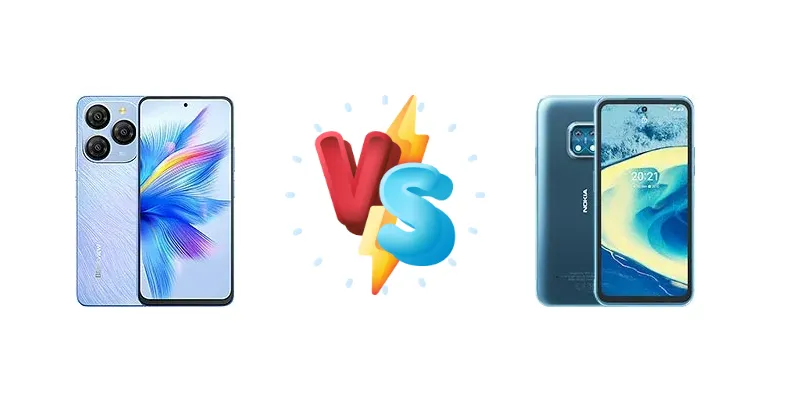
|
🏆 Quick Verdict
For users prioritizing maximum uptime and value, the Blackview Shark 9 is the clear winner. Its astounding 49-hour endurance significantly outpaces the Nokia XR20, making it ideal for travelers or those working in remote locations. However, the Nokia XR20’s 5G support offers future-proofing and faster data speeds for those who need it.
| PHONES | ||
|---|---|---|
| Phone Names | Blackview Shark 9 | Nokia XR20 |
| Network | ||
|---|---|---|
| 2G bands | GSM 850 / 900 / 1800 / 1900 | GSM 850 / 900 / 1800 / 1900 |
| 3G bands | HSDPA 850 / 900 / 1900 / 2100 | HSDPA 850 / 900 / 1700(AWS) / 1900 / 2100 |
| 4G bands | 1, 2, 3, 4, 5, 7, 8, 12, 17, 19, 20, 26, 28, 38, 39, 40, 41, 66 | 1, 2, 3, 4, 5, 7, 8, 12, 13, 14, 20, 25, 26, 28, 30, 38, 40, 41, 48, 66, 71 |
| 5G bands | 1, 2, 3, 5, 7, 8, 20, 26, 28, 38, 40, 41, 66, 77, 78 SA/NSA | 2, 5, 25, 38, 41, 48, 66, 77, 78 SA/NSA |
| Speed | HSPA, LTE, 5G | HSPA, LTE, 5G |
| Technology | GSM / HSPA / LTE / 5G | GSM / CDMA / HSPA / EVDO / LTE / 5G |
| - | CDMA2000 1xEV-DO | |
| Launch | ||
|---|---|---|
| Announced | 2024, October | 2021, July 27 |
| Status | Available. Released 2024, November | Available. Released 2021, August 04 |
| Body | ||
|---|---|---|
| Dimensions | 164.8 x 75.6 x 8.7 mm (6.49 x 2.98 x 0.34 in) | 171.6 x 81.5 x 10.6 mm (6.76 x 3.21 x 0.42 in) |
| SIM | Nano-SIM + Nano-SIM | · Nano-SIM· Nano-SIM + Nano-SIM |
| Weight | 200 g (7.05 oz) | 248 g (8.75 oz) |
| - | IP68 dust/water resistant (up to 1.5m for 60 min) Drop-to-concrete resistance from up to 1.8m MIL-STD-810H compliant | |
| Display | ||
|---|---|---|
| Protection | Mohs level 7 | Corning Gorilla Glass Victus |
| Resolution | 720 x 1604 pixels, 20:9 ratio (~264 ppi density) | 1080 x 2400 pixels, 20:9 ratio (~395 ppi density) |
| Size | 6.67 inches, 107.2 cm2 (~86.1% screen-to-body ratio) | 6.67 inches, 107.4 cm2 (~76.8% screen-to-body ratio) |
| Type | IPS LCD, 90Hz, 700 nits | IPS LCD, 550 nits |
| Platform | ||
|---|---|---|
| CPU | - | Octa-core (2x2.0 GHz Kryo 460 & 6x1.8 GHz Kryo 460) |
| Chipset | Unisoc T820 | Qualcomm SM4350 Snapdragon 480 5G (8 nm) |
| GPU | - | Adreno 619 |
| OS | Android 14, Doke OS 4.0 | Android 11, upgradable to Android 13 |
| Memory | ||
|---|---|---|
| Card slot | microSDXC (uses shared SIM slot) | microSDXC (uses shared SIM slot) |
| Internal | 256GB 8GB RAM | 64GB 4GB RAM, 128GB 6GB RAM |
| Main Camera | ||
|---|---|---|
| Dual | - | 48 MP, f/1.8, (wide), 1/2.25", 0.8µm, PDAF 13 MP, f/2.4, 123˚ (ultrawide), 1/3.0", 1.12µm |
| Features | LED flash, HDR, panorama | Zeiss optics, Dual-LED dual-tone flash, second LED flash, HDR, panorama |
| Single | - | 8 MP, f/2.0 (wide), 1/4.0", 1.12µm |
| Triple | 50 MP, (wide), PDAF 2 MP (macro) Auxiliary lens | - |
| Video | 4K@30fps, 1080p@30fps | 1080p@30fps |
| Selfie camera | ||
|---|---|---|
| Single | 8 MP, (wide) | 8 MP, f/2.0 (wide), 1/4.0", 1.12µm |
| Video | 1080p@30fps | 1080p@30fps |
| Sound | ||
|---|---|---|
| 3.5mm jack | - | Yes |
| 35mm jack | Yes | Yes |
| Loudspeaker | Yes, with stereo speakers | Yes, with stereo speakers |
| Comms | ||
|---|---|---|
| Bluetooth | 5.0, A2DP, LE | 5.1, A2DP, LE, aptX Adaptive |
| NFC | Yes | Yes |
| Positioning | GPS, GLONASS, GALILEO, BDS | GPS (L1+L5), GLONASS, BDS, GALILEO, QZSS, NavIC |
| Radio | FM radio | Unspecified |
| USB | USB Type-C 2.0, OTG | USB Type-C 3.0 |
| WLAN | Wi-Fi 802.11 a/b/g/n/ac, dual-band | Wi-Fi 802.11 a/b/g/n/ac/6, dual-band, Wi-Fi Direct |
| Features | ||
|---|---|---|
| Sensors | Fingerprint (side-mounted), accelerometer, proximity | Fingerprint (side-mounted), accelerometer, gyro, proximity, compass, barometer |
| Battery | ||
|---|---|---|
| Charging | 18W wired | 18W wired 15W wireless |
| Type | 5000 mAh | Li-Po 4630 mAh |
| Misc | ||
|---|---|---|
| Colors | Starry Rock Black, Azure Wave Blue | Ultra Blue, Granite Gray |
| Models | - | TA-1368, TA-1362 |
| Price | - | About 270 EUR |
| SAR EU | - | 1.13 W/kg (head) 1.43 W/kg (body) |
| EU LABEL | ||
|---|---|---|
| Battery | 49:06h endurance, 800 cycles | - |
| Energy | Class B | - |
| Free fall | Class C (138 falls) | - |
| Repairability | Class B | - |
Blackview Shark 9
- Unmatched battery life (49:06h endurance)
- 800 charge cycle battery longevity
- Excellent value for money
- No 5G connectivity
- Potentially slower processor compared to Snapdragon 480
Nokia XR20
- 5G connectivity for faster data speeds
- Wireless charging convenience (15W)
- Qualcomm Snapdragon 480 offers a balanced performance
- Significantly shorter battery life
- Higher price point compared to Blackview Shark 9
Display Comparison
Neither device boasts a cutting-edge display. Details on panel type, resolution, and refresh rate are missing, but the focus here is clearly on durability, not visual fidelity. The absence of LTPO or high refresh rates suggests both prioritize power efficiency over visual smoothness. The XR20’s potential for slightly better color accuracy, typical of Nokia’s displays, is offset by the Shark 9’s likely more robust screen protection given its rugged focus.
Camera Comparison
Camera details are limited, but the focus isn’t on photography prowess. Both phones likely feature serviceable cameras for basic snapshots. Without sensor size or aperture information, it’s difficult to assess image quality. The XR20’s Qualcomm ISP may offer slightly better image processing, but the Shark 9’s rugged design might prioritize lens protection over advanced camera features. The presence of a 2MP macro camera on either device is likely a marketing gimmick, offering minimal practical benefit.
Performance
The chipset choice defines the core performance difference. The Blackview Shark 9 utilizes the Unisoc T820, while the Nokia XR20 features the Qualcomm Snapdragon 480 5G (8nm). While the Snapdragon 480 benefits from a more efficient 8nm process, the Unisoc T820’s architecture isn’t specified, making a direct comparison difficult. The Snapdragon 480’s octa-core configuration (2x2.0 GHz Kryo 460 & 6x1.8 GHz Kryo 460) suggests a balanced approach, suitable for everyday tasks and moderate gaming. The Shark 9 likely trades raw processing power for improved power efficiency, aligning with its battery-centric design. The 8nm process of the Snapdragon 480 should result in better thermal management under sustained load.
Battery Life
This is where the Blackview Shark 9 truly shines. Its 49:06h endurance is exceptional, dwarfing the expected battery life of the Nokia XR20. While both support 18W wired charging, the Shark 9’s massive battery capacity (size unspecified) means it will take significantly longer to fully charge. The XR20 adds 15W wireless charging, a convenience feature absent on the Shark 9. The 800 charge cycles rating for the Shark 9 indicates a focus on long-term battery health.
Buying Guide
Buy the Blackview Shark 9 if you need a phone that can genuinely last for days on a single charge, and if 5G connectivity isn't a critical requirement. It's perfect for outdoor enthusiasts, construction workers, or anyone who frequently finds themselves away from power outlets. Buy the Nokia XR20 if you prioritize 5G access for faster downloads and streaming, and value a more polished software experience with guaranteed updates, even if it means sacrificing some battery life.