
Blackview Shark 9 vs BV9900E: A Deep Dive into Rugged Performance
| Phones Images | |||||
|---|---|---|---|---|---|
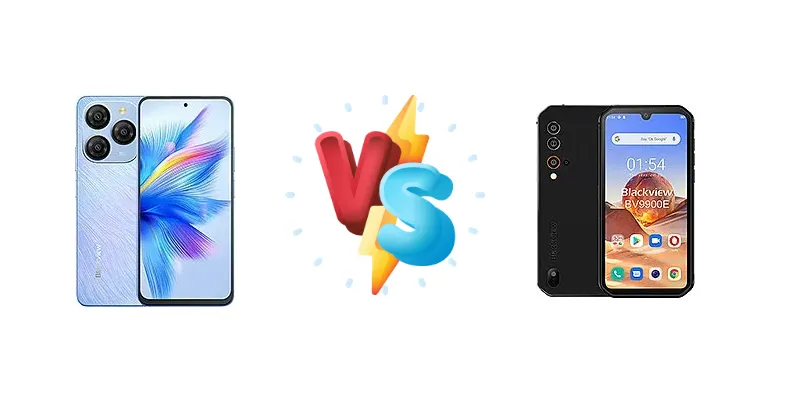
|
🏆 Quick Verdict
For most users, the Blackview Shark 9 emerges as the better choice. Its Unisoc T820 chipset offers a more modern architecture and likely superior sustained performance, coupled with an exceptional 49-hour battery endurance. While the BV9900E’s wireless charging is a plus, it’s outweighed by the Shark 9’s overall efficiency and processing power.
| PHONES | ||
|---|---|---|
| Phone Names | Blackview Shark 9 | Blackview BV9900E |
| Network | ||
|---|---|---|
| 2G bands | GSM 850 / 900 / 1800 / 1900 | GSM 850 / 900 / 1800 / 1900 |
| 3G bands | HSDPA 850 / 900 / 1900 / 2100 | HSDPA 800 / 850 / 900 / 1700(AWS) / 1900 / 2100 |
| 4G bands | 1, 2, 3, 4, 5, 7, 8, 12, 17, 19, 20, 26, 28, 38, 39, 40, 41, 66 | 1, 2, 3, 4, 5, 7, 8, 12, 13, 17, 18, 19, 20, 25, 26, 28, 34, 38, 39, 40, 41, 66 |
| 5G bands | 1, 2, 3, 5, 7, 8, 20, 26, 28, 38, 40, 41, 66, 77, 78 SA/NSA | - |
| Speed | HSPA, LTE, 5G | HSPA, LTE |
| Technology | GSM / HSPA / LTE / 5G | GSM / CDMA / HSPA / CDMA2000 / LTE |
| Launch | ||
|---|---|---|
| Announced | 2024, October | 2020, September 10. Released 2020, September |
| Status | Available. Released 2024, November | Discontinued |
| Body | ||
|---|---|---|
| Dimensions | 164.8 x 75.6 x 8.7 mm (6.49 x 2.98 x 0.34 in) | 156.5 x 78.3 x 14.2 mm (6.16 x 3.08 x 0.56 in) |
| SIM | Nano-SIM + Nano-SIM | Nano-SIM + Nano-SIM |
| Weight | 200 g (7.05 oz) | 273 g (9.63 oz) |
| Display | ||
|---|---|---|
| Protection | Mohs level 7 | Corning Gorilla Glass 5 |
| Resolution | 720 x 1604 pixels, 20:9 ratio (~264 ppi density) | 1080 x 2280 pixels, 19:9 ratio (~432 ppi density) |
| Size | 6.67 inches, 107.2 cm2 (~86.1% screen-to-body ratio) | 5.84 inches, 85.1 cm2 (~69.5% screen-to-body ratio) |
| Type | IPS LCD, 90Hz, 700 nits | IPS LCD |
| Platform | ||
|---|---|---|
| CPU | - | Octa-core (2x2.2 GHz Cortex-A75 & 6x2.0 GHz Cortex-A55) |
| Chipset | Unisoc T820 | Mediatek MT6779V/CE Helio P90 (12 nm) |
| GPU | - | PowerVR GM9446 |
| OS | Android 14, Doke OS 4.0 | Android 10 |
| Memory | ||
|---|---|---|
| Card slot | microSDXC (uses shared SIM slot) | microSDXC |
| Internal | 256GB 8GB RAM | 128GB 6GB RAM |
| Main Camera | ||
|---|---|---|
| Features | LED flash, HDR, panorama | LED flash, HDR, panorama |
| Quad | - | 48 MP, f/1.8, (wide), PDAF 16 MP, 120˚ (ultrawide) 2 MP (macro) Auxiliary lens |
| Triple | 50 MP, (wide), PDAF 2 MP (macro) Auxiliary lens | - |
| Video | 4K@30fps, 1080p@30fps | 4K@30fps, 1080p@60fps |
| Selfie camera | ||
|---|---|---|
| Single | 8 MP, (wide) | 16 MP, f/2.0, (wide) |
| Video | 1080p@30fps | 1080p@30fps |
| Sound | ||
|---|---|---|
| 35mm jack | Yes | No |
| Loudspeaker | Yes, with stereo speakers | Yes |
| Comms | ||
|---|---|---|
| Bluetooth | 5.0, A2DP, LE | 5.0, A2DP, LE |
| NFC | Yes | Yes |
| Positioning | GPS, GLONASS, GALILEO, BDS | GPS, GLONASS, GALILEO, BDS |
| Radio | FM radio | FM radio |
| USB | USB Type-C 2.0, OTG | USB Type-C 2.0, OTG |
| WLAN | Wi-Fi 802.11 a/b/g/n/ac, dual-band | Wi-Fi 802.11 a/b/g/n/ac |
| Features | ||
|---|---|---|
| Sensors | Fingerprint (side-mounted), accelerometer, proximity | Fingerprint (side-mounted), accelerometer, gyro, proximity, compass, barometer |
| Battery | ||
|---|---|---|
| Charging | 18W wired | 15W wired 18W wireless |
| Type | 5000 mAh | 4380 mAh |
| Misc | ||
|---|---|---|
| Colors | Starry Rock Black, Azure Wave Blue | Black, Silver |
| Price | - | About 260 EUR |
| EU LABEL | ||
|---|---|---|
| Battery | 49:06h endurance, 800 cycles | - |
| Energy | Class B | - |
| Free fall | Class C (138 falls) | - |
| Repairability | Class B | - |
Blackview Shark 9
- Exceptional 49:06h battery endurance
- Modern Unisoc T820 chipset for better performance
- Likely more efficient power consumption
- Lacks wireless charging
- Limited display information available
Blackview BV9900E
- Convenient 18W wireless charging
- Established Mediatek Helio P90 chipset
- Potentially more readily available accessories
- Shorter battery life compared to Shark 9
- Older chipset architecture may limit performance
Display Comparison
Neither device’s display specifications are provided, so a direct comparison is limited. However, given the Shark 9’s focus on modern features, it’s reasonable to assume it may incorporate a higher refresh rate panel. The BV9900E, being an older model, likely features a standard 60Hz display. Both will likely prioritize durability, with reinforced glass being a key feature for rugged phones.
Camera Comparison
Without detailed camera specs, a precise comparison is difficult. However, rugged phones often prioritize practicality over camera excellence. Both devices likely feature a multi-camera setup, but the sensor sizes and image processing algorithms will be key differentiators. The absence of information suggests neither phone will compete with flagship camera performance, but the Shark 9’s newer chipset may offer more advanced image processing capabilities.
Performance
The core difference lies in the chipsets. The Blackview Shark 9’s Unisoc T820 is a newer design, built on a more efficient process node than the BV9900E’s Mediatek Helio P90 (12nm). The Helio P90’s octa-core configuration (2x2.2 GHz Cortex-A75 & 6x2.0 GHz Cortex-A55) is respectable, but the T820’s architecture likely provides better overall performance and efficiency. This translates to smoother multitasking, faster app loading times, and potentially better sustained gaming performance on the Shark 9. The T820’s newer GPU will also offer a performance advantage in graphics-intensive tasks.
Battery Life
The Blackview Shark 9 boasts an impressive 49:06h endurance, significantly exceeding what’s expected from a typical smartphone. This is a major advantage for users who frequently travel or work in areas with limited access to power outlets. The BV9900E, with its 15W wired and 18W wireless charging, offers charging flexibility. However, the Shark 9’s 18W wired charging, combined with its superior battery endurance, likely results in less frequent charging cycles. The wireless charging on the BV9900E is convenient, but the slower charging speed may not fully compensate for the Shark 9’s longer runtime.
Buying Guide
Buy the Blackview Shark 9 if you need a phone for demanding tasks like mobile gaming, prolonged video streaming, or heavy multitasking, and prioritize long battery life above all else. Buy the Blackview BV9900E if you value the convenience of wireless charging, prefer a slightly more established chipset (Helio P90), and don't require the absolute highest level of processing performance. The BV9900E is a solid option for users who prioritize practicality and wireless power.