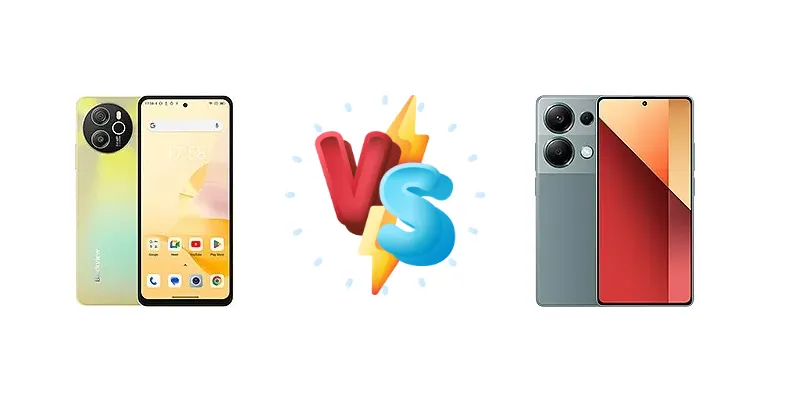
The Blackview Shark 8 and Xiaomi Redmi Note 13 Pro 4G both target the competitive mid-range smartphone market, but approach it with different priorities. The Shark 8 emphasizes exceptional battery endurance, while the Redmi Note 13 Pro 4G focuses on rapid charging and a brighter display. This comparison dissects their key specifications to determine which device best suits your needs.
🏆 Quick Verdict
For users prioritizing longevity and minimizing charging frequency, the Blackview Shark 8 is the clear winner thanks to its remarkable 52-hour and 24-minute battery endurance. However, the Xiaomi Redmi Note 13 Pro 4G’s 67W charging and brighter display make it a compelling choice for those who value convenience and visual clarity.
| Network |
|---|
| 2G bands | GSM 850 / 900 / 1800 / 1900 | GSM 850 / 900 / 1800 / 1900 |
| 3G bands | HSDPA 900 / 2100 | HSDPA 850 / 900 / 1700(AWS) / 1900 / 2100 |
| 4G bands | 1, 3, 7, 8, 19, 20, 28, 40 | 1, 2, 3, 4, 5, 7, 8, 12, 13, 17, 18, 19, 20, 26, 28, 38, 40, 41, 66 |
| Speed | HSPA, LTE | HSPA, LTE |
| Technology | GSM / HSPA / LTE | GSM / HSPA / LTE |
| Launch |
|---|
| Announced | 2023, November | 2024, January 15 |
| Status | Available. Released 2023, November | Available. Released 2024, January 15 |
| Body |
|---|
| Build | - | Glass front (Gorilla Glass 5), plastic frame, plastic back |
| Dimensions | 168.5 x 76.6 x 8.4 mm (6.63 x 3.02 x 0.33 in) | 161.1 x 75 x 8 mm (6.34 x 2.95 x 0.31 in) |
| SIM | Nano-SIM + Nano-SIM | Nano-SIM + Nano-SIM |
| Weight | 198.3 g (6.98 oz) | 188 g (6.63 oz) |
| Display |
|---|
| Protection | Mohs level 7 | Corning Gorilla Glass 5 |
| Resolution | 1080 x 2460 pixels (~396 ppi density) | 1080 x 2400 pixels, 20:9 ratio (~395 ppi density) |
| Size | 6.78 inches, 109.2 cm2 (~84.6% screen-to-body ratio) | 6.67 inches, 107.4 cm2 (~88.9% screen-to-body ratio) |
| Type | IPS LCD, 120Hz, 500 nits | AMOLED, 1B colors, 120Hz, 500 nits (typ), 1000 nits (HBM), 1300 nits (peak) |
| Platform |
|---|
| CPU | Octa-core (2x2.2 GHz Cortex-A76 & 6x2.0 GHz Cortex-A55) | Octa-core (2x2.2 GHz Cortex-A76 & 6x2.0 GHz Cortex-A55) |
| Chipset | Mediatek Helio G99 (6 nm) | Mediatek Helio G99 Ultra |
| GPU | Mali-G57 MC2 | Mali-G57 MC2 |
| OS | Android 13, Doke OS 4.0 | Android 13, up to 3 major Android upgrades, HyperOS |
| Memory |
|---|
| Card slot | microSDXC (dedicated slot) | microSDXC (uses shared SIM slot) |
| Internal | 256GB 8GB RAM | 128GB 8GB RAM, 256GB 8GB RAM, 256GB 12GB RAM, 512GB 8GB RAM, 512GB 12GB RAM |
| Main Camera |
|---|
| Dual | 64 MP, (wide), 1/1.97", 0.7µm, PDAF
Secondary unspecified camera | - |
| Features | LED flash, HDR, panorama | LED flash, HDR, panorama |
| Triple | - | 200 MP, f/1.7, 23mm (wide), 1/1.4", 0.56µm, multi-directional PDAF, OIS
8 MP, f/2.2, 15mm, 120˚ (ultrawide), 1/4.4", 1.0µm
2 MP (macro) |
| Video | 1440p@30fps, 1080p@30fps | 1080p@30/60fps |
| Selfie camera |
|---|
| Single | 13 MP, (wide), 1/3", 1.12µm | 16 MP, f/2.4, (wide), 1/3.0", 1.0µm |
| Video | 1080p@30fps | 1080p@30/60fps |
| Sound |
|---|
| 35mm jack | Yes | Yes |
| Loudspeaker | Yes | Yes, with dual speakers |
| Comms |
|---|
| Bluetooth | 5.0, A2DP, LE | 5.2, A2DP, LE |
| Infrared port | - | Yes |
| NFC | Yes | Yes (market/region dependent) |
| Positioning | GPS, GLONASS, GALILEO, BDS | GPS, GLONASS, GALILEO, BDS |
| Radio | FM radio | FM radio |
| USB | USB Type-C 2.0, OTG | USB Type-C 2.0, OTG |
| WLAN | Wi-Fi 802.11 a/b/g/n/ac, dual-band | Wi-Fi 802.11 a/b/g/n/ac, dual-band |
| Features |
|---|
| Sensors | Fingerprint (rear-mounted), accelerometer, proximity | Fingerprint (under display, optical), accelerometer, gyro, compass |
| Battery |
|---|
| Charging | 33W wired | 67W wired, 50% in 16 min, 100% in 46 min |
| Type | 5000 mAh | 5000 mAh |
| Misc |
|---|
| Colors | Galaxy Blue, Scorching Gold, Moonlight Grey | Midnight Black, Lavender Purple, Forest Green |
| Models | - | 23117RA68G, 2312FPCA6G |
| Price | About 160 EUR | € 92.00 / $ 269.99 / £ 299.99 |
| SAR | - | 1.09 W/kg (head) 1.09 W/kg (body) |
| SAR EU | - | 0.99 W/kg (head) 0.99 W/kg (body) |
| EU LABEL |
|---|
| Battery | 52:24h endurance, 800 cycles | - |
| Energy | Class A | - |
| Free fall | Class C (126 falls) | - |
| Repairability | Class B | - |
Blackview Shark 8
- Exceptional battery life (52h 24m endurance)
- High battery cycle count (800 cycles)
- Potentially more affordable price point
- Slower charging speed (33W)
- Display brightness likely lower than Redmi Note 13 Pro 4G
- Camera specifications unknown
Xiaomi Redmi Note 13 Pro 4G
- Faster charging (67W, 46 min to full)
- Brighter display (1047 nits)
- Potentially better camera system (based on Xiaomi's track record)
- Significantly shorter battery life (11h 36m)
- May be more expensive than Blackview Shark 8
- Helio G99 Ultra advantage may be minimal
Display Comparison
The Xiaomi Redmi Note 13 Pro 4G boasts a significantly brighter display, reaching a measured peak of 1047 nits. This is a substantial advantage for outdoor visibility and HDR content. While the Blackview Shark 8’s display specifications are not provided, the Redmi’s brightness level suggests a superior viewing experience in bright conditions. The Redmi Note 13 Pro 4G likely utilizes an AMOLED panel, common in this price range, offering excellent contrast and color accuracy, features not confirmed for the Shark 8.
Camera Comparison
The Redmi Note 13 Pro 4G’s camera system is highlighted, but specific details beyond 'Photo / Video' are absent. Given Xiaomi’s history, it likely features a high-resolution main sensor, potentially with Optical Image Stabilization (OIS). The Blackview Shark 8’s camera specifications are also not provided. Without sensor size, aperture, or OIS information, a direct comparison is impossible. It’s crucial to note that the inclusion of a 2MP macro camera on either device adds little practical value, focusing instead on the primary sensor's capabilities.
Performance
Both the Blackview Shark 8 and the Xiaomi Redmi Note 13 Pro 4G are powered by the Mediatek Helio G99 chipset, featuring an octa-core CPU configuration with 2x2.2 GHz Cortex-A76 and 6x2.0 GHz Cortex-A55 cores. However, the Redmi Note 13 Pro 4G utilizes the 'Ultra' variant of the G99. While the core architecture remains the same, the 'Ultra' designation typically indicates slightly higher clock speeds or optimizations for improved performance. In real-world usage, the difference is likely to be marginal, but the Redmi Note 13 Pro 4G may exhibit a slight edge in demanding tasks. Neither device’s RAM configuration is specified, but LPDDR4X is a likely candidate for both, impacting multitasking performance.
Battery Life
The Blackview Shark 8 truly shines in battery endurance, achieving an impressive 52 hours and 24 minutes of usage. This is a significant advantage over the Xiaomi Redmi Note 13 Pro 4G’s 11 hours and 36 minutes. However, the Redmi Note 13 Pro 4G compensates with its 67W wired charging, capable of reaching 50% charge in just 16 minutes and a full charge in 46 minutes. The Shark 8’s 33W charging is considerably slower. This trade-off means the Redmi Note 13 Pro 4G offers convenience, while the Shark 8 prioritizes longevity. The Shark 8 also boasts a claimed 800 charge cycles, suggesting a longer lifespan for the battery itself.
Buying Guide
Buy the Blackview Shark 8 if you need a phone that can reliably last through two full days of moderate use, or if you frequently find yourself away from power outlets. Buy the Xiaomi Redmi Note 13 Pro 4G if you prefer a phone that can quickly top up its battery, and if a vibrant, bright display is a priority for media consumption or outdoor use.
Frequently Asked Questions
❓ Does the Blackview Shark 8's 33W charging feel significantly slower compared to the Redmi Note 13 Pro 4G's 67W?
Yes, the difference is substantial. While 33W is adequate, the Redmi Note 13 Pro 4G can reach a full charge in under an hour, while the Shark 8 will take considerably longer. This impacts convenience, especially for users who need a quick top-up before leaving the house.
❓ Is the 'Helio G99 Ultra' in the Redmi Note 13 Pro 4G a noticeable performance upgrade over the standard Helio G99 in the Blackview Shark 8?
The performance difference between the standard Helio G99 and the 'Ultra' variant is likely to be minimal in most real-world scenarios. Both chips offer similar processing power for everyday tasks and moderate gaming. The 'Ultra' may provide a slight edge in sustained performance under heavy load, but it won't be a game-changer.
❓ How does the Blackview Shark 8's battery hold up over time, considering its 800 charge cycle claim?
The 800 charge cycle claim suggests the Shark 8's battery is designed for longevity. While all batteries degrade over time, 800 cycles indicate it should maintain a significant portion of its capacity even after extended use, potentially lasting longer than the Redmi Note 13 Pro 4G's battery.