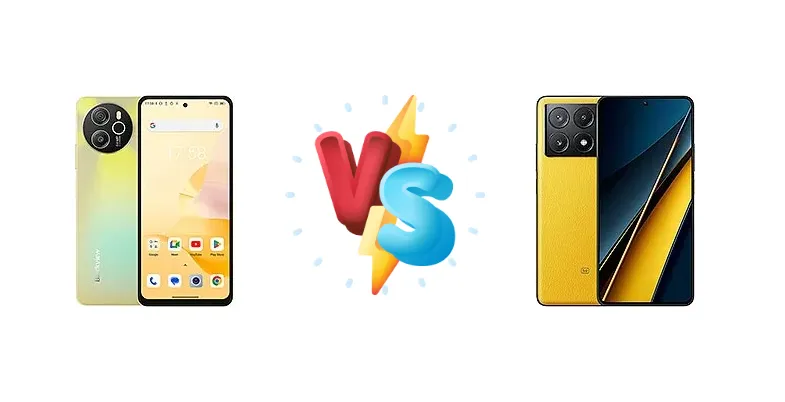
The Blackview Shark 8 and Xiaomi Poco X6 Pro represent distinct approaches to the mid-range smartphone market. The Shark 8 focuses on exceptional battery endurance and a robust build, while the Poco X6 Pro aims for near-flagship performance with the Dimensity 8300 Ultra chipset. This comparison dissects their strengths and weaknesses to determine which device best suits your needs.
🏆 Quick Verdict
For the average user prioritizing sustained performance and a brighter display, the Xiaomi Poco X6 Pro is the superior choice. Its Dimensity 8300 Ultra chipset offers a significant performance leap over the Shark 8’s Helio G99, and the 67W charging dramatically reduces downtime. However, the Blackview Shark 8 remains a compelling option for those who absolutely need maximum battery life.
| Network |
|---|
| 2G bands | GSM 850 / 900 / 1800 / 1900 | GSM 850 / 900 / 1800 / 1900 |
| 3G bands | HSDPA 900 / 2100 | HSDPA 850 / 900 / 1700(AWS) / 1900 / 2100 |
| 4G bands | 1, 3, 7, 8, 19, 20, 28, 40 | 1, 2, 3, 4, 5, 7, 8, 18, 19, 20, 28, 38, 40, 41, 48, 66 |
| 5G bands | - | 1, 2, 3, 5, 7, 8, 20, 28, 38, 40, 41, 48, 77, 78 SA/NSA/Sub6 |
| Speed | HSPA, LTE | HSPA, LTE, 5G |
| Technology | GSM / HSPA / LTE | GSM / HSPA / LTE / 5G |
| Launch |
|---|
| Announced | 2023, November | 2024, January 11 |
| Status | Available. Released 2023, November | Available. Released 2024, January 12 |
| Body |
|---|
| Build | - | Glass front (Gorilla Glass 5), plastic frame, plastic back or silicone polymer back (eco leather) |
| Dimensions | 168.5 x 76.6 x 8.4 mm (6.63 x 3.02 x 0.33 in) | 160.5 x 74.3 x 8.3 mm (6.32 x 2.93 x 0.33 in) |
| SIM | Nano-SIM + Nano-SIM | Nano-SIM + Nano-SIM |
| Weight | 198.3 g (6.98 oz) | 186 g or 190 g (6.56 oz) |
| Display |
|---|
| Protection | Mohs level 7 | Corning Gorilla Glass 5 |
| Resolution | 1080 x 2460 pixels (~396 ppi density) | 1220 x 2712 pixels, 20:9 ratio (~446 ppi density) |
| Size | 6.78 inches, 109.2 cm2 (~84.6% screen-to-body ratio) | 6.67 inches, 107.4 cm2 (~90.1% screen-to-body ratio) |
| Type | IPS LCD, 120Hz, 500 nits | AMOLED, 68B colors, 120Hz, 1920Hz PWM, HDR10+, Dolby Vision, 500 nits (typ), 1200 nits (HBM), 1800 nits (peak) |
| Platform |
|---|
| CPU | Octa-core (2x2.2 GHz Cortex-A76 & 6x2.0 GHz Cortex-A55) | Octa-core (1x3.35 GHz Cortex-A715 & 3x3.20 GHz Cortex-A715 & 4x2.20 GHz Cortex-A510) |
| Chipset | Mediatek Helio G99 (6 nm) | Mediatek Dimensity 8300 Ultra (4 nm) |
| GPU | Mali-G57 MC2 | Mali G615-MC6 |
| OS | Android 13, Doke OS 4.0 | Android 14, up to 3 major Android upgrades, HyperOS |
| Memory |
|---|
| Card slot | microSDXC (dedicated slot) | No |
| Internal | 256GB 8GB RAM | 256GB 8GB RAM, 256GB 12GB RAM, 512GB 12GB RAM |
| Main Camera |
|---|
| Dual | 64 MP, (wide), 1/1.97", 0.7µm, PDAF
Secondary unspecified camera | - |
| Features | LED flash, HDR, panorama | LED flash, HDR, panorama |
| Triple | - | 64 MP, f/1.7, 25mm (wide), 1/2.0", 0.7µm, PDAF, OIS
8 MP, f/2.2, 120˚ (ultrawide), 1/4.0", 1.12µm
2 MP (macro) |
| Video | 1440p@30fps, 1080p@30fps | 4K@24/30fps, 1080p@30/60fps, gyro-EIS |
| Selfie camera |
|---|
| Features | - | HDR, panorama |
| Single | 13 MP, (wide), 1/3", 1.12µm | 16 MP, f/2.4, (wide), 1/3.06", 1.0µm |
| Video | 1080p@30fps | 1080p@30/60fps |
| Sound |
|---|
| 35mm jack | Yes | No |
| Loudspeaker | Yes | Yes, with dual speakers |
| Comms |
|---|
| Bluetooth | 5.0, A2DP, LE | 5.4, A2DP, LE, aptX HD |
| Infrared port | - | Yes |
| NFC | Yes | Yes (market/region dependent) |
| Positioning | GPS, GLONASS, GALILEO, BDS | GPS, GALILEO, GLONASS, QZSS, BDS (B1I+B1c) |
| Radio | FM radio | No |
| USB | USB Type-C 2.0, OTG | USB Type-C 2.0, OTG |
| WLAN | Wi-Fi 802.11 a/b/g/n/ac, dual-band | Wi-Fi 802.11 a/b/g/n/ac/6, dual-band, Wi-Fi Direct |
| Features |
|---|
| Sensors | Fingerprint (rear-mounted), accelerometer, proximity | Fingerprint (under display, optical), accelerometer, gyro, compass |
| Battery |
|---|
| Charging | 33W wired | 67W wired, QC2.0, PD3.0, 100% in 45 min |
| Type | 5000 mAh | 5000 mAh |
| Misc |
|---|
| Colors | Galaxy Blue, Scorching Gold, Moonlight Grey | Black, Yellow, Gray |
| Models | - | 2311DRK48G, 2311DRK48I |
| Price | About 160 EUR | € 195.30 / $ 209.79 / £ 274.99 / ₹ 21,999 |
| SAR EU | - | 0.99 W/kg (head) 1.00 W/kg (body) |
| EU LABEL |
|---|
| Battery | 52:24h endurance, 800 cycles | - |
| Energy | Class A | - |
| Free fall | Class C (126 falls) | - |
| Repairability | Class B | - |
Blackview Shark 8
- Exceptional battery life (52:24h endurance)
- Long battery lifespan (800 charge cycles)
- Potentially more rugged build quality (based on brand reputation)
- Significantly slower processor (Helio G99)
- Slower charging speed (33W)
- Display brightness and quality likely inferior
Xiaomi Poco X6 Pro
- Powerful processor (Dimensity 8300 Ultra)
- Fast charging (67W, QC2.0, PD3.0, 45min)
- Bright and vibrant display (1148 nits)
- Shorter battery life (11:46h active use)
- Potentially less durable build
- May experience more thermal throttling under sustained load
Display Comparison
The Poco X6 Pro boasts a significantly brighter display, reaching a measured 1148 nits, compared to the Blackview Shark 8 which lacks published brightness data. This makes the Poco X6 Pro far more usable in direct sunlight. While the Shark 8’s display specs are unknown, the X6 Pro’s brightness advantage is substantial. The X6 Pro’s panel likely utilizes a higher refresh rate as well, contributing to a smoother visual experience, a feature not mentioned for the Shark 8. The X6 Pro’s superior brightness and likely refresh rate make it the clear winner for multimedia consumption and outdoor use.
Camera Comparison
The Poco X6 Pro’s camera system is described as offering both photo and video capabilities, but specific sensor details are missing. The Blackview Shark 8’s camera specs are also absent. Without detailed sensor information (megapixel count, aperture, OIS), a direct comparison is difficult. However, given Xiaomi’s history, the Poco X6 Pro likely features a more sophisticated camera system with better image processing algorithms. We can assume the X6 Pro will offer a more versatile and higher-quality photography experience.
Performance
The Xiaomi Poco X6 Pro’s Mediatek Dimensity 8300 Ultra (4nm) represents a massive leap in processing power compared to the Blackview Shark 8’s Mediatek Helio G99 (6nm). The Dimensity 8300 Ultra features a core configuration of 1x3.35 GHz Cortex-A715, 3x3.20 GHz Cortex-A715, and 4x2.20 GHz Cortex-A510, while the Helio G99 utilizes 2x2.2 GHz Cortex-A76 & 6x2.0 GHz Cortex-A55 cores. The 4nm process node of the Dimensity 8300 Ultra also translates to improved thermal efficiency, reducing the likelihood of performance throttling during extended gaming sessions. This difference will be particularly noticeable in graphically intensive games and demanding applications.
Battery Life
The Blackview Shark 8 excels in battery endurance, achieving a remarkable 52:24h of usage. This is significantly longer than the Poco X6 Pro’s 11:46h active use score. However, the Poco X6 Pro compensates with much faster charging: 67W wired with QC2.0 and PD3.0 support, achieving 100% charge in just 45 minutes. The Shark 8 is limited to 33W wired charging. While the Shark 8 offers superior longevity, the X6 Pro’s rapid charging minimizes downtime. The Shark 8 also boasts 800 charge cycles, suggesting a longer lifespan before battery degradation.
Buying Guide
Buy the Blackview Shark 8 if you need a phone that can reliably last well over a day on a single charge, and potentially for years thanks to its 800 charge cycles. It’s ideal for travelers, outdoor enthusiasts, or anyone who frequently finds themselves away from a power outlet. Buy the Xiaomi Poco X6 Pro if you prioritize gaming, demanding applications, and a vibrant, bright display. It’s the better choice for power users and those who want a more responsive and feature-rich experience.
Frequently Asked Questions
❓ Does the Mediatek Dimensity 8300 Ultra in the Poco X6 Pro get hot during prolonged gaming sessions?
While the Dimensity 8300 Ultra is a powerful chip, its 4nm process node and Xiaomi’s thermal management solutions are designed to mitigate overheating. However, extended gaming at maximum settings will inevitably generate heat. Expect some performance throttling after prolonged use, but it should be less severe than with less efficient chipsets.
❓ How does the 800 charge cycle rating of the Blackview Shark 8 translate to real-world battery lifespan?
The 800 charge cycle rating indicates the number of full charge/discharge cycles the battery can endure before significant degradation. This suggests the Shark 8’s battery should maintain a substantial portion of its capacity for several years of typical use, even with frequent charging. It's a significant advantage for long-term ownership.
❓ Is the 33W charging on the Blackview Shark 8 slow compared to the 67W on the Poco X6 Pro?
Yes, 33W charging is considerably slower than 67W. While the Shark 8’s exceptional battery life reduces the need for frequent charging, topping up the battery will take significantly longer. The Poco X6 Pro can go from 0-100% in 45 minutes, while the Shark 8 will require considerably more time.