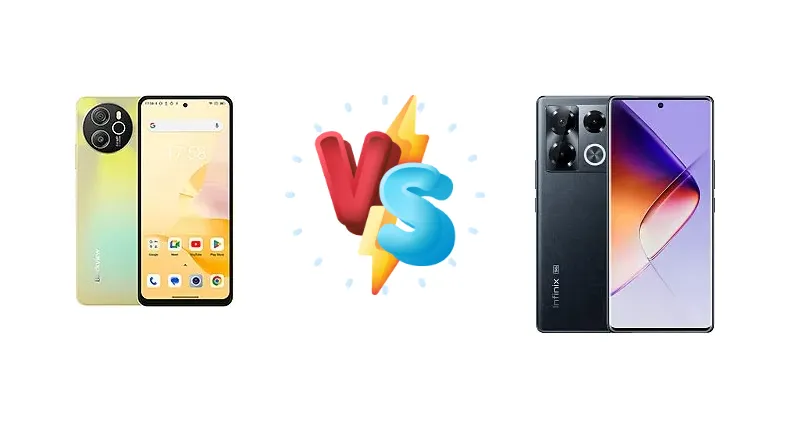
The Blackview Shark 8 and Infinix Note 40 Pro+ represent compelling options in the increasingly competitive mid-range smartphone market. While both devices utilize Mediatek chipsets and target budget-conscious consumers, they diverge significantly in their core philosophies: the Shark 8 prioritizes exceptional battery endurance, while the Note 40 Pro+ focuses on rapid charging and a more powerful processor.
🏆 Quick Verdict
For users prioritizing all-day battery life and longevity, the Blackview Shark 8 is the clear winner, boasting a remarkable 52:24h endurance. However, the Infinix Note 40 Pro+ delivers a significantly faster charging experience with its 100W wired and 20W MagCharge capabilities, making it ideal for those who need a quick power boost and demand more processing power.
| Network |
|---|
| 2G bands | GSM 850 / 900 / 1800 / 1900 | GSM 850 / 900 / 1800 / 1900 |
| 3G bands | HSDPA 900 / 2100 | HSDPA 850 / 900 / 1700(AWS) / 1900 / 2100 |
| 4G bands | 1, 3, 7, 8, 19, 20, 28, 40 | 1, 2, 3, 4, 5, 7, 8, 12, 17, 20, 28, 38, 40, 41, 42, 66 |
| 5G bands | - | 1, 3, 5, 7, 8, 12, 20, 28, 38, 40, 41, 66, 77, 78 SA/NSA |
| Speed | HSPA, LTE | HSPA, LTE, 5G |
| Technology | GSM / HSPA / LTE | GSM / HSPA / LTE / 5G |
| Launch |
|---|
| Announced | 2023, November | 2024, March 18 |
| Status | Available. Released 2023, November | Available. Released 2024, March 19 |
| Body |
|---|
| Build | - | Glass front, plastic frame, silicone polymer (eco leather) back |
| Dimensions | 168.5 x 76.6 x 8.4 mm (6.63 x 3.02 x 0.33 in) | 164.3 x 74.5 x 8.1 mm (6.47 x 2.93 x 0.32 in) |
| SIM | Nano-SIM + Nano-SIM | Nano-SIM + Nano-SIM |
| Weight | 198.3 g (6.98 oz) | 190 g or 196 g (6.70 oz) |
| Display |
|---|
| Protection | Mohs level 7 | Corning Gorilla Glass |
| Resolution | 1080 x 2460 pixels (~396 ppi density) | 1080 x 2436 pixels (~393 ppi density) |
| Size | 6.78 inches, 109.2 cm2 (~84.6% screen-to-body ratio) | 6.78 inches, 109.9 cm2 (~89.8% screen-to-body ratio) |
| Type | IPS LCD, 120Hz, 500 nits | AMOLED, 1B colors, 120Hz, 1300 nits (peak) |
| Platform |
|---|
| CPU | Octa-core (2x2.2 GHz Cortex-A76 & 6x2.0 GHz Cortex-A55) | Octa-core (2x2.2 GHz Cortex-A78 & 6x2.0 GHz Cortex-A55) |
| Chipset | Mediatek Helio G99 (6 nm) | Mediatek Dimensity 7020 (6 nm) |
| GPU | Mali-G57 MC2 | IMG BXM-8-256 |
| OS | Android 13, Doke OS 4.0 | Android 14, up to 2 major Android upgrades, XOS 14 |
| Memory |
|---|
| Card slot | microSDXC (dedicated slot) | No |
| Internal | 256GB 8GB RAM | 256GB 12GB RAM, 512GB 12GB RAM |
| Main Camera |
|---|
| Dual | 64 MP, (wide), 1/1.97", 0.7µm, PDAF
Secondary unspecified camera | - |
| Features | LED flash, HDR, panorama | Dual-LED flash, HDR, panorama |
| Triple | - | 108 MP, f/1.8, 24mm (wide), 1/1.67", 0.64µm, PDAF, OIS
2 MP, f/2.4
2 MP, f/2.4 |
| Video | 1440p@30fps, 1080p@30fps | 1440p@30fps, 1080p@30/60fps |
| Selfie camera |
|---|
| Features | - | Dual-LED flash |
| Single | 13 MP, (wide), 1/3", 1.12µm | 32 MP, f/2.2, (wide), 1/3.1", 0.7µm |
| Video | 1080p@30fps | 1440p@30fps, 1080p@30/60fps |
| Sound |
|---|
| 35mm jack | Yes | No |
| Loudspeaker | Yes | Yes, with stereo speakers |
| Comms |
|---|
| Bluetooth | 5.0, A2DP, LE | Yes |
| Infrared port | - | Yes |
| NFC | Yes | Yes (market/region dependent) |
| Positioning | GPS, GLONASS, GALILEO, BDS | GPS |
| Radio | FM radio | FM radio |
| USB | USB Type-C 2.0, OTG | USB Type-C 2.0, OTG |
| WLAN | Wi-Fi 802.11 a/b/g/n/ac, dual-band | Wi-Fi 802.11 a/b/g/n/ac, dual-band |
| Features |
|---|
| Sensors | Fingerprint (rear-mounted), accelerometer, proximity | Fingerprint (under display, optical), accelerometer, gyro, proximity, compass |
| Battery |
|---|
| Charging | 33W wired | 100W wired, 50% in 12 min
20W wireless MagCharge
Reverse wired
Reverse wireless |
| Type | 5000 mAh | 4600 mAh |
| Misc |
|---|
| Colors | Galaxy Blue, Scorching Gold, Moonlight Grey | Obsidian Black, Vintage Green, Racing Edition |
| Models | - | X6851B |
| Price | About 160 EUR | About 290 EUR |
| EU LABEL |
|---|
| Battery | 52:24h endurance, 800 cycles | - |
| Energy | Class A | - |
| Free fall | Class C (126 falls) | - |
| Repairability | Class B | - |
Blackview Shark 8
- Exceptional battery life (52:24h endurance)
- 800 charge cycles suggest long-term battery health
- Potentially more affordable price point
- Slower 33W charging
- Less powerful processor (Helio G99)
- Display brightness data unavailable, likely lower than Note 40 Pro+
Infinix Note 40 Pro+
- Ultra-fast 100W wired charging (50% in 12 min)
- 20W MagCharge wireless charging
- More powerful processor (Dimensity 7020)
- Significantly shorter battery life (12:23h)
- Potentially higher price
- May require more frequent charging
Display Comparison
The Infinix Note 40 Pro+ boasts a significantly brighter display, reaching a measured peak of 1130 nits. This is a substantial advantage over the Blackview Shark 8 (brightness data unavailable), making the Infinix more usable in direct sunlight. While the Shark 8’s display specs are unknown, the Note 40 Pro+'s brightness level suggests a superior viewing experience outdoors. The Note 40 Pro+ also benefits from potentially better color accuracy and contrast due to its higher peak brightness, though detailed panel analysis (like DCI-P3 coverage) is missing from the provided data.
Camera Comparison
Camera details beyond the presence of sensors are absent for both devices. However, given the market positioning, it’s reasonable to assume the Infinix Note 40 Pro+ will offer a more refined camera experience. The larger sensor size (if present, which is likely given the 'Pro+' designation) and potentially better image processing algorithms within the Dimensity 7020 chipset would contribute to superior image quality, especially in low-light conditions. The Blackview Shark 8 likely focuses on providing a functional camera system rather than competing on image quality.
Performance
The Infinix Note 40 Pro+ leverages the Mediatek Dimensity 7020, featuring two Cortex-A78 cores clocked at 2.2 GHz, alongside six Cortex-A55 cores. This represents a step up in CPU architecture compared to the Blackview Shark 8’s Helio G99, which utilizes two Cortex-A76 cores and six Cortex-A55 cores. The A78 cores in the Dimensity 7020 offer improved single-core performance, translating to snappier app launches and smoother multitasking. Both chipsets are fabricated on a 6nm process, but the architectural advantage of the Dimensity 7020 should result in a noticeable performance difference, particularly in demanding applications. The Shark 8 will be adequate for everyday tasks, but the Note 40 Pro+ is better equipped for gaming and resource-intensive apps.
Battery Life
The Blackview Shark 8’s standout feature is its exceptional battery endurance, achieving 52:24h in testing. This is dramatically longer than the Infinix Note 40 Pro+'s 12:23h. However, this longevity comes at the cost of charging speed. The Shark 8’s 33W wired charging is significantly slower than the Note 40 Pro+'s 100W charging, which can reach 50% charge in just 12 minutes. The Note 40 Pro+ also adds the convenience of 20W MagCharge wireless charging and reverse wired/wireless charging, features absent on the Shark 8. The Note 40 Pro+ prioritizes quick top-ups, while the Shark 8 aims to minimize charging frequency.
Buying Guide
Buy the Blackview Shark 8 if you need a phone that can reliably last through two full days of moderate use, or if you frequently find yourself away from power outlets. It’s the perfect companion for travelers, outdoor enthusiasts, or anyone who simply dislikes the anxiety of constantly monitoring battery percentage. Buy the Infinix Note 40 Pro+ if you prioritize fast charging, smoother multitasking, and a brighter display, and are willing to trade some battery endurance for these features. This phone is geared towards users who consume a lot of media and demand responsive performance.
Frequently Asked Questions
❓ Does the Dimensity 7020 in the Infinix Note 40 Pro+ tend to overheat during prolonged gaming sessions?
While the Dimensity 7020 is a capable chipset, sustained high loads can generate heat. However, the 6nm process node and potential thermal management features within the Note 40 Pro+ should mitigate significant throttling. Real-world testing would be needed to confirm sustained performance under heavy gaming, but it's generally less prone to overheating than older or less efficient chipsets.
❓ How does the 100W charging of the Infinix Note 40 Pro+ affect long-term battery health?
While fast charging is convenient, concerns about long-term battery degradation are valid. However, modern smartphones employ sophisticated charging algorithms that reduce charging speed as the battery nears full capacity, minimizing stress. The Infinix Note 40 Pro+ likely incorporates these technologies, and the 800 charge cycle claim of the Blackview Shark 8 suggests that modern batteries can withstand a significant number of fast charging cycles before noticeable degradation occurs.
❓ Is the Blackview Shark 8's Helio G99 sufficient for playing popular games like PUBG Mobile or Call of Duty Mobile?
The Helio G99 is capable of running PUBG Mobile and Call of Duty Mobile, but you'll likely need to lower graphics settings to achieve smooth frame rates. The Dimensity 7020 in the Infinix Note 40 Pro+ will provide a noticeably better gaming experience with higher frame rates and more detailed graphics.
❓ Does the Infinix Note 40 Pro+ support reverse wireless charging for accessories like earbuds?
Yes, the Infinix Note 40 Pro+ supports reverse wireless charging, allowing you to wirelessly charge compatible accessories like earbuds or smartwatches using the phone's battery. This is a convenient feature for users who frequently use wireless accessories.