
Blackview Shark 6 vs Ulefone Armor 9E: A Deep Dive into Rugged Smartphone Performance
| Phones Images | |||||
|---|---|---|---|---|---|
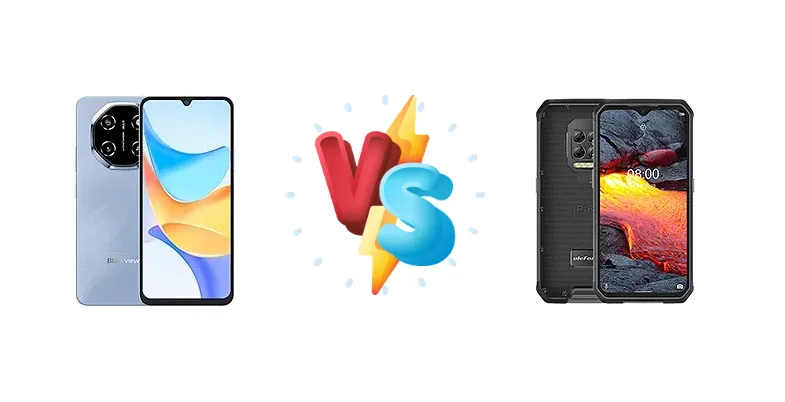
|
🏆 Quick Verdict
For most users, the Blackview Shark 6 emerges as the stronger choice. Its newer Unisoc T8100 chipset, built on a 6nm process, provides a more efficient and potentially faster experience than the Ulefone Armor 9E’s older 12nm Helio P90, coupled with impressive 53:38h battery endurance.
| PHONES | ||
|---|---|---|
| Phone Names | Blackview Shark 6 | Ulefone Armor 9E |
| Network | ||
|---|---|---|
| 2G bands | GSM 850 / 900 / 1800 / 1900 | GSM 850 / 900 / 1800 / 1900 |
| 3G bands | HSDPA 850 / 900 / 1900 / 2100 | HSDPA 850 / 900 / 1700(AWS) / 1900 / 2100 |
| 4G bands | 1, 2, 3, 4, 5, 7, 8, 12, 17, 19, 20, 26, 28, 38, 40, 41, 66 | 1, 2, 3, 4, 5, 7, 8, 12, 13, 17, 18, 19, 20, 25, 26, 28, 34, 38, 39, 40, 41, 66 |
| 5G bands | 1, 2, 3, 5, 7, 8, 20, 26, 28, 38, 40, 41, 66, 77, 78 SA/NSA | - |
| Speed | HSPA, LTE, 5G | HSPA 42.2/11.5 Mbps, LTE Cat12 600/150 Mbps |
| Technology | GSM / HSPA / LTE / 5G | GSM / CDMA / HSPA / EVDO / LTE |
| - | CDMA2000 1xEV-DO | |
| Launch | ||
|---|---|---|
| Announced | 2025, September | 2020, September 08. Released 2020, September 08 |
| Status | Available. Released 2025, September | Discontinued |
| Body | ||
|---|---|---|
| Build | - | Front glass, aluminum back with rubber, aluminum frame |
| Dimensions | 171.1 x 77.7 x 8.5 mm (6.74 x 3.06 x 0.33 in) | 168.2 x 82 x 15 mm (6.62 x 3.23 x 0.59 in) |
| SIM | Nano-SIM + Nano-SIM | Nano-SIM + Nano-SIM |
| Weight | 210.5 g (7.44 oz) | 324 g (11.43 oz) |
| - | IP68/IP69K dust/water resistant (up to 1.5m for 30 min) Drop-to-concrete resistance from up to 1.2m MIL-STD-810G compliant | |
| Display | ||
|---|---|---|
| Protection | Mohs level 7 | Scratch-resistant glass, oleophobic coating |
| Resolution | 720 x 1640 pixels (~260 ppi density) | 1080 x 2340 pixels, 19.5:9 ratio (~409 ppi density) |
| Size | 6.88 inches, 112.4 cm2 (~84.6% screen-to-body ratio) | 6.3 inches, 97.4 cm2 (~70.6% screen-to-body ratio) |
| Type | IPS LCD, 120Hz, 450 nits | IPS LCD |
| Platform | ||
|---|---|---|
| CPU | Octa-core (4x2.2 GHz Cortex-A76 & 4x2.0 GHz Cortex-A55) | Octa-core (2x2.2 GHz Cortex-A75 & 6x2.0 GHz Cortex-A55) |
| Chipset | Unisoc T8100 (6 nm) | Mediatek MT6779 Helio P90 (12 nm) |
| GPU | Mali-G57 | PowerVR GM9446 |
| OS | Android 15, DokeOS 4.2 | Android 10 |
| Memory | ||
|---|---|---|
| Card slot | microSDXC (dedicated slot) | microSDXC (uses shared SIM slot) |
| Internal | 128GB 4GB RAM, 128GB 8GB RAM | 128GB 8GB RAM |
| - | UFS 2.1 | |
| Main Camera | ||
|---|---|---|
| Dual | 16 MP, (wide), AF Auxiliary lens | - |
| Features | LED flash, HDR, panorama | Quad-LED flash, HDR, panorama |
| Quad | - | 64 MP, f/1.9, 26mm (wide), 1/1.72", 0.8µm, PDAF 8 MP, f/2.4, 100˚ (ultrawide), 1/4.0", 1.12µm 2 MP (macro) Auxiliary lens |
| Video | 4K@30fps, 1080p@30fps | 4K@30fps, 1080p@30fps |
| Selfie camera | ||
|---|---|---|
| Features | HDR | HDR, panorama |
| Single | 8 MP, (wide) | 8 MP, f/2.2 |
| Video | 1080p@30fps | 1080p@30fps |
| Sound | ||
|---|---|---|
| 3.5mm jack | - | Yes |
| 35mm jack | Yes | Yes |
| Loudspeaker | Yes | Yes |
| Comms | ||
|---|---|---|
| Bluetooth | 5.0, A2DP, LE | 5.0, A2DP, LE |
| NFC | Yes | Yes |
| Positioning | GPS, GLONASS, GALILEO, BDS | GPS, GLONASS, GALILEO, BDS |
| Radio | FM radio | FM radio, RDS, recording |
| USB | USB Type-C | USB Type-C 2.0, OTG, accessory connector |
| WLAN | Wi-Fi 802.11 a/b/g/n/ac, dual-band | Wi-Fi 802.11 a/b/g/n/ac, Wi-Fi Direct |
| Features | ||
|---|---|---|
| Sensors | Fingerprint (side-mounted), accelerometer, proximity | Fingerprint (side-mounted), accelerometer, gyro, proximity, compass, coulombmeter |
| - | Endoscope mount (camera sold separately) | |
| Battery | ||
|---|---|---|
| Charging | 18W wired | 18W wired |
| Type | Li-Po 5000 mAh | Li-Po 6600 mAh |
| Misc | ||
|---|---|---|
| Colors | Phantom Black, Glacier Blue, Mint Green | Black |
| Price | $ 115.99 / £ 159.99 / € 119.99 | About 290 EUR |
| EU LABEL | ||
|---|---|---|
| Battery | 53:38h endurance, 800 cycles | - |
| Energy | Class A | - |
| Free fall | Class C (98 falls) | - |
| Repairability | Class B | - |
Blackview Shark 6
- Superior battery life (53:38h endurance)
- More efficient Unisoc T8100 chipset (6nm)
- Longer battery lifespan (800 charge cycles)
- Lack of detailed display specifications
- Camera details are unknown
Ulefone Armor 9E
- Potentially lower price point
- Cortex-A75 CPU architecture
- Rugged design suitable for harsh environments
- Less efficient Helio P90 chipset (12nm)
- Shorter battery life compared to Shark 6
- Fewer CPU cores dedicated to efficiency
Display Comparison
Neither device provides display specifications in the provided data. However, given their market segment, both likely feature IPS LCD panels optimized for outdoor visibility. The absence of details like refresh rate or resolution suggests a focus on durability and battery life over premium display features. Expect both to prioritize ruggedness over color accuracy or peak brightness.
Camera Comparison
The provided data doesn’t offer camera specifics beyond the chipsets. Given the rugged nature of these phones, camera performance is likely a secondary consideration. Expect both to feature basic camera setups suitable for documenting work or outdoor activities, but not competing with flagship smartphone photography. The absence of details like sensor size or aperture suggests neither phone prioritizes high-end image quality.
Performance
The core difference lies in the chipsets. The Blackview Shark 6’s Unisoc T8100 (6nm) boasts a more modern architecture and fabrication process compared to the Ulefone Armor 9E’s MediaTek Helio P90 (12nm). The 6nm process inherently offers better power efficiency, translating to less heat generation and potentially longer sustained performance. While both are octa-core CPUs, the Shark 6 utilizes Cortex-A76 cores (2.2 GHz) which generally outperform the Armor 9E’s Cortex-A75 cores (2.2 GHz) in single-core tasks. The Armor 9E has 6x A55 cores vs the Shark 6's 4x A55 cores, but the architectural advantage of the A76 cores in the Shark 6 likely outweighs this difference. This means the Shark 6 will likely handle demanding apps and multitasking more smoothly.
Battery Life
The Blackview Shark 6 clearly excels in battery endurance with a reported 53:38h of usage. While both phones offer 18W wired charging, the Shark 6’s more efficient Unisoc T8100 chipset means it will likely reach a full charge faster and maintain that charge for a significantly longer period. The Shark 6 also boasts 800 charge cycles, indicating a longer lifespan for the battery itself, a crucial factor for users who rely on their phones for extended periods.
Buying Guide
Buy the Blackview Shark 6 if you prioritize long-lasting battery life and a more modern chipset for smoother multitasking and app performance. It’s ideal for users who frequently work outdoors, travel, or need a phone that can withstand demanding conditions without needing frequent charging. Buy the Ulefone Armor 9E if you prefer a slightly different CPU architecture (Cortex-A75) and are looking for a potentially lower price point, understanding that you’ll trade some efficiency and potentially performance for it.