
Blackview Shark 6 vs. BV9800 Pro: A Deep Dive into Rugged Smartphone Performance
| Phones Images | |||||
|---|---|---|---|---|---|
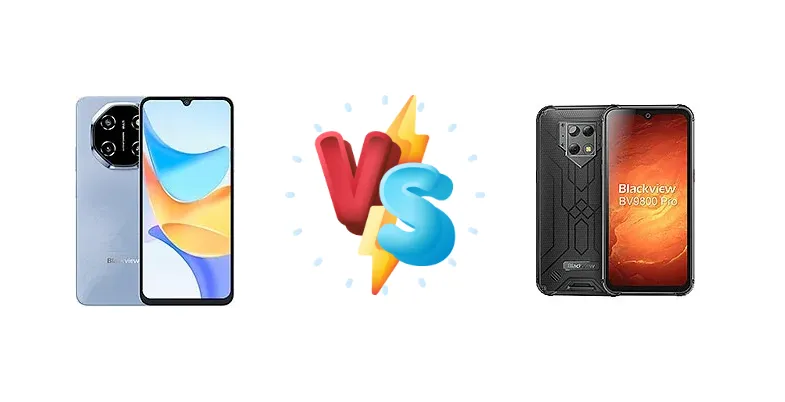
|
🏆 Quick Verdict
For most users, the Blackview Shark 6 emerges as the superior choice. Its newer Unisoc T8100 chipset, built on a 6nm process, offers a noticeable performance advantage and improved efficiency over the BV9800 Pro’s 12nm Helio P70. The Shark 6’s impressive 53:38h battery endurance further solidifies its position as the better all-rounder.
| PHONES | ||
|---|---|---|
| Phone Names | Blackview Shark 6 | Blackview BV9800 Pro |
| Network | ||
|---|---|---|
| 2G bands | GSM 850 / 900 / 1800 / 1900 | GSM 850 / 900 / 1800 / 1900 |
| 3G bands | HSDPA 850 / 900 / 1900 / 2100 | HSDPA 800 / 850 / 900 / 1700(AWS) / 1900 / 2100 |
| 4G bands | 1, 2, 3, 4, 5, 7, 8, 12, 17, 19, 20, 26, 28, 38, 40, 41, 66 | 1, 2, 3, 4, 5, 6, 7, 8, 12, 13, 17, 18, 19, 20, 25, 26, 28, 34, 38, 39, 40, 41, 66 |
| 5G bands | 1, 2, 3, 5, 7, 8, 20, 26, 28, 38, 40, 41, 66, 77, 78 SA/NSA | - |
| Speed | HSPA, LTE, 5G | HSPA, LTE |
| Technology | GSM / HSPA / LTE / 5G | GSM / CDMA / HSPA / CDMA2000 / LTE |
| Launch | ||
|---|---|---|
| Announced | 2025, September | 2019, October 28. Released 2019, November |
| Status | Available. Released 2025, September | Discontinued |
| Body | ||
|---|---|---|
| Dimensions | 171.1 x 77.7 x 8.5 mm (6.74 x 3.06 x 0.33 in) | 168.5 x 81 x 14.8 mm (6.63 x 3.19 x 0.58 in) |
| SIM | Nano-SIM + Nano-SIM | Nano-SIM + Nano-SIM |
| Weight | 210.5 g (7.44 oz) | 322 g (11.36 oz) |
| Display | ||
|---|---|---|
| Protection | Mohs level 7 | - |
| Resolution | 720 x 1640 pixels (~260 ppi density) | 1080 x 2340 pixels, 19.5:9 ratio (~409 ppi density) |
| Size | 6.88 inches, 112.4 cm2 (~84.6% screen-to-body ratio) | 6.3 inches, 97.4 cm2 (~71.4% screen-to-body ratio) |
| Type | IPS LCD, 120Hz, 450 nits | IPS LCD |
| Platform | ||
|---|---|---|
| CPU | Octa-core (4x2.2 GHz Cortex-A76 & 4x2.0 GHz Cortex-A55) | Octa-core (4x2.1 GHz Cortex-A73 & 4x2.0 GHz Cortex-A53) |
| Chipset | Unisoc T8100 (6 nm) | Mediatek MT6771V/CT Helio P70 (12 nm) |
| GPU | Mali-G57 | Mali-G72 MP3 |
| OS | Android 15, DokeOS 4.2 | Android 9.0 (Pie) |
| Memory | ||
|---|---|---|
| Card slot | microSDXC (dedicated slot) | microSDXC |
| Internal | 128GB 4GB RAM, 128GB 8GB RAM | 128GB 6GB RAM |
| Main Camera | ||
|---|---|---|
| Dual | 16 MP, (wide), AF Auxiliary lens | - |
| Features | LED flash, HDR, panorama | Thermal imaging, LED flash |
| Triple | - | 48 MP, (wide), PDAF 5 MP, thermal assisted camera FLIR thermal camera (Lepton module) |
| Video | 4K@30fps, 1080p@30fps | 1080p@30fps |
| Selfie camera | ||
|---|---|---|
| Features | HDR | - |
| Single | 8 MP, (wide) | 16 MP, f/2.0, (wide) |
| Video | 1080p@30fps | 1080p@30fps |
| Sound | ||
|---|---|---|
| 35mm jack | Yes | Yes |
| Loudspeaker | Yes | Yes |
| Comms | ||
|---|---|---|
| Bluetooth | 5.0, A2DP, LE | 4.1, A2DP |
| NFC | Yes | Yes |
| Positioning | GPS, GLONASS, GALILEO, BDS | GPS, GLONASS, GALILEO |
| Radio | FM radio | FM radio |
| USB | USB Type-C | USB Type-C 2.0, OTG |
| WLAN | Wi-Fi 802.11 a/b/g/n/ac, dual-band | Wi-Fi 802.11 a/b/g/n/ac |
| Features | ||
|---|---|---|
| Sensors | Fingerprint (side-mounted), accelerometer, proximity | Fingerprint (side-mounted), accelerometer, gyro, proximity, compass, barometer |
| Battery | ||
|---|---|---|
| Charging | 18W wired | 18W wired |
| Type | Li-Po 5000 mAh | 6580 mAh |
| Misc | ||
|---|---|---|
| Colors | Phantom Black, Glacier Blue, Mint Green | Black, Orange |
| Price | $ 115.99 / £ 159.99 / € 119.99 | About 340 EUR |
| EU LABEL | ||
|---|---|---|
| Battery | 53:38h endurance, 800 cycles | - |
| Energy | Class A | - |
| Free fall | Class C (98 falls) | - |
| Repairability | Class B | - |
Blackview Shark 6
- Superior chipset performance with Unisoc T8100
- Exceptional battery life (53:38h endurance)
- Likely more modern display technology
- Ruggedness level not explicitly stated (may be less than BV9800 Pro)
- Camera specifications unknown
Blackview BV9800 Pro
- Proven ruggedness and durability (Blackview’s reputation)
- Potentially lower price point due to age
- Reliable performance for basic tasks
- Older and less efficient MediaTek Helio P70 chipset
- Shorter battery life compared to Shark 6
- Likely outdated display technology
Display Comparison
Neither device’s display specifications are provided, so a direct comparison is limited. However, given the BV9800 Pro’s age, it likely utilizes an older LCD panel. The Shark 6, being a more recent model, may benefit from improved color accuracy and viewing angles. The absence of details like refresh rate or resolution makes a definitive statement impossible, but the Shark 6 likely offers a more modern visual experience.
Camera Comparison
Without detailed camera specifications, a comprehensive comparison is challenging. However, the market trend suggests the Shark 6 likely benefits from more advanced image processing algorithms. The BV9800 Pro, being an older model, may struggle in low-light conditions. The presence of a 2MP macro camera on either device is likely a marketing gimmick, offering limited practical benefit due to the small sensor size. Focus should be on the main sensor’s capabilities, which are currently unknown.
Performance
The core difference lies in the chipsets. The Blackview Shark 6’s Unisoc T8100 (6nm) is a significant upgrade over the BV9800 Pro’s MediaTek Helio P70 (12nm). The 6nm fabrication process allows for greater transistor density and improved power efficiency, translating to better performance and reduced heat generation. While both are octa-core CPUs, the Shark 6’s Cortex-A76 cores (2.2 GHz) are architecturally superior to the BV9800 Pro’s Cortex-A73 cores (2.1 GHz), offering a performance boost in CPU-intensive tasks. This means faster app loading times and smoother multitasking on the Shark 6.
Battery Life
The Blackview Shark 6 boasts an impressive 53:38h endurance, a testament to the efficiency of the Unisoc T8100 chipset and optimized software. Both devices share the same 18W wired charging, meaning charge times will be comparable. However, the Shark 6’s superior battery life means you’ll need to charge it less frequently. The 800 charge cycles rating for the Shark 6 also suggests a longer lifespan before significant battery degradation.
Buying Guide
Buy the Blackview Shark 6 if you need a rugged phone that can handle demanding tasks like gaming and multitasking, and prioritize long battery life. It’s ideal for outdoor workers, adventurers, or anyone who frequently finds themselves in challenging environments. Buy the Blackview BV9800 Pro if you prioritize maximum physical durability and are on a tighter budget, accepting a performance trade-off. It’s a solid option for those needing a reliable, extremely tough phone for basic communication and essential apps.