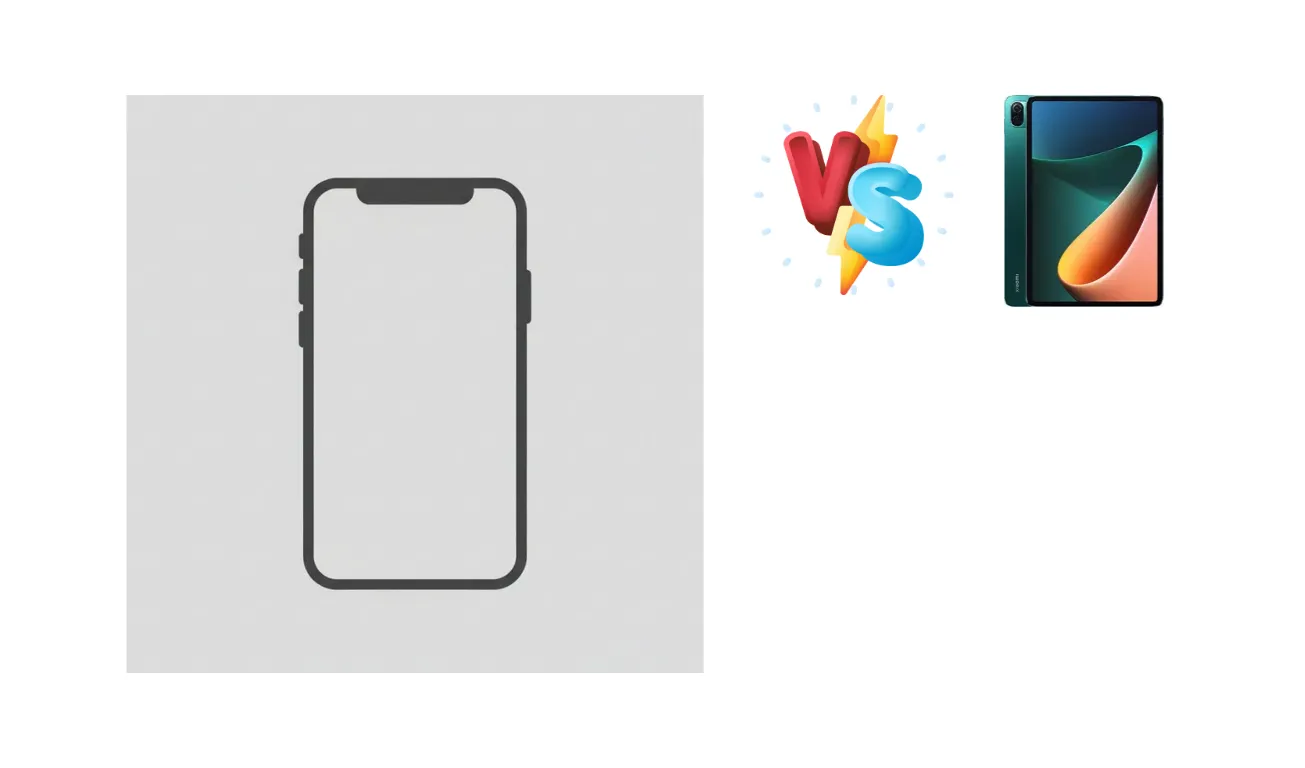
The tablet market offers a wide range of options, but finding the right balance of features and price can be tricky. Today, we're pitting the budget-friendly Blackview Oscal Pad 13 against the more established Xiaomi Pad 5 to see which one comes out on top. Let's dive in!
🏆 Quick Verdict
The Xiaomi Pad 5 is the clear winner, offering significantly better performance thanks to its Snapdragon 860 chipset and a brighter, more vibrant display. While the Oscal Pad 13 is a budget option, the Xiaomi Pad 5 provides a much smoother and more enjoyable user experience for a reasonable price increase.
| Network |
|---|
| 2G bands | GSM 850 / 900 / 1800 / 1900 - SIM 1 & SIM 2 | N/A |
| 3G bands | HSDPA 900 / 2100 | N/A |
| 4G bands | 1, 3, 7, 8, 20, 40 | - |
| EDGE | - | N/A |
| GPRS | - | N/A |
| Speed | HSPA, LTE | - |
| Technology | GSM / HSPA / LTE | No cellular connectivity |
| Launch |
|---|
| Announced | 2023, April 12 | 2021, August 10 |
| Status | Available. Released 2023, April 17 | Available. Released 2021, August 10 |
| Body |
|---|
| Build | - | Glass front, aluminum frame, plastic back |
| Dimensions | 239.2 x 158 x 7.6 mm (9.42 x 6.22 x 0.30 in) | 254.7 x 166.3 x 6.9 mm (10.03 x 6.55 x 0.27 in) |
| SIM | Hybrid Dual SIM (Nano-SIM, dual stand-by) | No |
| Weight | 435 g (15.34 oz) | 511 g (1.13 lb) |
| | - | Stylus support (magnetic) |
| Display |
|---|
| Resolution | 1200 x 1920 pixels, 16:10 ratio (~224 ppi density) | 1600 x 2560 pixels, 16:10 ratio (~274 ppi density) |
| Size | 10.1 inches, 295.8 cm2 (~78.3% screen-to-body ratio) | 11.0 inches, 350.9 cm2 (~82.8% screen-to-body ratio) |
| Type | IPS LCD | IPS LCD, 1B colors, 120Hz, HDR10, Dolby Vision |
| Platform |
|---|
| CPU | Octa-core (2x1.6 GHz Cortex-A75 & 6x1.6 GHz Cortex-A55) | Octa-core (1x2.96 GHz Kryo 485 Gold & 3x2.42 GHz Kryo 485 Gold & 4x1.78 GHz Kryo 485 Silver) |
| Chipset | Unisoc T606 (12 nm) | Qualcomm Snapdragon 860 (7 nm) |
| GPU | Mali-G57 MP1 | Adreno 640 |
| OS | Android 12, Doke-OS 3.0 | Android 11, upgradable to Android 13, MIUI 14 |
| Memory |
|---|
| Card slot | microSDXC (uses shared SIM slot) | No |
| Internal | 256GB 8GB RAM | 128GB 6GB RAM, 256GB 6GB RAM |
| | - | UFS 3.1 |
| Main Camera |
|---|
| Features | LED flash | Dual-LED flash, HDR, panorama |
| Single | 13 MP | 13 MP, f/2.0 |
| Video | 1080p@30fps | 4K@30fps, 1080p@30fps |
| Selfie camera |
|---|
| Single | 8 MP, 1/4", 1.12µm | 8 MP, f/2.0 |
| Video | Yes | 1080p@30fps |
| Sound |
|---|
| 3.5mm jack | No | No |
| 35mm jack | - | No |
| Loudspeaker | Yes, with dual speakers | Yes, with stereo speakers (4 speakers) |
| | - | 24-bit/192kHz audio |
| Comms |
|---|
| Bluetooth | 5.0, A2DP, LE | 5.0, A2DP, LE |
| NFC | No | No |
| Positioning | GPS, GLONASS, GALILEO, BDS | No |
| Radio | FM radio | No |
| USB | USB Type-C, OTG | USB Type-C |
| WLAN | Wi-Fi 802.11 a/b/g/n/ac, dual-band | Wi-Fi 802.11 a/b/g/n/ac, dual-band, Wi-Fi Direct |
| Features |
|---|
| Sensors | Unspecified | Accelerometer, gyro, proximity, compass |
| Battery |
|---|
| Charging | - | 33W wired, PD3.0 |
| Type | Li-Ion 7680 mAh, non-removable | Li-Po 8720 mAh |
| Misc |
|---|
| Colors | Glacier Blue, Space Grey | Cosmic Gray, Pearl White, Green |
| Models | - | 21051182G, 21051182C |
| Price | About 130 EUR | About 350 EUR |
| Tests |
|---|
| Display | - |
Contrast ratio: 1271:1 (nominal) |
| Loudspeaker | - |
-24.4 LUFS (Very good)
|
| Performance | - |
AnTuTu: 473819 (v8), 555079 (v9)
GeekBench: 2583 (v5.1)
GFXBench: 24fps (ES 3.1 onscreen) |
Blackview Oscal Pad 13
- Very affordable
- Decent battery life
- Large display for the price
- Underpowered chipset
- Dim display
- Slow charging
- Lower build quality
Xiaomi Pad 5
- Powerful Snapdragon 860 chipset
- Bright and vibrant display
- Fast charging (33W)
- 120Hz refresh rate
- Good build quality
- More expensive than Oscal Pad 13
- Camera quality is average
Display Comparison
The Xiaomi Pad 5 boasts a superior 11-inch LCD display with a 1271:1 contrast ratio and a measured 478 nits of brightness, making it much easier to view in various lighting conditions. The Oscal Pad 13's display, while adequate, lacks the same vibrancy and brightness. The Xiaomi Pad 5 also supports a higher refresh rate (120Hz) for smoother scrolling and animations.
Camera Comparison
While neither tablet excels in camera quality, the Xiaomi Pad 5 generally offers slightly better image quality due to its more capable hardware. Both cameras are primarily for video calls and casual snapshots, not serious photography.
Performance
Here's where the Xiaomi Pad 5 truly shines. Its Snapdragon 860 chipset is significantly more powerful than the Unisoc T606 in the Oscal Pad 13. Expect noticeably faster app loading times, smoother multitasking, and better gaming performance on the Xiaomi Pad 5. The Oscal Pad 13 can handle basic tasks, but struggles with more demanding applications.
Battery Life
The Xiaomi Pad 5 has a larger battery capacity (8720 mAh) and supports 33W fast charging (PD3.0), allowing for quicker top-ups. The Oscal Pad 13's battery life is decent, but charging is slower. Expect roughly similar real-world battery life depending on usage.
Buying Guide
The Blackview Oscal Pad 13 is ideal for users on a very tight budget who primarily need a tablet for basic tasks like browsing, reading, and light media consumption. The Xiaomi Pad 5 is perfect for students, casual gamers, and anyone who wants a responsive and feature-rich tablet experience without breaking the bank.
Frequently Asked Questions
❓ Is the Blackview Oscal Pad 13 good for gaming?
The Oscal Pad 13 is not ideal for demanding games. It can handle some lighter titles, but performance will be limited due to its weaker chipset.
❓ Does the Xiaomi Pad 5 support a stylus?
Yes, the Xiaomi Pad 5 supports a stylus (sold separately), making it a good option for note-taking and drawing.