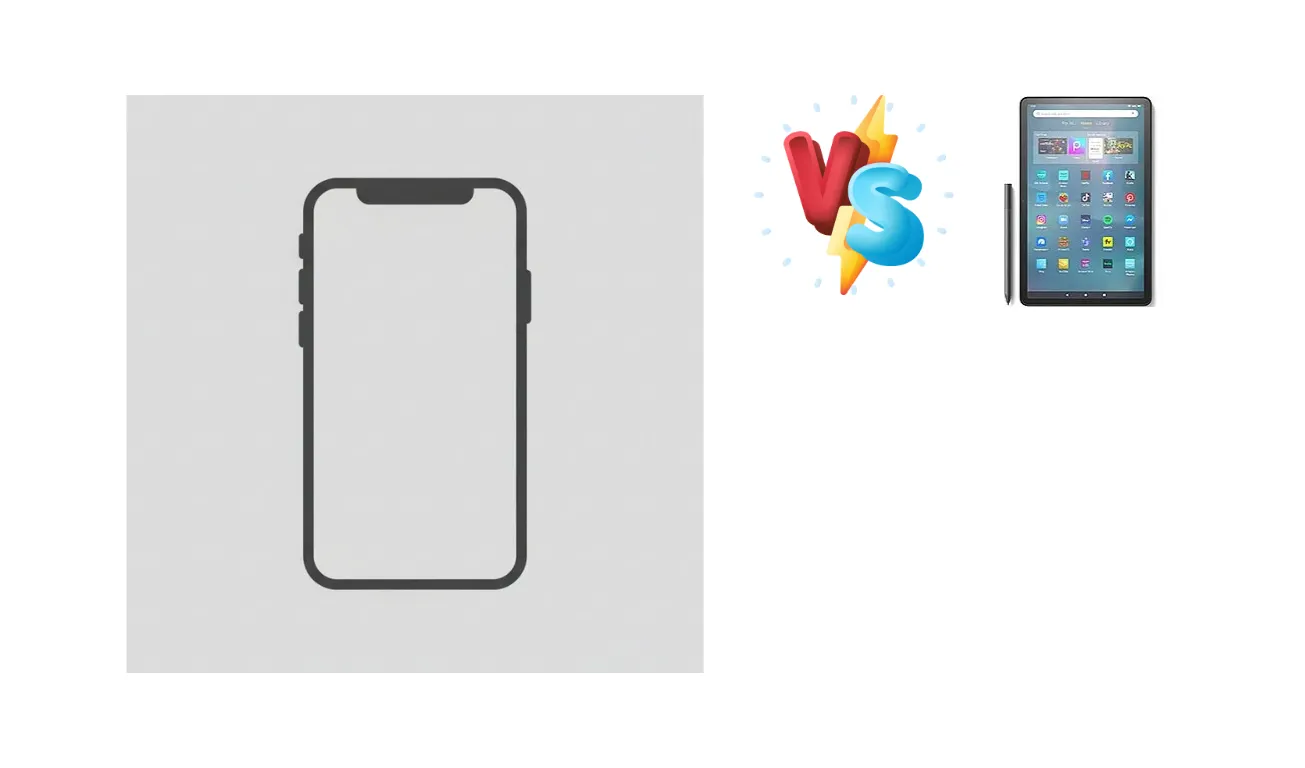
The tablet market offers a wide range of options, but finding the right balance between performance and price can be challenging. The Blackview Oscal Pad 13 and Amazon Fire Max 11 both aim to deliver an affordable tablet experience, but they take different approaches. The Oscal Pad 13 focuses on a more standard Android experience with a Unisoc chipset, while the Fire Max 11 leverages MediaTek and Amazon’s Fire OS ecosystem. This comparison will dissect their key differences to help you determine which tablet best suits your needs.
🏆 Quick Verdict
For users prioritizing raw performance and a standard Android experience, the Amazon Fire Max 11 is the better choice. Its Mediatek MT8188J chipset, featuring Cortex-A78 cores, provides a noticeable performance uplift over the Oscal Pad 13’s Unisoc T606. However, the Fire Max 11’s 15W charging is slower, and its software is heavily customized.
| Network |
|---|
| 2G bands | GSM 850 / 900 / 1800 / 1900 - SIM 1 & SIM 2 | N/A |
| 3G bands | HSDPA 900 / 2100 | - |
| 4G bands | 1, 3, 7, 8, 20, 40 | - |
| EDGE | - | No |
| GPRS | - | No |
| Speed | HSPA, LTE | - |
| Technology | GSM / HSPA / LTE | No cellular connectivity |
| Launch |
|---|
| Announced | 2023, April 12 | 2023, May 23 |
| Status | Available. Released 2023, April 17 | Available. Released 2023, May 23 |
| Body |
|---|
| Dimensions | 239.2 x 158 x 7.6 mm (9.42 x 6.22 x 0.30 in) | 259.1 x 163.7 x 7.5 mm (10.20 x 6.44 x 0.30 in) |
| SIM | Hybrid Dual SIM (Nano-SIM, dual stand-by) | No |
| Weight | 435 g (15.34 oz) | 490 g (1.08 lb) |
| Display |
|---|
| Resolution | 1200 x 1920 pixels, 16:10 ratio (~224 ppi density) | 2000 x 1200 pixels, 5:3 ratio (~212 ppi density) |
| Size | 10.1 inches, 295.8 cm2 (~78.3% screen-to-body ratio) | 11.0 inches, 344.4 cm2 (~81.2% screen-to-body ratio) |
| Type | IPS LCD | IPS LCD |
| Platform |
|---|
| CPU | Octa-core (2x1.6 GHz Cortex-A75 & 6x1.6 GHz Cortex-A55) | Octa-core (2x2.2 GHz Cortex-A78 & 6x2.0 GHz Cortex-A55) |
| Chipset | Unisoc T606 (12 nm) | Mediatek MT8188J |
| GPU | Mali-G57 MP1 | Mali-G57 MC2 |
| OS | Android 12, Doke-OS 3.0 | Android 11, Fire OS 8 |
| Memory |
|---|
| Card slot | microSDXC (uses shared SIM slot) | microSDXC (dedicated slot) |
| Internal | 256GB 8GB RAM | 64GB 4GB RAM, 128GB 4GB RAM |
| Main Camera |
|---|
| Features | LED flash | - |
| Single | 13 MP | 8 MP, AF |
| Video | 1080p@30fps | 1080p |
| Selfie camera |
|---|
| Single | 8 MP, 1/4", 1.12µm | 8 MP |
| Video | Yes | 1080p |
| Sound |
|---|
| 3.5mm jack | No | - |
| 35mm jack | - | No |
| Loudspeaker | Yes, with dual speakers | Yes, with stereo speakers |
| Comms |
|---|
| Bluetooth | 5.0, A2DP, LE | 5.3, A2DP, LE |
| NFC | No | No |
| Positioning | GPS, GLONASS, GALILEO, BDS | No |
| Radio | FM radio | No |
| USB | USB Type-C, OTG | USB Type-C 2.0, OTG, magnetic accessory connector |
| WLAN | Wi-Fi 802.11 a/b/g/n/ac, dual-band | Wi-Fi 802.11 a/b/g/n/ac/6, dual-band |
| Features |
|---|
| Sensors | Unspecified | Fingerprint (side-mounted), accelerometer, proximity (accessories only) |
| Battery |
|---|
| Charging | - | 15W wired |
| Type | Li-Ion 7680 mAh, non-removable | Li-Ion |
| Misc |
|---|
| Colors | Glacier Blue, Space Grey | Gray |
| Models | - | KFSNWI |
| Price | About 130 EUR | About 270 EUR |
Blackview Oscal Pad 13
- Potentially faster charging (if higher wattage than Fire Max 11)
- Clean Android experience
- Likely more affordable
- Less powerful Unisoc T606 chipset
- Potentially lower display quality
- Unknown battery capacity
Amazon Fire Max 11
- More powerful Mediatek MT8188J chipset with Cortex-A78 cores
- Optimized for Amazon ecosystem
- Potentially better display quality
- Slower 15W charging
- Fire OS customization (may not appeal to all users)
- Unknown battery capacity
Display Comparison
Neither device’s display specifications are provided, so a direct comparison is limited. However, given the price points, both likely utilize IPS LCD panels. The Fire Max 11, being a newer device, *may* benefit from slightly improved color accuracy and viewing angles. The absence of information regarding refresh rates suggests both are likely capped at 60Hz. Bezels are expected to be moderate on both, prioritizing affordability over an edge-to-edge design.
Camera Comparison
Without detailed camera specifications, a meaningful comparison is difficult. Both tablets likely feature modest camera setups geared towards casual use. It’s reasonable to assume both will include a primary rear camera and a front-facing camera for video calls. Given the market segment, image quality will likely be similar, with both struggling in low-light conditions. The absence of information suggests neither device prioritizes camera performance.
Performance
The core difference lies in the chipsets. The Amazon Fire Max 11’s Mediatek MT8188J boasts 2x2.2 GHz Cortex-A78 cores alongside 6x2.0 GHz Cortex-A55 cores, representing a significant architectural advantage over the Blackview Oscal Pad 13’s Unisoc T606 (2x1.6 GHz Cortex-A75 & 6x1.6 GHz Cortex-A55). The Cortex-A78 cores are demonstrably more powerful than the A75, translating to faster app loading times, smoother multitasking, and improved gaming performance. While both are octa-core CPUs, the Mediatek chipset’s superior core design provides a clear performance edge. The Oscal Pad 13 will be adequate for basic tasks, but the Fire Max 11 will handle more demanding applications with greater ease.
Battery Life
Battery capacity is not specified for either device. However, the Amazon Fire Max 11 includes 15W wired charging, while the Oscal Pad 13’s charging speed is unknown. 15W is relatively slow by modern standards, suggesting a longer charge time for the Fire Max 11. If the Oscal Pad 13 supports faster charging, it could offset a potentially smaller battery capacity, offering quicker top-ups. Without knowing the battery sizes, it’s difficult to definitively say which device offers better battery life, but the Fire Max 11’s slower charging is a disadvantage.
Buying Guide
Buy the Blackview Oscal Pad 13 if you need a tablet with a clean Android experience and prioritize value. It’s ideal for basic tasks like web browsing, reading, and light productivity. Buy the Amazon Fire Max 11 if you prefer a tablet optimized for media consumption within the Amazon ecosystem, and you value the performance boost offered by its more powerful processor, even with the trade-off of Fire OS.
Frequently Asked Questions
❓ Will the Mediatek MT8188J in the Fire Max 11 overheat during extended gaming sessions?
While the MT8188J is a capable chipset, its thermal performance will depend on the Fire Max 11’s cooling solution. Given the tablet’s price point, it likely utilizes passive cooling. Expect some throttling during prolonged, demanding gaming, but it shouldn’t reach critically high temperatures. The Unisoc T606 in the Oscal Pad 13 will likely throttle sooner due to its less efficient architecture.
❓ How much does Amazon’s Fire OS limit customization on the Fire Max 11 compared to standard Android?
Fire OS is heavily customized and deeply integrated with Amazon’s services. Customization options are significantly limited compared to standard Android. Users have less control over the home screen, default apps, and system settings. Sideloading apps is possible, but requires extra steps. The Oscal Pad 13, running a more standard Android version, offers a far more open and customizable experience.
❓ Is the performance difference between the Unisoc T606 and Mediatek MT8188J noticeable for everyday tasks like browsing and video streaming?
Yes, the performance difference is noticeable. While both chips can handle basic tasks, the Mediatek MT8188J’s Cortex-A78 cores provide a smoother and more responsive experience, especially when multitasking or loading complex web pages. Video streaming will be acceptable on both, but the Fire Max 11 will exhibit less lag and stuttering.