
Blackview N6000 vs Ulefone Power Armor 16 Pro: A Detailed Comparison
| Phones Images | |||||
|---|---|---|---|---|---|
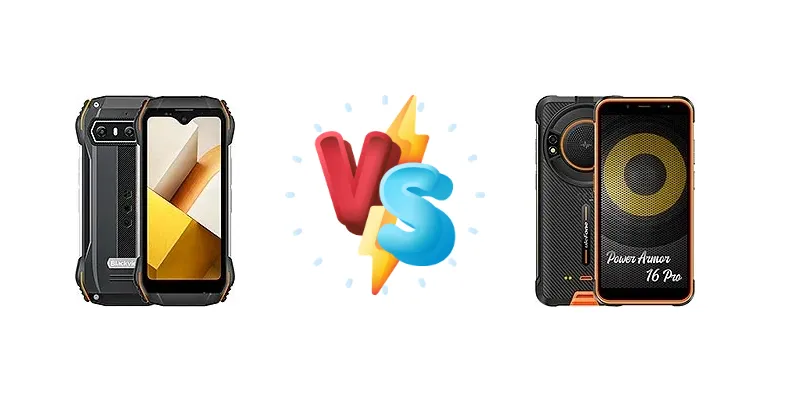
|
🏆 Quick Verdict
For the average user seeking a rugged phone capable of handling demanding tasks, the Blackview N6000 is the clear winner. Its Mediatek Helio G99 chipset provides a substantial performance advantage over the Ulefone Power Armor 16 Pro’s Helio G25, making it better suited for gaming and multitasking. While both offer 18W charging, the N6000’s superior processing power justifies its likely price premium.
| PHONES | ||
|---|---|---|
| Phone Names | Blackview N6000 | Ulefone Power Armor 16 Pro |
| Network | ||
|---|---|---|
| 2G bands | GSM 850 / 900 / 1800 / 1900 | GSM 850 / 900 / 1800 / 1900 |
| 3G bands | HSDPA 850 / 900 / 1700(AWS) / 1900 / 2100 | HSDPA 800 / 850 / 900 / 1700(AWS) / 1900 / 2100 |
| 4G bands | 1, 2, 3, 4, 5, 7, 8, 12, 13, 17, 18, 19, 20, 25, 26, 28, 38, 40, 41, 66 | 1, 2, 3, 4, 5, 7, 8, 12, 13, 17, 18, 19, 20, 25, 26, 28, 66 |
| Speed | HSPA, LTE | HSPA, LTE |
| Technology | GSM / HSPA / LTE | GSM / HSPA / LTE |
| - | eMMC 5.1 | |
| Launch | ||
|---|---|---|
| Announced | 2023, July 19 | 2022, September 16 |
| Status | Available. Released 2023, July 24 | Available. Released 2022, September 16 |
| Body | ||
|---|---|---|
| Dimensions | 133 x 65.3 x 18.4 mm (5.24 x 2.57 x 0.72 in) | 173.4 x 83.4 x 18.3 mm (6.83 x 3.28 x 0.72 in) |
| SIM | Nano-SIM + Nano-SIM | Nano-SIM + Nano-SIM |
| Weight | 208 g (7.34 oz) | 405 g (14.29 oz) |
| - | IP68/IP69K dust/water resistant (up to 1.5m for 30 min) Drop-to-concrete resistance from up to 1.5m MIL-STD-810G compliant Flashlight with a dedicated button Accessory connector (ulefone endoscope, microscope) | |
| Display | ||
|---|---|---|
| Protection | Corning Gorilla Glass 5 | - |
| Resolution | 540 x 1200 pixels, 20:9 ratio (~306 ppi density) | 720 x 1440 pixels, 18:9 ratio (~271 ppi density) |
| Size | 4.3 inches, 44.6 cm2 (~51.4% screen-to-body ratio) | 5.93 inches, 90.7 cm2 (~62.8% screen-to-body ratio) |
| Type | IPS LCD, 450 nits | IPS LCD |
| Platform | ||
|---|---|---|
| CPU | Octa-core (2x2.2 GHz Cortex-A76 & 6x2.0 GHz Cortex-A55) | Octa-core (4x2.0 GHz Cortex-A53 & 4x1.5 GHz Cortex-A53) |
| Chipset | Mediatek Helio G99 (6 nm) | Mediatek MT6762G Helio G25 (12 nm) |
| GPU | Mali-G57 MC2 | PowerVR GE8320 |
| OS | Android 13, DokeOS 3.1 | Android 12 |
| Memory | ||
|---|---|---|
| Card slot | No | microSDXC (dedicated slot) |
| Internal | 256GB 8GB RAM | 64GB 4GB RAM |
| Main Camera | ||
|---|---|---|
| Dual | 48 MP, (wide), 1/2.25", PDAF other unspecified camera | 16 MP, f/1.8, (wide), 1.12µm, PDAF 2 MP (macro) |
| Features | LED flash, HDR, panorama | LED flash, HDR, panorama |
| Single | - | 8 MP, f/2.0, (wide), 1.12µm |
| Video | 1440p@30fps, 1080p@30fps | 1080p@30fps |
| Selfie camera | ||
|---|---|---|
| Features | HDR | - |
| Single | 16 MP, (wide), 1/3" | 8 MP, f/2.0, (wide), 1.12µm |
| Video | 1080p | 1080p@30fps |
| Sound | ||
|---|---|---|
| 3.5mm jack | - | Yes |
| 35mm jack | No | Yes |
| Loudspeaker | Yes | Yes (122-decibel) |
| Comms | ||
|---|---|---|
| Bluetooth | 5.2, A2DP, LE | 5.0, A2DP, LE |
| NFC | Yes | Yes |
| Positioning | GPS, GLONASS, GALILEO, BDS | GPS, GLONASS, GALILEO, BDS |
| Radio | FM radio | Wireless FM radio, RDS, recording |
| USB | USB Type-C 2.0, OTG | USB Type-C 2.0, OTG, magnetic connector |
| WLAN | Wi-Fi 802.11 a/b/g/n/ac, dual-band | Wi-Fi 802.11 a/b/g/n/ac, dual-band |
| Features | ||
|---|---|---|
| Sensors | Fingerprint (side-mounted), accelerometer, gyro, proximity, compass, barometer | Fingerprint (side-mounted), accelerometer, proximity, compass |
| Battery | ||
|---|---|---|
| Charging | 18W wired 2.5W reverse wired | 18W wired 5W reverse wired |
| Type | 3880 mAh (solid state battery) | Li-Po 9600 mAh |
| Misc | ||
|---|---|---|
| Colors | Black, Orange, Green | Black, Black/Orange |
| Price | About 190 EUR | About 220 EUR |
Blackview N6000
- Significantly faster processor (Helio G99)
- More efficient 6nm process node
- Potentially better camera performance
- Faster reverse wired charging (2.5W vs 5W)
- Likely higher price point
- May have slightly less battery life if battery capacity is lower
Ulefone Power Armor 16 Pro
- More affordable price
- Rugged design for durability
- Acceptable performance for basic tasks
- Decent reverse wired charging (5W)
- Significantly slower processor (Helio G25)
- Less efficient 12nm process node
- Limited gaming and multitasking capabilities
Display Comparison
Neither device’s display specifications are provided, so a direct comparison is limited. However, given the N6000’s focus on performance, it’s reasonable to expect a slightly higher quality panel with potentially better color accuracy and brightness. The Power Armor 16 Pro, being a more budget-oriented device, likely utilizes a simpler display to reduce costs. Bezels are likely comparable, given the rugged design constraints of both phones.
Camera Comparison
Without specific camera sensor details, a detailed comparison is difficult. However, the N6000’s higher overall processing power suggests it will have a more capable image signal processor (ISP), leading to better image quality and faster processing times. It’s likely the N6000 will offer more advanced camera features and potentially better low-light performance. The Power Armor 16 Pro will likely focus on basic image capture, prioritizing functionality over advanced features.
Performance
The core difference lies in the chipsets. The Blackview N6000’s Mediatek Helio G99 (6nm) is a significantly more powerful processor than the Ulefone Power Armor 16 Pro’s Helio G25 (12nm). The G99 features two Cortex-A76 cores clocked at 2.2 GHz, alongside six Cortex-A55 cores at 2.0 GHz, offering a substantial uplift in CPU performance compared to the G25’s four Cortex-A53 cores at 2.0 GHz and another four at 1.5 GHz. The 6nm process node of the G99 also translates to better power efficiency and reduced thermal throttling during sustained workloads. This means the N6000 will handle graphically intensive games and multitasking with greater ease. The G25 is adequate for basic tasks, but will struggle with demanding applications.
Battery Life
Both devices support 18W wired charging and 2.5W/5W reverse wired charging respectively. While the battery capacity isn’t specified, the G99’s superior power efficiency in the N6000 could translate to comparable or even better battery life despite potentially having a similar capacity to the Power Armor 16 Pro. The faster charging speed of the N6000’s reverse wired charging is a minor advantage for topping up accessories.
Buying Guide
Buy the Blackview N6000 if you need a rugged phone that can comfortably handle gaming, streaming, and everyday multitasking without significant lag. It’s ideal for users who prioritize performance and responsiveness. Buy the Ulefone Power Armor 16 Pro if you prefer a basic, durable phone for essential communication and light tasks, and are on a very tight budget. It’s best suited for users who prioritize longevity and don’t require demanding performance.