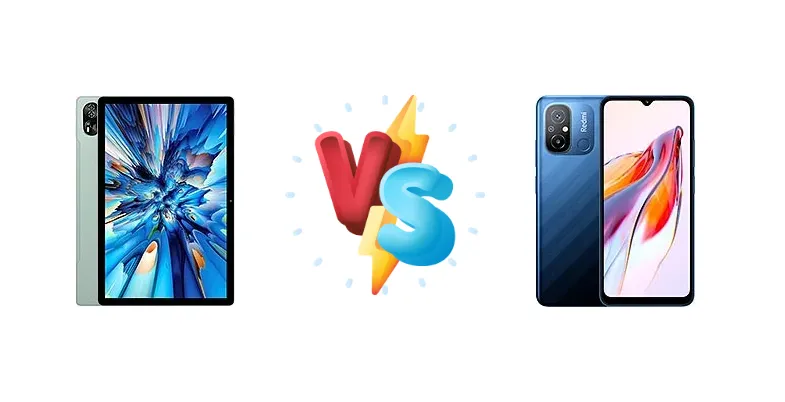
The Blackview Mega 8 and Xiaomi Redmi 12C represent two distinct approaches to the budget smartphone market. The Mega 8 prioritizes exceptional battery endurance, while the Redmi 12C aims for a balance of performance and affordability, leaning towards light gaming. This comparison dissects their core components to determine which device best suits your needs.
🏆 Quick Verdict
For users prioritizing longevity and minimizing charging frequency, the Blackview Mega 8 is the clear winner thanks to its massive 114-hour endurance rating. However, the Xiaomi Redmi 12C offers a slightly more responsive experience for casual gaming and everyday tasks due to its Helio G85 chipset.
| Network |
|---|
| 2G bands | GSM 850 / 900 / 1800 / 1900 | GSM 850 / 900 / 1800 / 1900 |
| 3G bands | HSDPA 900 / 2100 | HSDPA 850 / 900 / 2100 |
| 4G bands | 1, 3, 7, 8, 19, 20, 28, 40, 41 | 1, 3, 5, 7, 8, 20, 28, 38, 40, 41 - International |
| Speed | HSPA, LTE | HSPA, LTE |
| Technology | GSM / HSPA / LTE | GSM / CDMA / HSPA / EVDO / LTE |
| | - | CDMA2000 1xEV-DO |
| Launch |
|---|
| Announced | 2025, April | 2022, December 31 |
| Status | Available. Released 2025, May | Available. Released 2023, January 01 |
| Body |
|---|
| Dimensions | 302 x 197.5 x 7.9 mm (11.89 x 7.78 x 0.31 in) | 168.8 x 76.4 x 8.8 mm (6.65 x 3.01 x 0.35 in) |
| SIM | Nano-SIM + Nano-SIM | Nano-SIM + Nano-SIM |
| Weight | 736 g (1.62 lb) | 192 g (6.77 oz) |
| Display |
|---|
| Protection | Mohs level 4 | - |
| Resolution | 1200 x 1920 pixels, 16:10 ratio (~174 ppi density) | 720 x 1650 pixels (~268 ppi density) |
| Size | 13.0 inches, 490.0 cm2 (~82.2% screen-to-body ratio) | 6.71 inches, 106.5 cm2 (~82.6% screen-to-body ratio) |
| Type | IPS LCD | IPS LCD, 500 nits (typ) |
| Platform |
|---|
| CPU | Octa-core (2x2.2 GHz Cortex-A75 & 6x1.8 GHz Cortex-A55) | Octa-core (2x2.0 GHz Cortex-A75 & 6x1.8 GHz Cortex-A55) |
| Chipset | Unisoc T620 (12 nm) | Mediatek MT6769Z Helio G85 (12 nm) |
| GPU | Mali-G57 | Mali-G52 MC2 |
| OS | Android 15, DokeOS_P 4.1 | Android 12, MIUI 13 |
| Memory |
|---|
| Card slot | microSDXC (uses shared SIM slot) | microSDXC (dedicated slot) |
| Internal | 256GB 12GB RAM, 512GB 12GB RAM | 32GB 2GB RAM, 32GB 3GB RAM, 32GB 4GB RAM, 64GB 3GB RAM, 64GB 4GB RAM, 128GB 3GB RAM, 128GB 4GB RAM, 128GB 6GB RAM |
| | - | eMMC 5.1 |
| Main Camera |
|---|
| Dual | - | 50 MP, (wide), PDAF
0.08 MP (depth) |
| Features | LED flash, HDR | LED flash, HDR |
| Single | 50 MP | 50 MP, f/1.8, (wide), 1/2.76", PDAF
Auxiliary lens |
| Video | 1080p@30fps | 1080p@30fps |
| Selfie camera |
|---|
| Features | HDR | - |
| Single | 13 MP | 5 MP, f/2.2, (wide) |
| Video | 1080p@30fps | 1080p@30fps |
| Sound |
|---|
| 3.5mm jack | - | Yes |
| 35mm jack | Yes | Yes |
| Loudspeaker | Yes, with stereo speakers (4 speakers) | Yes |
| Comms |
|---|
| Bluetooth | 5.0, A2DP, LE | 5.1, A2DP, LE |
| NFC | No | Yes (market/region dependent) |
| Positioning | GPS, GLONASS, GALILEO, BDS | GPS, GLONASS, BDS, GALILEO |
| Radio | No | FM radio |
| USB | USB Type-C, OTG | microUSB 2.0 |
| WLAN | Wi-Fi 802.11 a/b/g/n/ac, dual-band | Wi-Fi 802.11 a/b/g/n/ac, dual-band, Wi-Fi Direct |
| Features |
|---|
| Sensors | Accelerometer, proximity (accessories only) | Fingerprint (rear-mounted), accelerometer |
| | - | Virtual proximity sensing |
| Battery |
|---|
| Charging | 18W wired | 10W wired |
| Type | Li-Ion 11000 mAh | Li-Po 5000 mAh |
| Misc |
|---|
| Colors | Space Grey, Twilight Blue, Lagoon Green | Graphite Gray, Ocean Blue, Mint Green, Lavender Purple |
| Models | - | 22120RN86G, 22120RN86I, 22126RN91Y, 2212ARNC4L |
| Price | - | £ 132.99 / € 107.41 |
| SAR | - | 1.08 W/kg (head) 0.64 W/kg (body) |
| SAR EU | - | 0.98 W/kg (head) 0.99 W/kg (body) |
| EU LABEL |
|---|
| Battery | 114:00h endurance, 1000 cycles | - |
| Energy | Class F | - |
| Free fall | Class D (52 falls) | - |
| Repairability | Class B | - |
Blackview Mega 8
- Exceptional battery life (114h endurance)
- Faster 18W charging
- Potentially longer battery lifespan (1000 cycles)
- Potentially less responsive for gaming
- Unisoc chipset may have limited software support
Xiaomi Redmi 12C
- Slightly better gaming performance (Helio G85)
- More established brand recognition (Xiaomi)
- Potentially wider software support
- Significantly shorter battery life
- Slower 10W charging
Display Comparison
Neither device boasts a standout display. Both utilize 12nm chipsets, suggesting similar power draw and therefore similar display capabilities. While specific display specs are missing, the focus here is on the core components. Expect basic LCD panels with 720p+ resolution on both, prioritizing affordability over visual fidelity. Bezels are likely comparable, given the price points.
Camera Comparison
Without detailed camera specifications, a direct comparison is difficult. Both phones likely feature a primary camera paired with depth or macro sensors. Given the market segment, image quality will be adequate for social media sharing but shouldn't be expected to compete with higher-end devices. The absence of OIS on either device suggests reliance on software stabilization, which may struggle in low-light conditions. The 2MP macro sensors commonly found on these devices offer limited practical benefit.
Performance
The core difference lies in the chipsets. The Xiaomi Redmi 12C’s MediaTek Helio G85 (2x2.0 GHz Cortex-A75 & 6x1.8 GHz Cortex-A55) offers a slight CPU clock speed advantage over the Blackview Mega 8’s Unisoc T620 (2x2.2 GHz Cortex-A75 & 6x1.8 GHz Cortex-A55). However, the Unisoc T620’s higher peak clock speed on its prime cores *could* translate to quicker response in single-threaded tasks. Both utilize the same Cortex-A55 efficiency cores, meaning multi-core performance will be relatively close. The Helio G85’s integrated GPU is likely more capable for gaming, but the T620’s efficiency could lead to better sustained performance under load due to potentially better thermal management.
Battery Life
This is where the Blackview Mega 8 truly shines. Its advertised 114-hour endurance is a significant advantage over what the Redmi 12C can likely achieve. While the Redmi 12C’s 10W charging is slower than the Mega 8’s 18W, the difference in charging speed is less critical given the Mega 8’s exceptional battery life. The Mega 8’s 1000 charge cycles claim suggests a longer lifespan for the battery itself, a crucial consideration for long-term ownership.
Buying Guide
Buy the Blackview Mega 8 if you need a phone that can reliably last for days on a single charge, making it ideal for travelers, field workers, or anyone who dislikes frequent charging. Buy the Xiaomi Redmi 12C if you prefer a more responsive experience for basic gaming and social media, and are willing to compromise on battery life for a slightly smoother user interface.
Frequently Asked Questions
❓ Is the Unisoc T620 chipset in the Blackview Mega 8 sufficient for everyday tasks like browsing and social media?
Yes, the Unisoc T620 is perfectly capable of handling everyday tasks. While not a powerhouse, its octa-core architecture and Cortex-A75 cores provide enough processing power for smooth browsing, social media, and basic app usage. The focus of this device is endurance, not raw performance.
❓ Will the Redmi 12C struggle with demanding games like PUBG or Call of Duty?
The Redmi 12C’s Helio G85 is a gaming-focused chipset, but it’s still a budget option. You’ll likely be able to play PUBG and Call of Duty, but you may need to lower graphics settings to achieve a playable frame rate. Expect some stuttering and potential overheating during extended gaming sessions.
❓ How long will it take to fully charge the Blackview Mega 8 with the 18W charger?
While a precise 0-100% charge time isn't available, the 18W charging should be significantly faster than the Redmi 12C’s 10W charging. Expect a full charge to take around 2.5 to 3.5 hours, depending on usage during charging.
❓ Does the Blackview Mega 8's battery health degrade quickly over time?
Blackview claims the battery supports 1000 charge cycles, suggesting a longer lifespan than many competitors. This indicates the battery is designed to retain a significant portion of its capacity even after extended use.