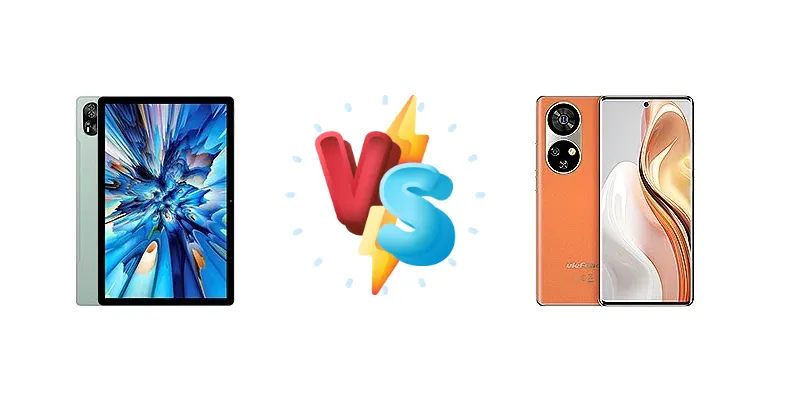
The Blackview Mega 8 and Ulefone Note 17 Pro represent two distinct approaches to the budget smartphone market. The Mega 8 prioritizes extreme battery longevity, while the Note 17 Pro focuses on a more efficient chipset and faster charging. This comparison dissects their key specifications to determine which device best suits your priorities.
🏆 Quick Verdict
For users prioritizing absolute battery life above all else, the Blackview Mega 8 is the clear winner, boasting over double the endurance of the Ulefone Note 17 Pro. However, the Note 17 Pro’s more modern and efficient Helio G99 chipset, coupled with 33W charging, makes it a compelling choice for those seeking a balance between performance and convenience.
| Network |
|---|
| 2G bands | GSM 850 / 900 / 1800 / 1900 | GSM 850 / 900 / 1800 / 1900 |
| 3G bands | HSDPA 900 / 2100 | HSDPA 850 / 900 / 1700(AWS) / 1900 / 2100 |
| 4G bands | 1, 3, 7, 8, 19, 20, 28, 40, 41 | 1, 2, 3, 4, 5, 7, 8, 12, 13, 17, 18, 19, 20, 28, 34, 38, 39, 40, 41, 66 |
| Speed | HSPA, LTE | HSPA, LTE |
| Technology | GSM / HSPA / LTE | GSM / CDMA / HSPA / LTE |
| Launch |
|---|
| Announced | 2025, April | 2024, January 25 |
| Status | Available. Released 2025, May | Available. Released 2024, January |
| Body |
|---|
| Dimensions | 302 x 197.5 x 7.9 mm (11.89 x 7.78 x 0.31 in) | 163.8 x 74.2 x 9 mm (6.45 x 2.92 x 0.35 in) |
| SIM | Nano-SIM + Nano-SIM | Nano-SIM + Nano-SIM |
| Weight | 736 g (1.62 lb) | 197.8 g (6.98 oz) |
| Display |
|---|
| Protection | Mohs level 4 | Corning Gorilla Glass 5, Mohs level 4 |
| Resolution | 1200 x 1920 pixels, 16:10 ratio (~174 ppi density) | 1080 x 2400 pixels, 20:9 ratio (~388 ppi density) |
| Size | 13.0 inches, 490.0 cm2 (~82.2% screen-to-body ratio) | 6.78 inches, 111.0 cm2 (~91.3% screen-to-body ratio) |
| Type | IPS LCD | AMOLED, 120Hz, 500 nits (HBM) |
| Platform |
|---|
| CPU | Octa-core (2x2.2 GHz Cortex-A75 & 6x1.8 GHz Cortex-A55) | Octa-core (2x2.2 GHz Cortex-A76 & 6x2.0 GHz Cortex-A55) |
| Chipset | Unisoc T620 (12 nm) | Mediatek Helio G99 (6 nm) |
| GPU | Mali-G57 | Mali-G57 MC2 |
| OS | Android 15, DokeOS_P 4.1 | Android 13 |
| Memory |
|---|
| Card slot | microSDXC (uses shared SIM slot) | No |
| Internal | 256GB 12GB RAM, 512GB 12GB RAM | 256GB 12GB RAM |
| Main Camera |
|---|
| Dual | - | 108 MP, f/1.9, (wide), 0.7µm, PDAF
5 MP (macro) |
| Features | LED flash, HDR | LED flash, HDR, panorama |
| Single | 50 MP | - |
| Video | 1080p@30fps | 1440p@30fps, 1080p@30fps |
| Selfie camera |
|---|
| Features | HDR | - |
| Single | 13 MP | 32 MP, f/2.5, (wide), 0.7µm |
| Video | 1080p@30fps | 1080p@30fps |
| Sound |
|---|
| 35mm jack | Yes | Yes |
| Loudspeaker | Yes, with stereo speakers (4 speakers) | Yes |
| Comms |
|---|
| Bluetooth | 5.0, A2DP, LE | 5.2, A2DP, LE |
| Infrared port | - | Yes |
| NFC | No | Yes |
| Positioning | GPS, GLONASS, GALILEO, BDS | GPS, GLONASS, GALILEO, BDS |
| Radio | No | Stereo FM radio, RDS, recording |
| USB | USB Type-C, OTG | USB Type-C 2.0 |
| WLAN | Wi-Fi 802.11 a/b/g/n/ac, dual-band | Wi-Fi 802.11 a/b/g/n/ac, dual-band |
| Features |
|---|
| Sensors | Accelerometer, proximity (accessories only) | Fingerprint (under display, optical), accelerometer, gyro, proximity, compass |
| Battery |
|---|
| Charging | 18W wired | 33W wired |
| Type | Li-Ion 11000 mAh | Li-Po 5050 mAh |
| Misc |
|---|
| Colors | Space Grey, Twilight Blue, Lagoon Green | Velvet Black, Pearl White, Amber Orange |
| Price | - | About 300 EUR |
| EU LABEL |
|---|
| Battery | 114:00h endurance, 1000 cycles | 47:33h endurance, 1000 cycles |
| Energy | Class F | Class B |
| Free fall | Class D (52 falls) | Class C (112 falls) |
| Repairability | Class B | Class B |
Blackview Mega 8
- Unrivaled battery life – lasts for days on a single charge.
- 1000 charge cycles suggest excellent long-term battery health.
- Potentially lower price point due to older chipset.
- Less powerful chipset compared to the competition.
- Slower 18W charging.
- Likely less refined software experience.
Ulefone Note 17 Pro
- More efficient and powerful Mediatek Helio G99 chipset.
- Faster 33W wired charging.
- Potentially better camera performance due to improved image processing.
- Significantly shorter battery life compared to the Blackview Mega 8.
- May be slightly more expensive.
- Battery capacity is unknown.
Display Comparison
Display specifications are not provided, so a direct comparison is limited. However, given the price points, both devices likely utilize LCD panels. The Ulefone Note 17 Pro, benefiting from a newer design cycle, may incorporate a slightly higher peak brightness and potentially better color accuracy. Bezels are likely comparable, focusing on maximizing screen real estate within the budget constraints.
Camera Comparison
Without detailed camera specifications, a comprehensive comparison is difficult. However, it’s reasonable to assume both phones feature multi-camera setups geared towards general photography. The Ulefone Note 17 Pro’s more powerful chipset likely enables more sophisticated image processing algorithms, potentially resulting in better dynamic range and low-light performance. The presence of a newer chipset also suggests a higher probability of supporting features like 1080p video recording at 60fps. We can expect both phones to include lower-resolution auxiliary cameras (e.g., 2MP macro) that offer limited practical benefit.
Performance
The Ulefone Note 17 Pro’s Mediatek Helio G99, fabricated on a 6nm process, offers a significant architectural advantage over the Blackview Mega 8’s Unisoc T620 (12nm). While both CPUs feature a 2x2.2 GHz core configuration, the G99 utilizes Cortex-A76 cores, which are demonstrably more efficient and powerful than the T620’s Cortex-A75 cores. This translates to snappier app loading, smoother multitasking, and improved gaming performance on the Ulefone. The 6nm process also contributes to better thermal management, reducing the likelihood of throttling during sustained workloads.
Battery Life
The Blackview Mega 8’s defining feature is its exceptional battery endurance – a claimed 114 hours. This is more than double the Ulefone Note 17 Pro’s 47.33 hours. While the Note 17 Pro’s battery capacity isn’t specified, the endurance difference suggests a significantly smaller battery. However, the Note 17 Pro compensates with 33W wired charging, allowing for a much faster 0-100% charge time compared to the Mega 8’s 18W charging. The Mega 8’s 1000 charge cycles promise long-term battery health, but the Ulefone’s faster charging offers greater convenience for daily use.
Buying Guide
Buy the Blackview Mega 8 if you need a phone that can reliably last for days on a single charge, even with moderate use, and aren't concerned with the latest processing speeds. Buy the Ulefone Note 17 Pro if you prefer a more responsive user experience, faster charging, and a more modern chipset, even if it means charging your phone more frequently.
Frequently Asked Questions
❓ Will the Unisoc T620 in the Blackview Mega 8 struggle with demanding games like PUBG Mobile?
The Unisoc T620 is a capable chipset for casual gaming, but it will likely require reduced graphics settings and frame rates to achieve a smooth experience in demanding titles like PUBG Mobile. The Ulefone Note 17 Pro’s Helio G99 offers a noticeable performance boost and will handle these games more comfortably.
❓ How long does it *actually* take to fully charge the Ulefone Note 17 Pro with the 33W charger?
While 33W charging is faster than 18W, the actual charge time depends on the battery capacity (which is not specified). However, we can estimate a full charge from 0-100% will likely take between 60-90 minutes, significantly faster than the Blackview Mega 8.
❓ Is the difference in battery endurance between the two phones noticeable in everyday use?
Absolutely. The Blackview Mega 8’s 114-hour endurance means you could potentially go 2-3 days without needing to charge, even with moderate usage. The Ulefone Note 17 Pro will likely require daily charging, especially with heavier use.
❓ Does the Ulefone Note 17 Pro's Helio G99 chipset generate excessive heat during prolonged gaming sessions?
The Helio G99, built on a 6nm process, is relatively efficient and incorporates thermal management features. While some heat generation is inevitable during gaming, it's unlikely to cause significant throttling or discomfort during typical gaming sessions. The 6nm process is more efficient than the 12nm process used in the Blackview Mega 8.