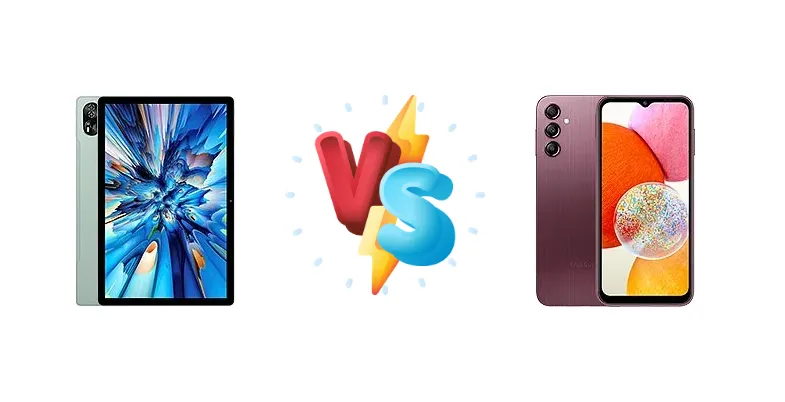
The Blackview Mega 8 and Samsung Galaxy A14 occupy a similar price bracket, targeting budget-conscious consumers. However, they diverge significantly in their core philosophies: the Mega 8 prioritizes exceptional battery endurance, while the Galaxy A14 aims for a more balanced experience with Samsung’s established software and brand recognition. This comparison dissects these differences to determine which phone best suits your needs.
🏆 Quick Verdict
For users prioritizing battery life above all else, the Blackview Mega 8 is the clear winner, boasting an astounding 114-hour endurance. However, the Samsung Galaxy A14 offers a more refined software experience and potentially better performance depending on the variant, making it a strong contender for those seeking a well-rounded device.
| Network |
|---|
| 2G bands | GSM 850 / 900 / 1800 / 1900 | GSM 850 / 900 / 1800 / 1900 |
| 3G bands | HSDPA 900 / 2100 | HSDPA 850 / 900 / 2100 |
| 4G bands | 1, 3, 7, 8, 19, 20, 28, 40, 41 | 1, 3, 5, 7, 8, 20, 28, 38, 40, 41 |
| Speed | HSPA, LTE | HSPA, LTE |
| Technology | GSM / HSPA / LTE | GSM / HSPA / LTE |
| Launch |
|---|
| Announced | 2025, April | 2023, February 28 |
| Status | Available. Released 2025, May | Available. Released 2023, March 27 |
| Body |
|---|
| Build | - | Glass front, plastic back, plastic frame |
| Dimensions | 302 x 197.5 x 7.9 mm (11.89 x 7.78 x 0.31 in) | 167.7 x 78 x 9.1 mm (6.60 x 3.07 x 0.36 in) |
| SIM | Nano-SIM + Nano-SIM | · Nano-SIM· Nano-SIM + Nano-SIM |
| Weight | 736 g (1.62 lb) | 201 g (7.09 oz) |
| Display |
|---|
| Protection | Mohs level 4 | - |
| Resolution | 1200 x 1920 pixels, 16:10 ratio (~174 ppi density) | 1080 x 2408 pixels, 20:9 ratio (~400 ppi density) |
| Size | 13.0 inches, 490.0 cm2 (~82.2% screen-to-body ratio) | 6.6 inches, 104.9 cm2 (~80.2% screen-to-body ratio) |
| Type | IPS LCD | PLS LCD |
| Platform |
|---|
| CPU | Octa-core (2x2.2 GHz Cortex-A75 & 6x1.8 GHz Cortex-A55) | Octa-core (2x2.0 GHz Cortex-A75 & 6x1.8 GHz Cortex-A55) - Version AOcta-core (4x2.0 GHz Cortex-A55 & 4x2.0 GHz Cortex-A55) - Version B |
| Chipset | Unisoc T620 (12 nm) | Mediatek MT6769 Helio G80 (12 nm) - Version AExynos 850 (8 nm) - Version B |
| GPU | Mali-G57 | Mali-G52 MC2 |
| OS | Android 15, DokeOS_P 4.1 | Android 13, upgradable to Android 15, One UI 7 |
| Memory |
|---|
| Card slot | microSDXC (uses shared SIM slot) | microSDXC (dedicated slot) |
| Internal | 256GB 12GB RAM, 512GB 12GB RAM | 64GB 4GB RAM, 128GB 4GB RAM, 128GB 6GB RAM |
| Main Camera |
|---|
| Features | LED flash, HDR | LED flash, panorama, HDR |
| Single | 50 MP | 13 MP, f/2.0, (wide) |
| Triple | - | 50 MP, f/1.8, 26mm (wide), 1/2.75", 0.64µm, PDAF
5 MP, f/2.2, 17mm (ultrawide), 1/5.0", 1.12µm
2 MP (macro) |
| Video | 1080p@30fps | 1080p@30fps |
| Selfie camera |
|---|
| Features | HDR | - |
| Single | 13 MP | 13 MP, f/2.0, 26mm (wide), 1/3.1", 1.12µm |
| Video | 1080p@30fps | 1080p@30fps |
| Sound |
|---|
| 3.5mm jack | - | Yes |
| 35mm jack | Yes | Yes |
| Loudspeaker | Yes, with stereo speakers (4 speakers) | Yes |
| Comms |
|---|
| Bluetooth | 5.0, A2DP, LE | 5.1 or 5.3, A2DP, LE |
| NFC | No | Yes (market/region dependent) |
| Positioning | GPS, GLONASS, GALILEO, BDS | GPS, GALILEO, GLONASS, BDS, QZSS |
| Radio | No | Unspecified |
| USB | USB Type-C, OTG | USB Type-C 2.0 |
| WLAN | Wi-Fi 802.11 a/b/g/n/ac, dual-band | Wi-Fi 802.11 a/b/g/n/ac, dual-band, Wi-Fi Direct |
| Features |
|---|
| Sensors | Accelerometer, proximity (accessories only) | Fingerprint (side-mounted), accelerometer, proximity, compass |
| Battery |
|---|
| Charging | 18W wired | 15W wired |
| Type | Li-Ion 11000 mAh | Li-Po 5000 mAh |
| Misc |
|---|
| Colors | Space Grey, Twilight Blue, Lagoon Green | Black, Dark Red, Silver, Green |
| Models | - | SM-A145F, SM-A145F/DSN, SM-A145M, SM-A145M/DS, SM-A145P, SM-A145R |
| Price | - | € 85.76 / $ 147.60 / £ 79.95 |
| SAR EU | - | 0.46 W/kg (head) 1.37 W/kg (body) |
| EU LABEL |
|---|
| Battery | 114:00h endurance, 1000 cycles | - |
| Energy | Class F | - |
| Free fall | Class D (52 falls) | - |
| Repairability | Class B | - |
Blackview Mega 8
- Unrivaled battery life (114h endurance)
- Potentially longer battery lifespan (1000 charge cycles)
- Decent single-core performance with Unisoc T620
- Software experience may not be as polished as Samsung’s
- Camera performance likely average
Samsung Galaxy A14
- Samsung’s One UI provides a refined software experience
- Exynos 850 version offers potentially better power efficiency
- Wider availability of accessories and support
- Battery life significantly shorter than the Mega 8
- Helio G80 version offers lower performance
Display Comparison
Neither device is expected to deliver a flagship-level display experience. Specifics like panel type (IPS vs. AMOLED) and resolution are missing, but both likely utilize LCD panels given the price point. The focus here is on functionality rather than visual fidelity. Bezels are likely comparable, and color accuracy will be standard for this segment. The absence of high refresh rates on both devices suggests a focus on power conservation.
Camera Comparison
Camera performance is likely to be a secondary consideration for both devices. Details regarding sensor size and image processing are absent. The Galaxy A14 likely benefits from Samsung’s established image processing algorithms, potentially delivering more consistent results. The presence of a 2MP macro camera on both devices is largely a marketing tactic, offering limited practical benefit due to the small sensor size and lack of optical image stabilization (OIS). Focusing on the main sensor’s capabilities is crucial; without further information, it’s difficult to definitively declare a winner.
Performance
The performance landscape is more nuanced. The Blackview Mega 8’s Unisoc T620 (12nm) features a Cortex-A75 prime core configuration, which should provide a decent boost in single-core tasks. The Samsung Galaxy A14 presents two chipset options: the MediaTek Helio G80 (12nm) and the Exynos 850 (8nm). The Exynos 850, built on a smaller 8nm process, theoretically offers better power efficiency and potentially higher sustained performance due to improved thermal management. However, the Helio G80’s Mali-G52 MC2 GPU might offer a slight edge in gaming. The A14’s CPU configuration varies; Version A mirrors the Mega 8’s Cortex-A75/A55 setup, while Version B utilizes only Cortex-A55 cores, indicating a significant performance downgrade. Users should verify which chipset version they are purchasing.
Battery Life
This is where the Blackview Mega 8 truly shines. Its 114-hour endurance rating is exceptional for a smartphone, suggesting a massive battery capacity (likely exceeding 6000mAh). The Samsung Galaxy A14, with its 15W charging, will take longer to fully charge. While the A14’s battery capacity isn’t specified, the slower charging speed combined with a potentially smaller battery suggests it won’t match the Mega 8’s longevity. The Mega 8’s 18W charging, while not fast, is sufficient to replenish the large battery overnight. The 1000 charge cycles claim for the Mega 8 also indicates a focus on long-term battery health.
Buying Guide
Buy the Blackview Mega 8 if you need a phone that can reliably last for days on a single charge, frequently travel, or rely heavily on mobile connectivity without consistent access to power. Buy the Samsung Galaxy A14 if you prefer a familiar Android experience with Samsung’s One UI, value a potentially more responsive application experience (depending on the chipset version), and appreciate a wider ecosystem of accessories and support.
Frequently Asked Questions
❓ Does the Samsung Galaxy A14’s Exynos 850 chip overheat during prolonged gaming sessions?
The Exynos 850 (8nm) is generally known for its decent thermal efficiency. While it may experience some throttling during extended gaming, it’s unlikely to overheat significantly. However, the Helio G80 version may throttle more readily due to its less efficient 12nm process.
❓ Is the 2MP macro camera on either phone actually useful for taking detailed close-up photos?
Unfortunately, the 2MP macro cameras on both the Blackview Mega 8 and Samsung Galaxy A14 are largely marketing features. The small sensor size and lack of autofocus result in images that are often soft, lacking in detail, and generally inferior to photos taken with the main camera.
❓ How long will it take to fully charge the Blackview Mega 8 with the 18W charger?
Given the Mega 8’s large battery capacity (likely over 6000mAh), a full charge from 0% to 100% will likely take between 3-4 hours with the included 18W charger. While not the fastest charging speed, it’s sufficient for overnight charging.
❓ Which version of the Samsung Galaxy A14 (Helio G80 or Exynos 850) should I choose?
If available and the price difference is minimal, the Exynos 850 version is the preferable choice. Its 8nm process offers better power efficiency and potentially higher sustained performance compared to the Helio G80’s 12nm process. However, verify the chipset before purchasing, as availability varies by region.