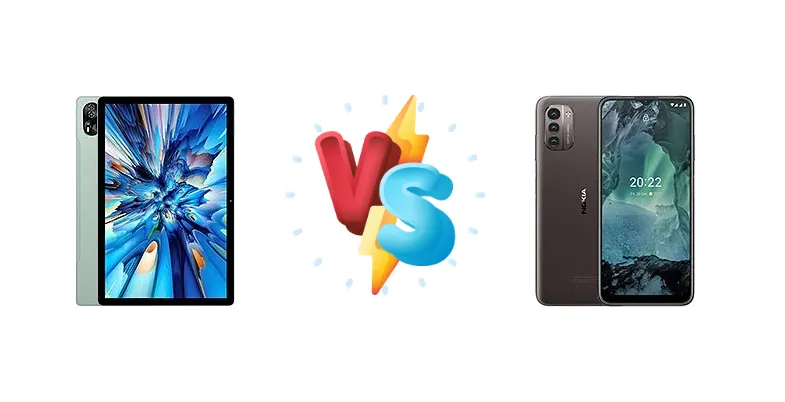
The Blackview Mega 8 and Nokia G21 represent compelling options in the ultra-budget smartphone space, but cater to slightly different priorities. The Nokia G21 emphasizes a more balanced feature set, while the Blackview Mega 8 aggressively targets users prioritizing maximum battery life and longevity. This comparison dissects their key differences to determine which device delivers the best value.
🏆 Quick Verdict
For users prioritizing sheer battery endurance, the Blackview Mega 8 is the clear winner, boasting a remarkable 114-hour endurance rating and a 1000-cycle battery lifespan. While the Nokia G21 offers a respectable 126-hour rating, the Mega 8’s longevity promise and slightly faster CPU give it the edge for power users.
| Network |
|---|
| 2G bands | GSM 850 / 900 / 1800 / 1900 | GSM 850 / 900 / 1800 / 1900 |
| 3G bands | HSDPA 900 / 2100 | HSDPA 850 / 900 / 2100 - International |
| 4G bands | 1, 3, 7, 8, 19, 20, 28, 40, 41 | 1, 3, 5, 7, 8, 20, 28, 38, 40, 41 - International |
| Speed | HSPA, LTE | HSPA 42.2/5.76 Mbps, LTE Cat4 150/50 Mbps |
| Technology | GSM / HSPA / LTE | GSM / HSPA / LTE |
| | - | 1, 2, 3, 4, 5, 7, 8, 12, 17, 28, 40, 66 - LATAM |
| Launch |
|---|
| Announced | 2025, April | 2022, February 14 |
| Status | Available. Released 2025, May | Available. Released 2022, February 15 |
| Body |
|---|
| Build | - | Glass front, plastic frame, plastic back |
| Dimensions | 302 x 197.5 x 7.9 mm (11.89 x 7.78 x 0.31 in) | 164.6 x 75.9 x 8.5 mm (6.48 x 2.99 x 0.33 in) |
| SIM | Nano-SIM + Nano-SIM | · Nano-SIM· Nano-SIM + Nano-SIM |
| Weight | 736 g (1.62 lb) | 190 g (6.70 oz) |
| Display |
|---|
| Protection | Mohs level 4 | - |
| Resolution | 1200 x 1920 pixels, 16:10 ratio (~174 ppi density) | 720 x 1600 pixels, 20:9 ratio (~270 ppi density) |
| Size | 13.0 inches, 490.0 cm2 (~82.2% screen-to-body ratio) | 6.5 inches, 102.0 cm2 (~81.6% screen-to-body ratio) |
| Type | IPS LCD | IPS LCD, 90Hz, 400 nits (typ) |
| Platform |
|---|
| CPU | Octa-core (2x2.2 GHz Cortex-A75 & 6x1.8 GHz Cortex-A55) | Octa-core (2x1.6 GHz Cortex-A75 & 6x1.6 GHz Cortex-A55) |
| Chipset | Unisoc T620 (12 nm) | Unisoc T606 (12 nm) |
| GPU | Mali-G57 | Mali-G57 MP1 |
| OS | Android 15, DokeOS_P 4.1 | Android 11, upgradable to Android 13 |
| Memory |
|---|
| Card slot | microSDXC (uses shared SIM slot) | microSDXC (dedicated slot) |
| Internal | 256GB 12GB RAM, 512GB 12GB RAM | 64GB 3GB RAM, 64GB 4GB RAM, 128GB 4GB RAM, 128GB 6GB RAM |
| | - | eMMC 5.1 |
| Main Camera |
|---|
| Features | LED flash, HDR | LED flash, HDR, panorama |
| Single | 50 MP | 8 MP, f/2.0, (wide) |
| Triple | - | 50 MP, f/1.8, 28mm (wide), 1/2.76", 0.64µm, PDAF
2 MP (macro)
Auxiliary lens |
| Video | 1080p@30fps | 1080p@30fps |
| Selfie camera |
|---|
| Features | HDR | - |
| Single | 13 MP | 8 MP, f/2.0, (wide) |
| Video | 1080p@30fps | 1080p@30fps |
| Sound |
|---|
| 3.5mm jack | - | Yes |
| 35mm jack | Yes | Yes |
| Loudspeaker | Yes, with stereo speakers (4 speakers) | Yes |
| Comms |
|---|
| Bluetooth | 5.0, A2DP, LE | 5.0, A2DP, LE |
| NFC | No | Yes (market/region dependent) |
| Positioning | GPS, GLONASS, GALILEO, BDS | GPS, GLONASS, GALILEO |
| Radio | No | FM radio, RDS |
| USB | USB Type-C, OTG | USB Type-C 2.0, OTG |
| WLAN | Wi-Fi 802.11 a/b/g/n/ac, dual-band | Wi-Fi 802.11 a/b/g/n/ac, dual-band, Wi-Fi Direct |
| Features |
|---|
| Sensors | Accelerometer, proximity (accessories only) | Fingerprint (side-mounted), accelerometer, proximity |
| Battery |
|---|
| Charging | 18W wired | 18W wired, PD3.0 |
| Type | Li-Ion 11000 mAh | Li-Po 5050 mAh |
| Misc |
|---|
| Colors | Space Grey, Twilight Blue, Lagoon Green | Nordic Blue, Dusk |
| Models | - | TA-1418, TA-1477, TA-1415, TA-1405, TA-1404, TA-1412 |
| Price | - | About 90 EUR |
| SAR | - | 1.00 W/kg (head) 1.10 W/kg (body) |
| SAR EU | - | 0.34 W/kg (head) 1.05 W/kg (body) |
| Tests |
|---|
| Battery life | - |
Endurance rating 126h
|
| Camera | - |
Photo / Video |
| Display | - |
Contrast ratio: 1631:1 (nominal) |
| Loudspeaker | - |
-30.7 LUFS (Below average)
|
| Performance | - |
AnTuTu: 171299 (v9)
GeekBench: 1193 (v5.1)
GFXBench: 8.9fps (ES 3.1 onscreen) |
| EU LABEL |
|---|
| Battery | 114:00h endurance, 1000 cycles | - |
| Energy | Class F | - |
| Free fall | Class D (52 falls) | - |
| Repairability | Class B | - |
Blackview Mega 8
- Exceptional 114-hour battery endurance
- 1000-cycle battery lifespan for long-term reliability
- Slightly faster CPU (Unisoc T620) for improved performance
- Display brightness likely lower than Nokia G21
- Camera specifications are unknown, potentially limiting image quality
Nokia G21
- 500 nits peak brightness for better outdoor visibility
- PD3.0 charging compatibility for potentially faster charging
- More established brand reputation (Nokia)
- Lower battery endurance (126 hours) compared to Blackview Mega 8
- Slower CPU (Unisoc T606) for less responsive performance
Display Comparison
Both devices feature similar contrast ratios at 1631:1, suggesting comparable panel quality in terms of black levels. However, the Nokia G21’s measured 500 nits of peak brightness provides a noticeable advantage in direct sunlight, making content more readable outdoors. The Blackview Mega 8’s display specifications are not provided, so we assume a standard brightness level for this price point. Neither device is expected to offer high refresh rates or advanced panel technologies like LTPO.
Camera Comparison
Both phones list 'Photo / Video' capabilities, but lack specific details regarding sensor size, aperture, or image processing. This suggests both devices will offer basic camera functionality suitable for casual snapshots. The absence of details implies neither phone will excel in low-light photography or offer advanced features like optical image stabilization (OIS). The inclusion of a 2MP macro camera on either device is likely a marketing tactic, offering limited practical benefit due to the small sensor size and low resolution.
Performance
The Blackview Mega 8 utilizes the Unisoc T620 chipset, featuring a CPU configuration of 2x2.2 GHz Cortex-A75 and 6x1.8 GHz Cortex-A55 cores. The Nokia G21, conversely, employs the Unisoc T606 with a slightly slower CPU configuration of 2x1.6 GHz Cortex-A75 and 6x1.6 GHz Cortex-A55 cores. This suggests the Mega 8 will offer a modest performance advantage in CPU-intensive tasks. Both chipsets are 12nm, indicating similar power efficiency characteristics, but the higher clock speeds of the T620 translate to quicker application loading and smoother multitasking. RAM configurations are not specified, but both likely utilize LPDDR4X to keep costs down.
Battery Life
The Blackview Mega 8’s standout feature is its exceptional 114-hour endurance rating, coupled with a remarkable 1000-cycle battery lifespan. This indicates the battery will retain a significant portion of its capacity even after years of use. The Nokia G21 offers a respectable 126-hour endurance, but falls short of the Mega 8’s longevity promise. Both devices support 18W wired charging, but the Nokia G21 adds PD3.0 compatibility, potentially allowing for faster charging with compatible chargers. However, the Mega 8’s larger endurance buffer may negate the need for frequent charging, even with a slower charging speed.
Buying Guide
Buy the Blackview Mega 8 if you need a phone that can reliably last for days on a single charge, and you anticipate owning the device for several years. Its 1000-cycle battery is a significant differentiator. Buy the Nokia G21 if you prefer a slightly more refined software experience, benefit from PD3.0 charging compatibility, and value a measured 500 nits of display brightness for outdoor visibility.
Frequently Asked Questions
❓ How does the 1000-cycle battery lifespan of the Blackview Mega 8 translate to real-world use?
A 1000-cycle battery lifespan means the battery can be fully charged and discharged 1000 times with minimal degradation in capacity. This is significantly higher than the typical 500-cycle lifespan of most smartphone batteries, ensuring the Mega 8 will maintain a usable battery capacity for a much longer period, potentially several years of regular use.
❓ Does the Unisoc T606 chipset in the Nokia G21 struggle with demanding applications or multitasking?
The Unisoc T606 is a budget-oriented chipset. While capable of handling basic tasks like web browsing, social media, and light gaming, it may exhibit slowdowns or lag when running multiple demanding applications simultaneously. The Blackview Mega 8’s Unisoc T620 offers a modest performance improvement, making it slightly better suited for multitasking.
❓ Is PD3.0 charging on the Nokia G21 a significant advantage over the Blackview Mega 8’s 18W charging?
PD3.0 allows for potentially faster charging speeds *if* you have a compatible PD3.0 charger. However, the Blackview Mega 8’s exceptional battery endurance means you may not need to charge it as frequently, mitigating the benefit of faster charging. The difference in charging speed will likely be minimal without a dedicated PD3.0 charger.