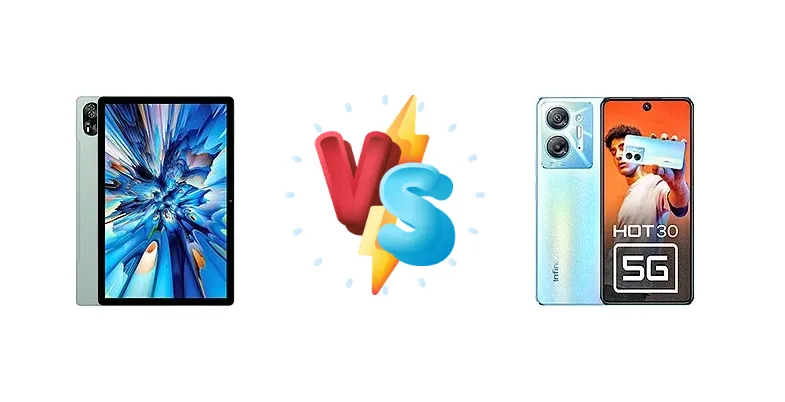
The sub-$200 5G smartphone market is heating up, and the Blackview Mega 8 and Infinix Hot 30 5G are two contenders vying for your attention. The Mega 8 prioritizes exceptional battery endurance, while the Hot 30 5G focuses on a more modern chipset for improved performance. This comparison dissects their strengths and weaknesses to determine which device delivers the best overall value.
🏆 Quick Verdict
For users prioritizing all-day (and multi-day) battery life, the Blackview Mega 8 is the clear winner, boasting an impressive 114-hour endurance. However, the Infinix Hot 30 5G offers a more responsive experience thanks to its Mediatek Dimensity 6020 chipset, making it the better choice for those who value performance over sheer longevity.
| Network |
|---|
| 2G bands | GSM 850 / 900 / 1800 / 1900 | GSM 850 / 900 / 1800 / 1900 |
| 3G bands | HSDPA 900 / 2100 | HSDPA 850 / 900 / 1700(AWS) / 1900 / 2100 |
| 4G bands | 1, 3, 7, 8, 19, 20, 28, 40, 41 | LTE |
| 5G bands | - | 1, 3, 5, 8, 28, 38, 40, 41, 77, 78 SA/NSA |
| Speed | HSPA, LTE | HSPA, LTE, 5G |
| Technology | GSM / HSPA / LTE | GSM / HSPA / LTE / 5G |
| Launch |
|---|
| Announced | 2025, April | 2023, July 14 |
| Status | Available. Released 2025, May | Available. Released 2023, July 18 |
| Body |
|---|
| Build | - | Glass front, plastic frame, plastic back |
| Dimensions | 302 x 197.5 x 7.9 mm (11.89 x 7.78 x 0.31 in) | 168.5 x 76.5 x 9.2 mm (6.63 x 3.01 x 0.36 in) |
| SIM | Nano-SIM + Nano-SIM | Nano-SIM + Nano-SIM |
| Weight | 736 g (1.62 lb) | 215 g (7.58 oz) |
| Display |
|---|
| Protection | Mohs level 4 | - |
| Resolution | 1200 x 1920 pixels, 16:10 ratio (~174 ppi density) | 1080 x 2460 pixels (~396 ppi density) |
| Size | 13.0 inches, 490.0 cm2 (~82.2% screen-to-body ratio) | 6.78 inches, 109.2 cm2 (~84.7% screen-to-body ratio) |
| Type | IPS LCD | IPS LCD, 120Hz, 580 nits (peak) |
| Platform |
|---|
| CPU | Octa-core (2x2.2 GHz Cortex-A75 & 6x1.8 GHz Cortex-A55) | Octa-core (2x2.2 GHz Cortex-A76 & 6x2.0 GHz Cortex-A55) |
| Chipset | Unisoc T620 (12 nm) | Mediatek Dimensity 6020 (7 nm) |
| GPU | Mali-G57 | Mali-G57 MC2 |
| OS | Android 15, DokeOS_P 4.1 | Android 13, XOS 13 |
| Memory |
|---|
| Card slot | microSDXC (uses shared SIM slot) | microSDXC (dedicated slot) |
| Internal | 256GB 12GB RAM, 512GB 12GB RAM | 128GB 4GB RAM, 128GB 8GB RAM |
| Main Camera |
|---|
| Features | LED flash, HDR | Quad-LED flash, HDR, panorama |
| Single | 50 MP | 50 MP, f/1.6, (wide), 1/2.55", AF
Auxiliary lens |
| Video | 1080p@30fps | 1440p@30fps, 1080p@30fps |
| Selfie camera |
|---|
| Features | HDR | Dual-LED flash |
| Single | 13 MP | 8 MP, f/2.0, (wide) |
| Video | 1080p@30fps | 1080p@30fps |
| Sound |
|---|
| 35mm jack | Yes | Yes |
| Loudspeaker | Yes, with stereo speakers (4 speakers) | Yes, with stereo speakers |
| Comms |
|---|
| Bluetooth | 5.0, A2DP, LE | 5.1, A2DP, LE |
| NFC | No | No |
| Positioning | GPS, GLONASS, GALILEO, BDS | GPS, GLONASS, GALILEO, BDS |
| Radio | No | FM radio |
| USB | USB Type-C, OTG | USB Type-C 2.0 |
| WLAN | Wi-Fi 802.11 a/b/g/n/ac, dual-band | Wi-Fi 802.11 a/b/g/n/ac, dual-band |
| Features |
|---|
| Sensors | Accelerometer, proximity (accessories only) | Fingerprint (side-mounted), accelerometer, proximity, compass |
| Battery |
|---|
| Charging | 18W wired | 18W wired |
| Type | Li-Ion 11000 mAh | 5000 mAh |
| Misc |
|---|
| Colors | Space Grey, Twilight Blue, Lagoon Green | Knight Black, Aurora Blue |
| Models | - | X6832 |
| Price | - | About 140 EUR |
| EU LABEL |
|---|
| Battery | 114:00h endurance, 1000 cycles | - |
| Energy | Class F | - |
| Free fall | Class D (52 falls) | - |
| Repairability | Class B | - |
Blackview Mega 8
- Exceptional battery life (114h endurance)
- Potentially lower operating temperatures due to less powerful chipset
- 1000 charge cycles promise long-term battery health
- Older chipset architecture (Unisoc T620)
- Likely slower app loading and multitasking
- Potentially limited gaming performance
Infinix Hot 30 5G
- More modern and efficient chipset (Dimensity 6020)
- Faster application loading and smoother multitasking
- Better gaming performance compared to the Mega 8
- Shorter battery life compared to the Mega 8
- Potentially more susceptible to thermal throttling
- May require more frequent charging
Display Comparison
Neither device boasts a standout display. Both likely utilize IPS LCD panels, common in this price bracket. The focus here isn't on visual fidelity, but rather on functionality. While specific display specs are unavailable, the performance difference will be minimal. Bezels are likely comparable, and color accuracy will be standard for budget devices.
Camera Comparison
Without detailed camera specs, a direct comparison is difficult. However, it's safe to assume both phones feature a primary camera and supporting lenses. Given the price point, image processing will likely prioritize speed over detail. The absence of OIS on either device suggests low-light performance will be limited. The focus should be on the main sensor resolution, which is currently unknown for both devices. Any secondary sensors (like the often-present 2MP macro) are unlikely to significantly impact image quality.
Performance
The core difference lies in the chipsets. The Infinix Hot 30 5G’s Mediatek Dimensity 6020, fabricated on a 7nm process, offers a significant architectural advantage over the Blackview Mega 8’s Unisoc T620 (12nm). The Dimensity 6020 utilizes Cortex-A76 cores, a step up from the A75 cores in the T620, resulting in noticeably faster application loading and smoother multitasking. While both CPUs feature a 2x2.2 GHz configuration for their performance cores, the 7nm process of the Dimensity 6020 translates to better power efficiency and potentially less thermal throttling during sustained loads. This benefits gamers and users running demanding apps.
Battery Life
The Blackview Mega 8’s standout feature is its exceptional battery endurance – a claimed 114 hours. This is achieved through a combination of a large battery capacity (unspecified, but likely 5000-6000mAh) and the relatively power-efficient Unisoc T620 chipset. The Infinix Hot 30 5G, while also likely equipped with a sizable battery, will drain faster due to the more powerful Dimensity 6020. Both phones share the same 18W wired charging, meaning 0-100% times will be comparable, likely exceeding 2 hours. The Mega 8’s longevity is its key advantage, potentially lasting two full days on a single charge for moderate users.
Buying Guide
Buy the Blackview Mega 8 if you need a phone that can reliably last through multiple days of moderate use, and you aren't a demanding mobile gamer. It's ideal for travelers, field workers, or anyone who frequently finds themselves away from a power outlet. Buy the Infinix Hot 30 5G if you prefer a smoother, more responsive user experience, enjoy occasional gaming, and don't mind charging your phone more frequently. It's a better fit for everyday users who want a balance of features and performance.
Frequently Asked Questions
❓ Will the Unisoc T620 in the Blackview Mega 8 struggle with demanding apps like video editing?
Yes, the Unisoc T620 is a budget chipset and will likely exhibit slowdowns and lag when running resource-intensive applications like video editors. It's best suited for basic tasks like browsing, social media, and light gaming.
❓ Does the Mediatek Dimensity 6020 in the Infinix Hot 30 5G support carrier aggregation for faster 5G speeds?
The Dimensity 6020 *does* support carrier aggregation, but the specific bands supported will vary depending on the region and carrier. This feature allows the phone to combine multiple 5G channels for potentially faster download and upload speeds, provided your carrier network supports it.
❓ How long will it take to fully charge both the Blackview Mega 8 and the Infinix Hot 30 5G with the 18W charger?
Expect a full charge to take approximately 2.5 to 3.5 hours for both devices. While both use 18W charging, the larger battery capacity of the Blackview Mega 8 will likely result in a slightly longer charging time.
❓ Is the Blackview Mega 8 a good choice for mobile gaming?
The Blackview Mega 8 is not ideal for serious mobile gaming. The Unisoc T620 chipset will struggle with graphically demanding titles, and you'll likely need to lower graphics settings to achieve playable frame rates. The Infinix Hot 30 5G is the better option for gaming.