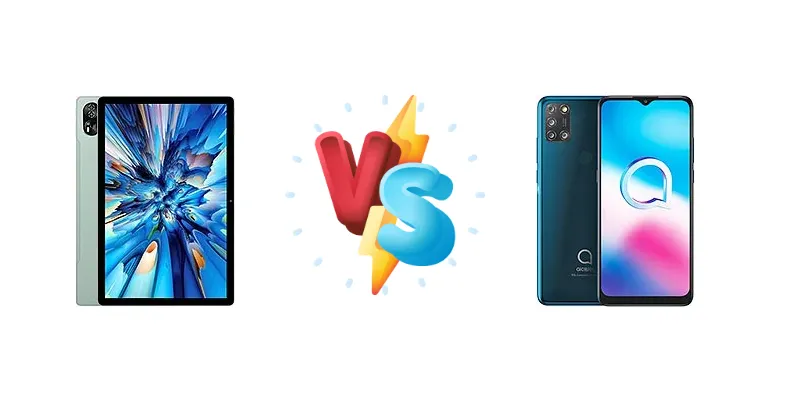
The Blackview Mega 8 and Alcatel 3X (2020) represent opposite ends of the budget smartphone spectrum. The Mega 8 aggressively targets users prioritizing extreme battery life, while the 3X aims for affordability. This comparison dissects their core components to determine which device delivers the best experience for your money.
🏆 Quick Verdict
For the average user needing a phone that lasts for days, the Blackview Mega 8 is the clear winner. Its significantly superior chipset and massive battery endurance outweigh the Alcatel 3X’s lower price. However, if absolute cost is the primary concern, the 3X remains a viable, albeit limited, option.
| Network |
|---|
| 2G bands | GSM 850 / 900 / 1800 / 1900 | GSM 850 / 900 / 1800 / 1900 |
| 3G bands | HSDPA 900 / 2100 | HSDPA 850 / 900 / 1900 / 2100 |
| 4G bands | 1, 3, 7, 8, 19, 20, 28, 40, 41 | 1, 3, 5, 7, 8, 20, 28, 38, 40, 41 |
| Speed | HSPA, LTE | HSPA 42.2/11.5 Mbps, LTE Cat4 150/50 Mbps |
| Technology | GSM / HSPA / LTE | GSM / HSPA / LTE |
| Launch |
|---|
| Announced | 2025, April | 2020, June. Released 2020, June |
| Status | Available. Released 2025, May | Discontinued |
| Body |
|---|
| Build | - | Glass front, plastic back, plastic frame |
| Dimensions | 302 x 197.5 x 7.9 mm (11.89 x 7.78 x 0.31 in) | 165 x 75 x 9.1 mm (6.50 x 2.95 x 0.36 in) |
| SIM | Nano-SIM + Nano-SIM | Nano-SIM + Nano-SIM |
| Weight | 736 g (1.62 lb) | 186 g (6.56 oz) |
| Display |
|---|
| Protection | Mohs level 4 | - |
| Resolution | 1200 x 1920 pixels, 16:10 ratio (~174 ppi density) | 720 x 1600 pixels, 20:9 ratio (~269 ppi density) |
| Size | 13.0 inches, 490.0 cm2 (~82.2% screen-to-body ratio) | 6.52 inches, 102.6 cm2 (~82.9% screen-to-body ratio) |
| Type | IPS LCD | IPS LCD |
| Platform |
|---|
| CPU | Octa-core (2x2.2 GHz Cortex-A75 & 6x1.8 GHz Cortex-A55) | Octa-core 2.0 GHz Cortex-A53 |
| Chipset | Unisoc T620 (12 nm) | Mediatek MT6762 Helio P22 (12 nm) |
| GPU | Mali-G57 | PowerVR GE8320 |
| OS | Android 15, DokeOS_P 4.1 | Android 10 |
| Memory |
|---|
| Card slot | microSDXC (uses shared SIM slot) | microSDXC (uses shared SIM slot) |
| Internal | 256GB 12GB RAM, 512GB 12GB RAM | 64GB 4GB RAM, 128GB 4GB RAM, 128GB 6GB RAM |
| | - | eMMC 5.1 |
| Main Camera |
|---|
| Features | LED flash, HDR | Dual-LED dual-tone flash, HDR, panorama |
| Quad | - | 16 MP, f/1.8, (wide), 1/2.8", 1.12µm, PDAF
5 MP, f/2.2, (ultrawide), 1/5.0", 1.12µm
2 MP (macro)
Auxiliary lens |
| Single | 50 MP | - |
| Video | 1080p@30fps | 1080p@30fps |
| Selfie camera |
|---|
| Features | HDR | - |
| Single | 13 MP | 8 MP, f/2.0, (wide), 1/4.0", 1.12µm |
| Video | 1080p@30fps | 1080p@30fps |
| Sound |
|---|
| 3.5mm jack | - | Yes |
| 35mm jack | Yes | Yes |
| Loudspeaker | Yes, with stereo speakers (4 speakers) | Yes |
| Comms |
|---|
| Bluetooth | 5.0, A2DP, LE | 5.0, A2DP, LE |
| NFC | No | No |
| Positioning | GPS, GLONASS, GALILEO, BDS | GPS |
| Radio | No | FM radio |
| USB | USB Type-C, OTG | microUSB 2.0, OTG |
| WLAN | Wi-Fi 802.11 a/b/g/n/ac, dual-band | Wi-Fi 802.11 b/g/n, Wi-Fi Direct |
| Features |
|---|
| Sensors | Accelerometer, proximity (accessories only) | Fingerprint (rear-mounted), accelerometer, proximity, compass |
| Battery |
|---|
| Charging | 18W wired | 10W wired |
| Type | Li-Ion 11000 mAh | Li-Po 5000 mAh |
| Misc |
|---|
| Colors | Space Grey, Twilight Blue, Lagoon Green | Black, Blue |
| Models | - | 5061U, 5061K_EEA, 5061K, 5061U_EEA, 5061A |
| Price | - | About 170 EUR |
| EU LABEL |
|---|
| Battery | 114:00h endurance, 1000 cycles | - |
| Energy | Class F | - |
| Free fall | Class D (52 falls) | - |
| Repairability | Class B | - |
Blackview Mega 8
- Exceptional battery life (114h endurance)
- More powerful Unisoc T620 chipset
- Faster 18W charging
- Likely basic camera performance
- May be larger and heavier due to large battery
alcatel 3X (2020)
- Lower price point
- Compact and lightweight design (likely)
- Acceptable for basic smartphone tasks
- Significantly weaker performance
- Slow 10W charging
- Limited battery life
Display Comparison
Neither device boasts a standout display. Both utilize 12nm chipsets, suggesting similar power constraints impacting display capabilities. While specific display specs are unavailable for the Alcatel 3X, its market positioning suggests a lower-quality panel compared to what the Mega 8 could potentially support given its processing power. The focus here isn't on visual fidelity, but rather on maximizing battery efficiency, meaning both likely prioritize power-saving display technologies over high brightness or color accuracy.
Camera Comparison
Camera performance is likely a weak point on both devices, given their budget nature. Without detailed sensor information, it’s difficult to make precise comparisons. However, the Alcatel 3X’s inclusion of a 2MP macro lens is largely a marketing gimmick, offering minimal practical benefit. The Mega 8, while likely also featuring basic camera sensors, benefits from the more powerful ISP (Image Signal Processor) within the Unisoc T620, potentially resulting in slightly better image processing and detail capture. Expect both to struggle in low-light conditions.
Performance
The Blackview Mega 8’s Unisoc T620 chipset represents a substantial leap over the Alcatel 3X’s MediaTek Helio P22. The T620’s octa-core configuration, featuring two Cortex-A75 cores clocked at 2.2 GHz alongside six Cortex-A55 cores at 1.8 GHz, provides significantly more processing power than the 3X’s all-Cortex-A53 setup running at 2.0 GHz. The A75 cores in the T620 offer a noticeable performance boost in demanding applications and multitasking, while the 12nm process node on both chips suggests comparable efficiency. This translates to a smoother user experience and better responsiveness on the Mega 8.
Battery Life
This is where the Blackview Mega 8 truly shines. Its advertised 114-hour endurance and 1000 charge cycles are exceptional for a budget device. The 18W wired charging is a welcome addition, though not particularly fast by modern standards. The Alcatel 3X, with its 10W charging, will take considerably longer to replenish its battery. While the exact battery capacity of the 3X is unknown, the Mega 8’s endurance suggests a significantly larger battery, coupled with optimized power management thanks to the more efficient chipset.
Buying Guide
Buy the Blackview Mega 8 if you need a phone that can reliably last through multi-day use, frequently travel without access to charging, or require a more responsive experience for everyday tasks. Buy the Alcatel 3X (2020) if you prioritize the lowest possible upfront cost and only need a phone for basic communication and light usage, accepting compromises in performance and battery life.
Frequently Asked Questions
❓ How does the Unisoc T620 handle multitasking compared to the Helio P22?
The Unisoc T620, with its Cortex-A75 performance cores, handles multitasking significantly better than the Helio P22. The P22’s all-Cortex-A53 architecture struggles with multiple apps running simultaneously, leading to noticeable slowdowns. The Mega 8 will offer a smoother experience when switching between apps or running demanding applications in the background.
❓ Is the 1000 charge cycle claim for the Blackview Mega 8 realistic?
While 1000 charge cycles is an ambitious claim, Blackview’s focus on battery longevity suggests they’ve implemented battery health management features. This doesn’t guarantee the battery will retain 100% capacity after 1000 cycles, but it indicates a commitment to minimizing battery degradation over time, offering a longer usable lifespan than typical budget phones.
❓ Can the Alcatel 3X handle basic mobile games like Candy Crush or Subway Surfers?
Yes, the Alcatel 3X can handle less demanding mobile games like Candy Crush or Subway Surfers, but expect lower frame rates and potential stuttering, especially with multiple background apps running. The Helio P22 is not designed for graphically intensive gaming.
❓ What type of charging port does the Blackview Mega 8 use?
While not explicitly stated, most Blackview devices in this price range utilize a USB-C port. This is a modern standard offering faster data transfer and reversible connectivity, unlike the older Micro-USB found on some budget phones.