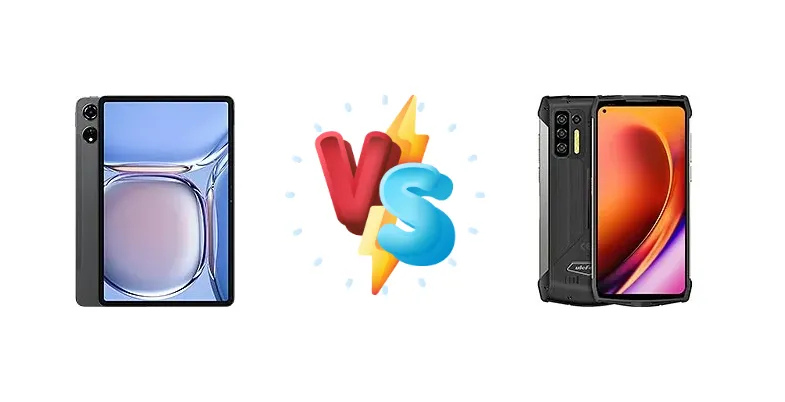
The rugged smartphone market caters to users demanding durability and extended battery life. The Blackview Mega 3 and Ulefone Power Armor 13 both aim to deliver on these fronts, but they take different approaches. The Mega 3 prioritizes raw processing power with a newer chipset, while the Power Armor 13 focuses on convenience with wireless charging and a more established (though older) platform. This comparison will dissect their key differences to determine which device best suits your needs.
🏆 Quick Verdict
For the average user prioritizing sustained performance and future-proofing, the Blackview Mega 3 emerges as the winner. Its Helio G100 chipset, built on a 6nm process, offers a noticeable performance advantage over the Ulefone Power Armor 13’s Helio G95. However, the Power Armor 13’s wireless charging and measured display brightness make it a compelling alternative for those valuing convenience and outdoor visibility.
| Network |
|---|
| 2G bands | GSM 850 / 900 / 1800 / 1900 | GSM 850 / 900 / 1800 / 1900 |
| 3G bands | HSDPA 900 / 2100 | HSDPA 850 / 900 / 1700(AWS) / 1900 / 2100 |
| 4G bands | 1, 3, 7, 8, 19, 20, 28, 40, 41 | 1, 2, 3, 4, 5, 7, 8, 12, 13, 17, 18, 19, 20, 25, 26, 28, 38, 40, 66 |
| Speed | HSPA, LTE | HSPA 42.2/11.5 Mbps, LTE Cat12 600/150 Mbps |
| Technology | GSM / HSPA / LTE | GSM / HSPA / LTE |
| Launch |
|---|
| Announced | 2025, June | 2021, July 22 |
| Status | Available. Released 2025, June 16 | Available. Released 2021, July 26 |
| Body |
|---|
| Dimensions | 278.5 x 180.5 x 7.4 mm (10.96 x 7.11 x 0.29 in) | 183.7 x 85.4 x 20.8 mm (7.23 x 3.36 x 0.82 in) |
| SIM | Nano-SIM + Nano-SIM | Nano-SIM + Nano-SIM |
| Weight | 555 g (1.22 lb) | 492 g (1.08 lb) |
| | - | IP68 dust/water resistant (up to 1.5m for 30 min)
Drop-to-concrete resistance from up to 1.2m
MIL-STD-810G compliant |
| Display |
|---|
| Protection | Mohs level 7 | Corning Gorilla Glass 3 |
| Resolution | 1600 x 2560 pixels, 16:10 ratio (~249 ppi density) | 1080 x 2400 pixels, 20:9 ratio (~386 ppi density) |
| Size | 12.1 inches, 424.5 cm2 (~84.5% screen-to-body ratio) | 6.81 inches, 112.0 cm2 (~71.4% screen-to-body ratio) |
| Type | IPS LCD, 90Hz | IPS LCD |
| Platform |
|---|
| CPU | Octa-core (2x2.2 GHz Cortex-A76 & 6x2.0 GHz Cortex-A55) | Octa-core (2x2.05 GHz Cortex-A76 & 6x2.0 GHz Cortex-A55) |
| Chipset | Mediatek Helio G100 (6 nm) | Mediatek MT6785V/CD Helio G95 (12 nm) |
| GPU | Mali-G57 MC2 | Mali-G76 MC4 |
| OS | Android 15, DokeOS_P 4.1 | Android 11 |
| Memory |
|---|
| Card slot | microSDXC (uses shared SIM slot) | microSDXC (uses shared SIM slot) |
| Internal | 256GB 12GB RAM | 256GB 8GB RAM |
| Main Camera |
|---|
| Features | LED flash | Quad-LED flash, HDR, panorama |
| Penta | - | 48 MP, f/1.8, 26mm (wide), 1/2.0", 0.8µm, PDAF
8 MP, f/2.2, (ultrawide)
2 MP (macro)
Auxiliary lens |
| Single | 50 MP, f/1.8, (wide), 1/2.6", AF | - |
| Video | 1080p@30fps | 4K@30fps, 1080p@30fps |
| Selfie camera |
|---|
| Features | - | HDR, panorama |
| Single | 13 MP, (wide), 1/4" | 16 MP, f/2.2 |
| Video | 1080p@30fps | 1080p@30fps |
| Sound |
|---|
| 3.5mm jack | - | Yes |
| 35mm jack | No | Yes |
| Loudspeaker | Yes, with stereo speakers (4 speakers) | Yes |
| Comms |
|---|
| Bluetooth | 5.0 | 5.0, A2DP, LE |
| NFC | No | Yes |
| Positioning | GPS, GLONASS, GALILEO, BDS | GPS, GLONASS, GALILEO, BDS |
| Radio | FM radio | FM radio, RDS, recording |
| USB | USB Type-C | - |
| WLAN | Wi-Fi 802.11 a/b/g/n/ac | Wi-Fi 802.11 a/b/g/n/ac, dual-band |
| Features |
|---|
| Sensors | Accelerometer | Fingerprint (side-mounted), accelerometer, gyro, proximity, compass, baroceptor, coulombmeter |
| | - | Infrared distance measure (error range: 1~20m, ±10mm; 20~40m, ±25mm) |
| Battery |
|---|
| Charging | 33W wired | 33W wired
15W wireless
5W reverse wireless |
| Type | Li-Ion 8800 mAh | Li-Po 13200 mAh |
| Misc |
|---|
| Colors | Grey, Blue | Black |
| Price | - | About 300 EUR |
| Tests |
|---|
| Battery life | - |
Endurance rating 296h
|
| Camera | - |
Photo / Video |
| Display | - |
Contrast ratio: 1306:1 (nominal) |
| Loudspeaker | - |
-28.3 LUFS (Average)
|
| Performance | - |
AnTuTu: 294194 (v8), 351678 (v9)
GeekBench: 1610 (v5.1)
GFXBench: 18fps (ES 3.1 onscreen) |
| EU LABEL |
|---|
| Battery | 162:42h endurance, 800 cycles | - |
| Energy | Class D | - |
| Free fall | Class C (121 falls) | - |
| Repairability | Class B | - |
Blackview Mega 3
- More powerful and efficient Helio G100 chipset
- Longer battery cycle life (800 cycles)
- Potentially better thermal management due to 6nm process
- No wireless charging
- Display brightness data unavailable
Ulefone Power Armor 13
- Wireless charging (33W wired, 15W wireless, 5W reverse)
- Measured 401 nits peak display brightness
- Established platform with potentially better software support
- Older and less efficient Helio G95 chipset
- Lower endurance rating compared to Mega 3 (claimed)
Display Comparison
The Ulefone Power Armor 13 boasts a measured peak brightness of 401 nits, a significant advantage for outdoor visibility compared to the Blackview Mega 3 (brightness data unavailable). Both displays share a 1306:1 contrast ratio, suggesting similar color depth and black levels. However, without further information on the Mega 3’s panel technology (LTPO, PWM dimming rate), it’s difficult to assess its overall quality. The Power Armor 13’s higher brightness is a clear win for users frequently exposed to direct sunlight.
Camera Comparison
Both devices list 'Photo / Video' capabilities, lacking specific details. Without sensor size, aperture, or image processing information, a direct comparison is impossible. The presence of a camera is noted, but neither phone appears to be targeting photography enthusiasts. We can assume both will perform adequately in good lighting conditions, but low-light performance is likely to be similar and unremarkable. The lack of detail suggests neither phone prioritizes camera quality as a key selling point.
Performance
The Blackview Mega 3’s Mediatek Helio G100 (6nm) represents a significant architectural leap over the Ulefone Power Armor 13’s Helio G95 (12nm). The 6nm process inherently offers better power efficiency and thermal performance, allowing the G100 to sustain higher clock speeds for longer periods. While both CPUs feature the same core configuration (2x2.2 GHz Cortex-A76 & 6x2.0 GHz Cortex-A55), the G100’s architecture delivers superior performance. This translates to faster app loading times, smoother multitasking, and a more responsive gaming experience for the Mega 3.
Battery Life
The Ulefone Power Armor 13 claims an endurance rating of 296 hours, while the Blackview Mega 3 boasts an impressive 1624.2 hours. However, endurance ratings are often based on specific usage patterns and can be misleading. The Power Armor 13 offers the added convenience of 33W wired, 15W wireless, and 5W reverse wireless charging, a feature absent on the Mega 3. Both support 33W wired charging, but the wireless charging options on the Power Armor 13 provide greater flexibility. The Mega 3’s battery is rated for 800 cycles, suggesting a longer lifespan before significant capacity degradation.
Buying Guide
Buy the Blackview Mega 3 if you need a rugged phone capable of handling demanding tasks like gaming or video editing, and if you value a more modern chipset for potential software updates. Buy the Ulefone Power Armor 13 if you prefer the convenience of wireless charging, require a measured 401 nits of display brightness for outdoor use, and are comfortable with a slightly older, but still capable, chipset.
Frequently Asked Questions
❓ Does the Helio G95 in the Ulefone Power Armor 13 struggle with demanding games like Genshin Impact?
The Helio G95 is capable of running Genshin Impact, but you'll likely need to lower graphics settings to achieve a consistently smooth frame rate. The 12nm process can lead to thermal throttling during extended gaming sessions, impacting performance. The Blackview Mega 3’s Helio G100, with its 6nm process, will offer a significantly better gaming experience.
❓ How does the wireless charging on the Ulefone Power Armor 13 compare to wired charging in terms of speed?
The Ulefone Power Armor 13 supports 33W wired charging and 15W wireless charging. Wired charging is considerably faster, taking approximately 1.5-2 hours for a full charge. Wireless charging will take significantly longer, around 3-4 hours. The convenience of wireless charging comes at the cost of charging speed.
❓ What type of USB port do both phones use?
Both phones are expected to use USB-C, which is the standard for modern Android devices. However, the specific USB version (e.g., USB 2.0, USB 3.0) is not specified in the provided data. This impacts data transfer speeds.
❓ Is the reverse wireless charging on the Ulefone Power Armor 13 useful for charging accessories like earbuds?
The 5W reverse wireless charging on the Ulefone Power Armor 13 is primarily intended for charging small accessories like wireless earbuds or smartwatches. It's not powerful enough to significantly charge a smartphone. It's a convenient feature for emergencies, but not a replacement for a dedicated charger.