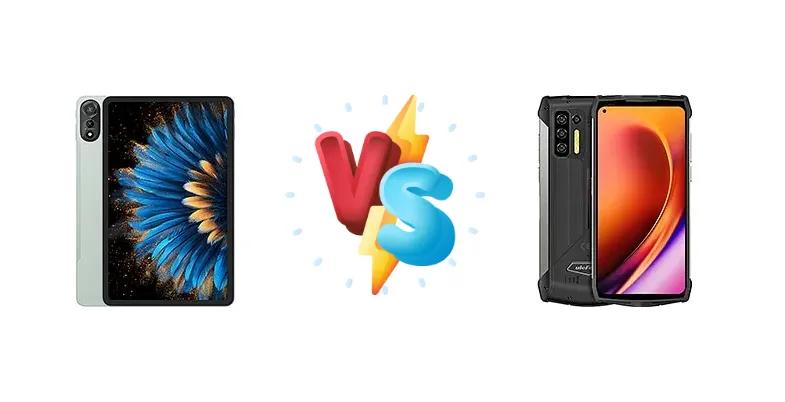
The rugged smartphone market caters to a specific need: durability and extended battery life. Both the Blackview Mega 2 and the Ulefone Power Armor 13 aim to deliver on this promise, but they take different approaches. The Mega 2 focuses on maximizing endurance through a massive battery and efficient chipset, while the Power Armor 13 prioritizes faster charging and a more visually appealing display alongside a more powerful processor.
🏆 Quick Verdict
For users prioritizing absolute battery longevity and long-term reliability, the Blackview Mega 2 is the clear winner. Its exceptional 108:47h endurance rating significantly surpasses the Ulefone Power Armor 13’s 296h. However, the Power Armor 13 is a better choice for those who value faster charging speeds and a brighter, more vibrant display.
| Network |
|---|
| 2G bands | GSM 850 / 900 / 1800 / 1900 | GSM 850 / 900 / 1800 / 1900 |
| 3G bands | HSDPA 900 / 2100 | HSDPA 850 / 900 / 1700(AWS) / 1900 / 2100 |
| 4G bands | 1, 3, 7, 8, 19, 20, 28, 40, 41 | 1, 2, 3, 4, 5, 7, 8, 12, 13, 17, 18, 19, 20, 25, 26, 28, 38, 40, 66 |
| Speed | HSPA, LTE | HSPA 42.2/11.5 Mbps, LTE Cat12 600/150 Mbps |
| Technology | GSM / HSPA / LTE | GSM / HSPA / LTE |
| Launch |
|---|
| Announced | 2025, January | 2021, July 22 |
| Status | Available. Released 2025, January | Available. Released 2021, July 26 |
| Body |
|---|
| Dimensions | 281.7 x 177.2 x 8 mm (11.09 x 6.98 x 0.31 in) | 183.7 x 85.4 x 20.8 mm (7.23 x 3.36 x 0.82 in) |
| SIM | Nano-SIM + Nano-SIM | Nano-SIM + Nano-SIM |
| Weight | 615 g (1.36 lb) | 492 g (1.08 lb) |
| | - | IP68 dust/water resistant (up to 1.5m for 30 min)
Drop-to-concrete resistance from up to 1.2m
MIL-STD-810G compliant |
| Display |
|---|
| Protection | Mohs level 5 | Corning Gorilla Glass 3 |
| Resolution | 1200 x 2000 pixels, 5:3 ratio (~194 ppi density) | 1080 x 2400 pixels, 20:9 ratio (~386 ppi density) |
| Size | 12.0 inches, 409.9 cm2 (~82.1% screen-to-body ratio) | 6.81 inches, 112.0 cm2 (~71.4% screen-to-body ratio) |
| Type | IPS LCD | IPS LCD |
| Platform |
|---|
| CPU | Octa-core (2x1.8 GHz Cortex-A75 & 6x1.6 GHz Cortex-A55) | Octa-core (2x2.05 GHz Cortex-A76 & 6x2.0 GHz Cortex-A55) |
| Chipset | Unisoc T615 (12 nm) | Mediatek MT6785V/CD Helio G95 (12 nm) |
| GPU | Mali-G57 MP1 | Mali-G76 MC4 |
| OS | Android 15 | Android 11 |
| Memory |
|---|
| Card slot | microSDXC (uses shared SIM slot) | microSDXC (uses shared SIM slot) |
| Internal | 256GB 8GB RAM, 256GB 12GB RAM | 256GB 8GB RAM |
| Main Camera |
|---|
| Features | LED flash | Quad-LED flash, HDR, panorama |
| Penta | - | 48 MP, f/1.8, 26mm (wide), 1/2.0", 0.8µm, PDAF
8 MP, f/2.2, (ultrawide)
2 MP (macro)
Auxiliary lens |
| Single | 16 MP | - |
| Video | Yes | 4K@30fps, 1080p@30fps |
| Selfie camera |
|---|
| Features | - | HDR, panorama |
| Single | 8 MP | 16 MP, f/2.2 |
| Video | Yes | 1080p@30fps |
| Sound |
|---|
| 3.5mm jack | - | Yes |
| 35mm jack | Unspecified | Yes |
| Loudspeaker | Yes, with stereo speakers | Yes |
| Comms |
|---|
| Bluetooth | Yes | 5.0, A2DP, LE |
| NFC | No | Yes |
| Positioning | GPS, GLONASS, GALILEO, BDS | GPS, GLONASS, GALILEO, BDS |
| Radio | Unspecified | FM radio, RDS, recording |
| USB | USB Type-C | - |
| WLAN | Yes | Wi-Fi 802.11 a/b/g/n/ac, dual-band |
| Features |
|---|
| Sensors | Accelerometer | Fingerprint (side-mounted), accelerometer, gyro, proximity, compass, baroceptor, coulombmeter |
| | - | Infrared distance measure (error range: 1~20m, ±10mm; 20~40m, ±25mm) |
| Battery |
|---|
| Charging | 18W wired | 33W wired
15W wireless
5W reverse wireless |
| Type | 9000 mAh | Li-Po 13200 mAh |
| Misc |
|---|
| Colors | Grey, Blue, Green | Black |
| Price | - | About 300 EUR |
| Tests |
|---|
| Battery life | - |
Endurance rating 296h
|
| Camera | - |
Photo / Video |
| Display | - |
Contrast ratio: 1306:1 (nominal) |
| Loudspeaker | - |
-28.3 LUFS (Average)
|
| Performance | - |
AnTuTu: 294194 (v8), 351678 (v9)
GeekBench: 1610 (v5.1)
GFXBench: 18fps (ES 3.1 onscreen) |
| EU LABEL |
|---|
| Battery | 108:47h endurance, 800 cycles | - |
| Energy | Class D | - |
| Free fall | Class B (156 falls) | - |
| Repairability | Class B | - |
Blackview Mega 2
- Exceptional battery life (108:47h endurance)
- Long battery lifespan (800 charge cycles)
- Efficient Unisoc T615 chipset for extended use
- Slow 18W charging
- Display brightness data unavailable, likely lower than competitor
Ulefone Power Armor 13
- Faster 33W wired and 15W wireless charging
- Brighter display (401 nits)
- More powerful Mediatek Helio G95 chipset
- Significantly lower battery endurance (296h)
- Limited battery lifespan information
Display Comparison
The Ulefone Power Armor 13 boasts a measured peak brightness of 401 nits, a significant advantage over the Blackview Mega 2 (brightness data unavailable). Both displays share a 1306:1 contrast ratio, suggesting similar black levels and color depth. However, the brighter display on the Ulefone will be noticeably more usable in direct sunlight. The lack of refresh rate information for the Blackview Mega 2 suggests it likely operates at the standard 60Hz, while the Power Armor 13’s display technology isn’t specified, but the higher brightness suggests a more modern panel.
Camera Comparison
Both phones list 'Photo / Video' capabilities, but lack specific details. Without sensor size or aperture information, a direct comparison is difficult. The absence of details suggests neither phone is targeting photography enthusiasts. The Ulefone Power Armor 13’s chipset, however, includes a more capable ISP (Image Signal Processor) which *could* translate to better image processing, but this is speculative without further data. The prevalence of low-resolution macro lenses on both devices suggests they are included for marketing purposes rather than practical use.
Performance
The Ulefone Power Armor 13’s Mediatek Helio G95 (12nm) chipset, featuring a Cortex-A76 based CPU, offers a performance edge over the Blackview Mega 2’s Unisoc T615 (12nm). The G95’s 2x2.05 GHz Cortex-A76 cores will deliver faster application loading and smoother multitasking compared to the Mega 2’s 2x1.8 GHz Cortex-A75 cores. While both are 12nm chips, the architectural improvements in the G95 translate to a more responsive experience, particularly in demanding applications. The Mega 2’s focus is efficiency, prioritizing battery life over raw processing power.
Battery Life
The Blackview Mega 2’s standout feature is its incredible 108:47h endurance rating, a testament to its optimized chipset and battery management. This dwarfs the Ulefone Power Armor 13’s 296h endurance. While the Power Armor 13 compensates with significantly faster charging – 33W wired, 15W wireless, and 5W reverse wireless – the Mega 2’s longevity is unmatched. The Mega 2’s 18W charging is comparatively slow, but the need to charge less frequently mitigates this drawback. The 800 charge cycles rating for the Mega 2 also suggests a longer lifespan for the battery itself.
Buying Guide
Buy the Blackview Mega 2 if you need a phone that can genuinely last for days on a single charge, and you frequently find yourself away from power outlets. This is ideal for outdoor professionals, travelers, or anyone who simply dislikes daily charging. Buy the Ulefone Power Armor 13 if you prefer a phone with faster charging capabilities (including wireless options), a brighter screen for outdoor visibility, and a more responsive user experience thanks to the Helio G95 chipset.
Frequently Asked Questions
❓ How much faster is the Ulefone Power Armor 13's charging compared to the Blackview Mega 2?
The Ulefone Power Armor 13 supports 33W wired charging, 15W wireless charging, and even 5W reverse wireless charging. The Blackview Mega 2 is limited to 18W wired charging. This means the Power Armor 13 will significantly reduce charging times, potentially going from 0-100% in under 2 hours, while the Mega 2 will likely take considerably longer.
❓ Will the Helio G95 in the Ulefone Power Armor 13 handle demanding games like PUBG or Call of Duty?
The Helio G95 is a capable mid-range chipset that *can* handle PUBG and Call of Duty, but you'll likely need to lower graphics settings for a smooth experience. While it's not a flagship-level processor, it offers a noticeable performance boost over the Unisoc T615 in the Blackview Mega 2, making it the better choice for mobile gaming.
❓ Is the 800 charge cycle rating on the Blackview Mega 2 a significant benefit?
Yes, the 800 charge cycle rating indicates that the Mega 2's battery is designed to retain a substantial portion of its capacity even after being fully charged and discharged 800 times. This suggests a longer overall battery lifespan compared to phones with lower cycle ratings, making it a worthwhile investment for long-term users.