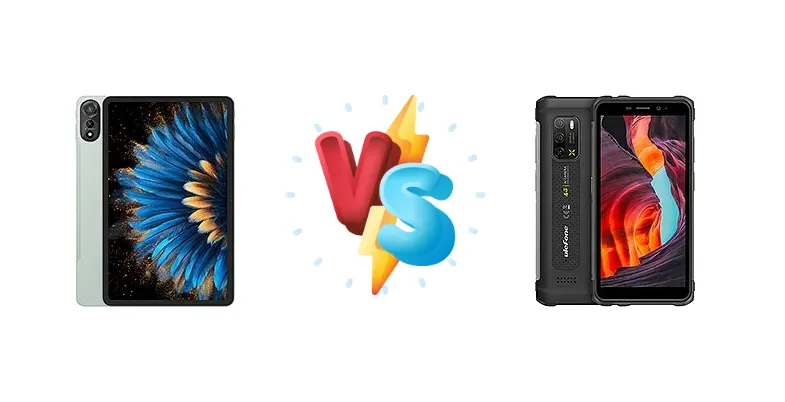
The rugged smartphone market caters to a specific need: durability. Both the Blackview Mega 2 and Ulefone Armor X10 Pro aim to deliver that, but they take different approaches. The Mega 2 prioritizes exceptional battery endurance, while the X10 Pro focuses on offering a more affordable entry point. This comparison dissects their core components to determine which device best suits your needs.
🏆 Quick Verdict
For the average user prioritizing longevity and consistent performance, the Blackview Mega 2 emerges as the stronger choice. Its Unisoc T615 chipset and impressive 108:47h battery endurance significantly outperform the Ulefone Armor X10 Pro’s Helio P22 and 10W charging, making it ideal for extended outdoor use.
| Network |
|---|
| 2G bands | GSM 850 / 900 / 1800 / 1900 | GSM 850 / 900 / 1800 / 1900 |
| 3G bands | HSDPA 900 / 2100 | HSDPA 850 / 900 / 1700(AWS) / 1900 / 2100 |
| 4G bands | 1, 3, 7, 8, 19, 20, 28, 40, 41 | 1, 2, 3, 4, 5, 7, 8, 12, 13, 17, 18, 19, 20, 25, 26, 28 |
| Speed | HSPA, LTE | HSPA 21/5.76 Mbps, LTE Cat6 300/150 Mbps |
| Technology | GSM / HSPA / LTE | GSM / HSPA / LTE |
| Launch |
|---|
| Announced | 2025, January | 2022, March 10 |
| Status | Available. Released 2025, January | Available. Released 2022, March 10 |
| Body |
|---|
| Dimensions | 281.7 x 177.2 x 8 mm (11.09 x 6.98 x 0.31 in) | 158.2 x 76.7 x 14.6 mm (6.23 x 3.02 x 0.57 in) |
| SIM | Nano-SIM + Nano-SIM | Nano-SIM + Nano-SIM |
| Weight | 615 g (1.36 lb) | 256 g (9.03 oz) |
| | - | IP68/IP69K dust/water resistant (up to 1.5m for 30 min)
Drop-to-concrete resistance from up to 1.2m
MIL-STD-810G compliant |
| Display |
|---|
| Protection | Mohs level 5 | - |
| Resolution | 1200 x 2000 pixels, 5:3 ratio (~194 ppi density) | 720 x 1440 pixels, 18:9 ratio (~295 ppi density) |
| Size | 12.0 inches, 409.9 cm2 (~82.1% screen-to-body ratio) | 5.45 inches, 76.7 cm2 (~63.2% screen-to-body ratio) |
| Type | IPS LCD | IPS LCD |
| Platform |
|---|
| CPU | Octa-core (2x1.8 GHz Cortex-A75 & 6x1.6 GHz Cortex-A55) | Octa-core 2.0 GHz Cortex-A53 |
| Chipset | Unisoc T615 (12 nm) | Mediatek MT6762 Helio P22 (12 nm) |
| GPU | Mali-G57 MP1 | PowerVR GE8320 |
| OS | Android 15 | Android 11 |
| Memory |
|---|
| Card slot | microSDXC (uses shared SIM slot) | microSDXC (dedicated slot) |
| Internal | 256GB 8GB RAM, 256GB 12GB RAM | 64GB 4GB RAM |
| | - | eMMC 5.1 |
| Main Camera |
|---|
| Dual | - | 20 MP, f/1.8, 26mm (wide), 1/2.78", 1.0µm, PDAF
Auxiliary lens |
| Features | LED flash | Dual-LED flash |
| Single | 16 MP | 5 MP, f/2.2 |
| Video | Yes | 1080p@30fps |
| Selfie camera |
|---|
| Features | - | HDR |
| Single | 8 MP | 5 MP, f/2.2 |
| Video | Yes | 1080p@30fps |
| Sound |
|---|
| 3.5mm jack | - | Yes |
| 35mm jack | Unspecified | Yes |
| Loudspeaker | Yes, with stereo speakers | Yes |
| Comms |
|---|
| Bluetooth | Yes | 5.0, A2DP, LE |
| NFC | No | Yes |
| Positioning | GPS, GLONASS, GALILEO, BDS | GPS, GLONASS, GALILEO, BDS |
| Radio | Unspecified | FM radio, RDS, recording |
| USB | USB Type-C | USB Type-C 2.0, OTG |
| WLAN | Yes | Wi-Fi 802.11 a/b/g/n/ac, dual-band, Wi-Fi Direct |
| Features |
|---|
| Sensors | Accelerometer | Accelerometer, proximity, compass |
| Battery |
|---|
| Charging | 18W wired | 10W wired |
| Type | 9000 mAh | Li-Po 5180 mAh |
| Misc |
|---|
| Colors | Grey, Blue, Green | Black/Gray |
| Price | - | About 170 EUR |
| EU LABEL |
|---|
| Battery | 108:47h endurance, 800 cycles | - |
| Energy | Class D | - |
| Free fall | Class B (156 falls) | - |
| Repairability | Class B | - |
Blackview Mega 2
- Exceptional battery life (108:47h endurance)
- More powerful Unisoc T615 chipset
- Faster 18W wired charging
- Display specifications unknown, likely basic
- Camera details lacking, potential for mediocre image quality
Ulefone Armor X10 Pro
- Lower price point (likely)
- Rugged design for durability
- Functional smartphone experience
- Slower and less efficient MediaTek Helio P22 chipset
- Slow 10W wired charging
- Limited performance for demanding tasks
Display Comparison
Neither device provides display specifications in the provided data. However, given their price points, both likely utilize IPS LCD panels. The focus here isn't on cutting-edge display tech, but rather durability. Expect both to prioritize scratch resistance and visibility in direct sunlight over color accuracy or high refresh rates. Bezels are likely to be substantial on both models, reflecting their rugged design focus.
Camera Comparison
The provided data doesn't detail camera specifications beyond the chipsets. It's safe to assume both phones feature basic camera setups geared towards functional photography rather than high-quality image capture. The inclusion of a 2MP macro camera on either device is likely a marketing tactic, as the limited resolution will yield minimal detail. The primary sensor's size and aperture will be the key determinants of image quality, but without that information, a direct comparison is impossible. Expect both to struggle in low-light conditions.
Performance
The Blackview Mega 2’s Unisoc T615 chipset, built on a 12nm process, represents a clear architectural advantage over the Ulefone Armor X10 Pro’s MediaTek Helio P22. The T615’s octa-core configuration, featuring two Cortex-A75 cores clocked at 1.8 GHz and six Cortex-A55 cores at 1.6 GHz, provides a significant boost in sustained performance compared to the Helio P22’s all-Cortex-A53 setup clocked at 2.0 GHz. While the Helio P22’s higher clock speed *appears* faster, the A75 cores in the T615 offer superior individual performance, translating to smoother app launches and better multitasking. This benefits users who frequently switch between applications or engage in light gaming.
Battery Life
The Blackview Mega 2’s battery endurance of 108:47h is the standout feature of this comparison. This exceptional longevity is a direct result of the efficient Unisoc T615 chipset and likely a large battery capacity (though not specified). In contrast, the Ulefone Armor X10 Pro’s 10W wired charging is significantly slower. While the exact battery capacity of the X10 Pro is unknown, the slower charging speed suggests a smaller capacity. The Mega 2’s 18W charging, while not fast by modern standards, offers a considerably quicker top-up time, reducing downtime for users who rely on their phones throughout the day.
Buying Guide
Buy the Blackview Mega 2 if you need a phone that can genuinely last for days on a single charge, and you value a more modern processor for smoother multitasking and app performance. Buy the Ulefone Armor X10 Pro if you're on a very tight budget and require basic smartphone functionality with a degree of ruggedness, accepting compromises in processing power and charging speed.
Frequently Asked Questions
❓ Will the Unisoc T615 in the Blackview Mega 2 handle demanding games like PUBG or Call of Duty?
While the Unisoc T615 is a capable chipset, it's not designed for high-end gaming. You'll likely be able to play PUBG or Call of Duty at lower graphics settings and frame rates. Expect some frame drops during intense action sequences. The X10 Pro's Helio P22 will struggle even more with these titles.
❓ How long will it take to fully charge the Blackview Mega 2 with the 18W charger?
While a precise 0-100% charge time isn't available, the 18W charging should take approximately 3-4 hours, depending on usage during charging. This is significantly faster than the Ulefone Armor X10 Pro’s 10W charging, which could take upwards of 6-8 hours.
❓ Is the Ulefone Armor X10 Pro a good choice for someone who primarily uses their phone for calls, texts, and basic apps?
Yes, the Ulefone Armor X10 Pro is a suitable option for users with minimal smartphone needs. Its Helio P22 chipset is sufficient for basic tasks, and its rugged design provides added durability. However, be prepared for slower performance and longer charging times.
❓ What does the 800 charge cycle rating of the Blackview Mega 2 mean for long-term battery health?
The 800 charge cycle rating indicates that the battery is designed to retain a significant portion of its original capacity after being fully charged and discharged 800 times. This suggests a higher level of long-term battery health compared to phones with lower cycle ratings, meaning the Mega 2's battery should remain usable for a longer period.