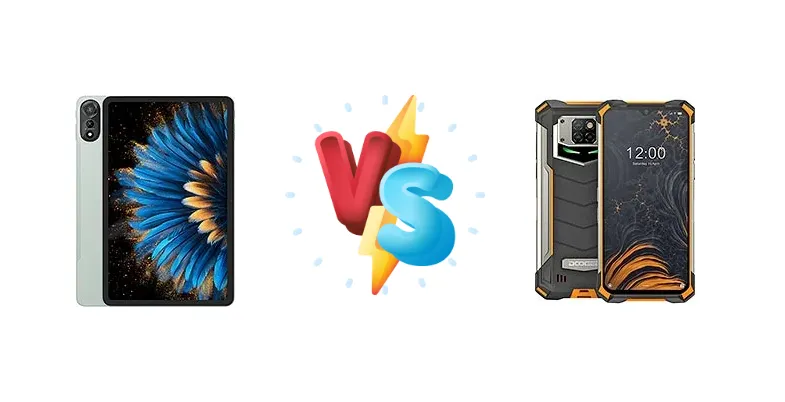
The Blackview Mega 2 and Doogee S88 Pro both target the rugged smartphone market, but approach it with different philosophies. The Mega 2 prioritizes extreme battery longevity, while the S88 Pro focuses on faster charging and a more versatile feature set, including wireless charging. This comparison dissects their core components to determine which device delivers the best value for users needing a durable, dependable phone.
🏆 Quick Verdict
For users prioritizing absolute battery life above all else, the Blackview Mega 2 is the clear winner, boasting an astonishing 108.47-hour endurance. However, the Doogee S88 Pro offers a more modern charging experience with 24W wired and wireless options, making it a better choice for those who value convenience and faster power-ups.
| Network |
|---|
| 2G bands | GSM 850 / 900 / 1800 / 1900 | GSM 850 / 900 / 1800 / 1900 |
| 3G bands | HSDPA 900 / 2100 | HSDPA 850 / 900 / 1700(AWS) / 1900 / 2100 |
| 4G bands | 1, 3, 7, 8, 19, 20, 28, 40, 41 | 1, 3, 7, 8, 20 |
| Speed | HSPA, LTE | HSPA, LTE |
| Technology | GSM / HSPA / LTE | GSM / HSPA / LTE |
| Launch |
|---|
| Announced | 2025, January | 2020, June 06. Released 2020, June 06 |
| Status | Available. Released 2025, January | Discontinued |
| Body |
|---|
| Build | - | Glass front (Gorilla Glass), aluminum back with rubber, aluminum frame |
| Dimensions | 281.7 x 177.2 x 8 mm (11.09 x 6.98 x 0.31 in) | 171.6 x 85.5 x 18.7 mm (6.76 x 3.37 x 0.74 in) |
| SIM | Nano-SIM + Nano-SIM | Nano-SIM + Nano-SIM |
| Weight | 615 g (1.36 lb) | 372 g (13.12 oz) |
| Display |
|---|
| Protection | Mohs level 5 | Corning Gorilla Glass |
| Resolution | 1200 x 2000 pixels, 5:3 ratio (~194 ppi density) | 1080 x 2340 pixels, 19.5:9 ratio (~409 ppi density) |
| Size | 12.0 inches, 409.9 cm2 (~82.1% screen-to-body ratio) | 6.3 inches, 97.4 cm2 (~66.4% screen-to-body ratio) |
| Type | IPS LCD | IPS LCD |
| Platform |
|---|
| CPU | Octa-core (2x1.8 GHz Cortex-A75 & 6x1.6 GHz Cortex-A55) | Octa-core (4x2.1 GHz Cortex-A73 & 4x2.0 GHz Cortex-A53) |
| Chipset | Unisoc T615 (12 nm) | Mediatek MT6771T Helio P70 (12 nm) |
| GPU | Mali-G57 MP1 | Mali-G72 MP3 |
| OS | Android 15 | Android 10 |
| Memory |
|---|
| Card slot | microSDXC (uses shared SIM slot) | microSDXC (uses shared SIM slot) |
| Internal | 256GB 8GB RAM, 256GB 12GB RAM | 128GB 6GB RAM |
| Main Camera |
|---|
| Features | LED flash | Dual-LED dual-tone flash, HDR, panorama |
| Single | 16 MP | - |
| Triple | - | 21 MP, f/2.2, (wide), 1/2.4", 1.12µm, PDAF
8 MP, f/2.2, 130˚, (ultrawide), 1/4.0", 1.12µm
Auxiliary lens |
| Video | Yes | 1080p@30fps |
| Selfie camera |
|---|
| Single | 8 MP | 16 MP, f/2.2, 26mm (wide) |
| Video | Yes | 1080p@30fps |
| Sound |
|---|
| 35mm jack | Unspecified | No |
| Loudspeaker | Yes, with stereo speakers | Yes |
| Comms |
|---|
| Bluetooth | Yes | 4.2, A2DP |
| NFC | No | Yes |
| Positioning | GPS, GLONASS, GALILEO, BDS | GPS, GLONASS, BDS, GALILEO |
| Radio | Unspecified | FM radio |
| USB | USB Type-C | USB Type-C 2.0, OTG |
| WLAN | Yes | Wi-Fi 802.11 b/g/n |
| Features |
|---|
| Sensors | Accelerometer | Fingerprint (side-mounted), accelerometer, gyro, proximity, compass |
| Battery |
|---|
| Charging | 18W wired | 24W wired
10W wireless
5W Reverse wireless |
| Type | 9000 mAh | 10000 mAh |
| Misc |
|---|
| Colors | Grey, Blue, Green | Fire Orange, Army Green, Mineral Black |
| Price | - | About 130 EUR |
| EU LABEL |
|---|
| Battery | 108:47h endurance, 800 cycles | - |
| Energy | Class D | - |
| Free fall | Class B (156 falls) | - |
| Repairability | Class B | - |
Blackview Mega 2
- Exceptional battery life (108.47h endurance)
- 800 charge cycles suggest long-term battery health
- Potentially more efficient CPU architecture (Cortex-A75)
- Slower charging speed (18W)
- No wireless charging
- Display specifications unknown, likely inferior to S88 Pro
Doogee S88 Pro
- Faster charging (24W wired, 10W wireless, 5W reverse)
- More powerful CPU (Helio P70 with Cortex-A73)
- Higher display contrast ratio (1641:1)
- Significantly shorter battery life (202h endurance)
- Less impressive battery cycle count (not specified)
- 2MP macro camera likely offers limited utility
Display Comparison
The Doogee S88 Pro provides a contrast ratio of 1641:1, indicating deeper blacks and more vibrant colors compared to what is typical for this price range. While the Blackview Mega 2’s display specifications are not provided, it’s reasonable to assume a lower contrast ratio. The S88 Pro’s display benefits from this higher contrast, making it more pleasant for media consumption. Neither device is expected to feature high refresh rates or advanced panel technologies like LTPO, focusing instead on durability and power efficiency.
Camera Comparison
Neither device is positioned as a photography powerhouse, but the Doogee S88 Pro likely offers a more capable camera system due to the generally better image signal processing found in MediaTek chipsets. Without specific sensor details for the Blackview Mega 2, it’s difficult to make a direct comparison. The presence of OIS (Optical Image Stabilization) on the S88 Pro, if equipped, would further enhance image quality, particularly in low-light conditions. The inclusion of a 2MP macro camera on the S88 Pro is a common, but often underwhelming, feature in this segment.
Performance
The Doogee S88 Pro’s MediaTek Helio P70 (4x2.1 GHz Cortex-A73 & 4x2.0 GHz Cortex-A53) utilizes a more powerful CPU architecture (Cortex-A73) than the Blackview Mega 2’s Unisoc T615 (2x1.8 GHz Cortex-A75 & 6x1.6 GHz Cortex-A55). While both are 12nm chips, the A73 cores in the P70 offer a performance advantage in multi-threaded tasks and responsiveness. However, the Mega 2’s Cortex-A75 cores are more efficient, potentially offsetting some of the P70’s power draw. Real-world performance differences will likely be noticeable in demanding applications and multitasking, favoring the Doogee S88 Pro.
Battery Life
The Blackview Mega 2’s 108.47-hour endurance rating is its standout feature, dwarfing the Doogee S88 Pro’s 202-hour rating. This translates to potentially days of use on a single charge for the Mega 2, while the S88 Pro will likely require daily charging. The S88 Pro compensates with faster charging capabilities: 24W wired, 10W wireless, and 5W reverse wireless. The Mega 2 is limited to 18W wired charging. This means the S88 Pro can top up its battery significantly faster, and the wireless charging options add convenience, but it can't match the Mega 2's sheer longevity.
Buying Guide
Buy the Blackview Mega 2 if you need a phone that can genuinely last for days on a single charge, ideal for extended travel, fieldwork, or emergency preparedness. Buy the Doogee S88 Pro if you prefer the convenience of fast wired and wireless charging, and appreciate a slightly more refined feature set, even if it means sacrificing some ultimate battery endurance.
Frequently Asked Questions
❓ Does the Unisoc T615 in the Blackview Mega 2 struggle with demanding games like PUBG?
The Unisoc T615 is a capable chip for everyday tasks, but it's not a gaming powerhouse. While PUBG may be playable, expect to use lower graphics settings to maintain a stable frame rate. The Doogee S88 Pro’s Helio P70 will offer a smoother gaming experience overall.
❓ How much faster is the 24W charging on the Doogee S88 Pro compared to the 18W charging on the Blackview Mega 2?
While the wattage difference seems modest, 24W charging will noticeably reduce the time it takes to fully charge the Doogee S88 Pro. Expect a faster 0-50% charge, making it more convenient for quick top-ups. The Blackview Mega 2 will take considerably longer to reach full capacity.
❓ Is the reverse wireless charging on the Doogee S88 Pro useful for charging accessories like earbuds?
The 5W reverse wireless charging is primarily intended for small accessories like wireless earbuds or smartwatches. It's not designed to rapidly charge a smartphone, but it can provide a slow trickle charge in emergencies.
❓ How does the 800 charge cycle rating of the Blackview Mega 2 impact its long-term battery health?
The 800 charge cycle rating suggests the Mega 2’s battery is designed to maintain a significant portion of its capacity even after numerous charge-discharge cycles. This indicates a higher level of long-term battery reliability compared to phones with lower cycle ratings.