
Blackview Mega 2 vs BV9900E: Which Rugged Phone Reigns Supreme?
| Phones Images | |||||
|---|---|---|---|---|---|
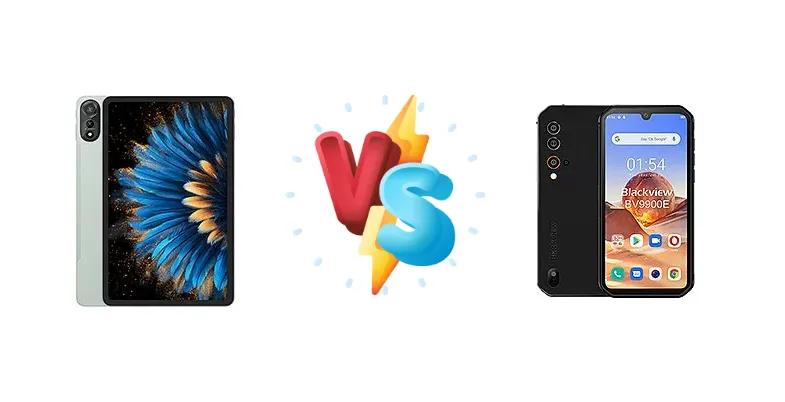
|
🏆 Quick Verdict
For the average user prioritizing longevity and cost-effectiveness, the Blackview Mega 2 emerges as the winner. Its incredible 108-hour battery endurance and efficient Unisoc T615 chipset offer a worry-free experience. However, users needing more processing power for demanding tasks will find the BV9900E's Helio P90 a better fit.
| PHONES | ||
|---|---|---|
| Phone Names | Blackview Mega 2 | Blackview BV9900E |
| Network | ||
|---|---|---|
| 2G bands | GSM 850 / 900 / 1800 / 1900 | GSM 850 / 900 / 1800 / 1900 |
| 3G bands | HSDPA 900 / 2100 | HSDPA 800 / 850 / 900 / 1700(AWS) / 1900 / 2100 |
| 4G bands | 1, 3, 7, 8, 19, 20, 28, 40, 41 | 1, 2, 3, 4, 5, 7, 8, 12, 13, 17, 18, 19, 20, 25, 26, 28, 34, 38, 39, 40, 41, 66 |
| Speed | HSPA, LTE | HSPA, LTE |
| Technology | GSM / HSPA / LTE | GSM / CDMA / HSPA / CDMA2000 / LTE |
| Launch | ||
|---|---|---|
| Announced | 2025, January | 2020, September 10. Released 2020, September |
| Status | Available. Released 2025, January | Discontinued |
| Body | ||
|---|---|---|
| Dimensions | 281.7 x 177.2 x 8 mm (11.09 x 6.98 x 0.31 in) | 156.5 x 78.3 x 14.2 mm (6.16 x 3.08 x 0.56 in) |
| SIM | Nano-SIM + Nano-SIM | Nano-SIM + Nano-SIM |
| Weight | 615 g (1.36 lb) | 273 g (9.63 oz) |
| Display | ||
|---|---|---|
| Protection | Mohs level 5 | Corning Gorilla Glass 5 |
| Resolution | 1200 x 2000 pixels, 5:3 ratio (~194 ppi density) | 1080 x 2280 pixels, 19:9 ratio (~432 ppi density) |
| Size | 12.0 inches, 409.9 cm2 (~82.1% screen-to-body ratio) | 5.84 inches, 85.1 cm2 (~69.5% screen-to-body ratio) |
| Type | IPS LCD | IPS LCD |
| Platform | ||
|---|---|---|
| CPU | Octa-core (2x1.8 GHz Cortex-A75 & 6x1.6 GHz Cortex-A55) | Octa-core (2x2.2 GHz Cortex-A75 & 6x2.0 GHz Cortex-A55) |
| Chipset | Unisoc T615 (12 nm) | Mediatek MT6779V/CE Helio P90 (12 nm) |
| GPU | Mali-G57 MP1 | PowerVR GM9446 |
| OS | Android 15 | Android 10 |
| Memory | ||
|---|---|---|
| Card slot | microSDXC (uses shared SIM slot) | microSDXC |
| Internal | 256GB 8GB RAM, 256GB 12GB RAM | 128GB 6GB RAM |
| Main Camera | ||
|---|---|---|
| Features | LED flash | LED flash, HDR, panorama |
| Quad | - | 48 MP, f/1.8, (wide), PDAF 16 MP, 120˚ (ultrawide) 2 MP (macro) Auxiliary lens |
| Single | 16 MP | - |
| Video | Yes | 4K@30fps, 1080p@60fps |
| Selfie camera | ||
|---|---|---|
| Single | 8 MP | 16 MP, f/2.0, (wide) |
| Video | Yes | 1080p@30fps |
| Sound | ||
|---|---|---|
| 35mm jack | Unspecified | No |
| Loudspeaker | Yes, with stereo speakers | Yes |
| Comms | ||
|---|---|---|
| Bluetooth | Yes | 5.0, A2DP, LE |
| NFC | No | Yes |
| Positioning | GPS, GLONASS, GALILEO, BDS | GPS, GLONASS, GALILEO, BDS |
| Radio | Unspecified | FM radio |
| USB | USB Type-C | USB Type-C 2.0, OTG |
| WLAN | Yes | Wi-Fi 802.11 a/b/g/n/ac |
| Features | ||
|---|---|---|
| Sensors | Accelerometer | Fingerprint (side-mounted), accelerometer, gyro, proximity, compass, barometer |
| Battery | ||
|---|---|---|
| Charging | 18W wired | 15W wired 18W wireless |
| Type | 9000 mAh | 4380 mAh |
| Misc | ||
|---|---|---|
| Colors | Grey, Blue, Green | Black, Silver |
| Price | - | About 260 EUR |
| EU LABEL | ||
|---|---|---|
| Battery | 108:47h endurance, 800 cycles | - |
| Energy | Class D | - |
| Free fall | Class B (156 falls) | - |
| Repairability | Class B | - |
Blackview Mega 2
- Unmatched battery life (108:47h endurance)
- Excellent long-term battery health (800 cycles)
- More affordable price point (likely)
- Less powerful processor for demanding tasks
- Limited gaming performance
Blackview BV9900E
- Faster processor (Helio P90) for smoother performance
- Wireless charging convenience
- Potentially better image processing
- Shorter battery life compared to Mega 2
- Higher price (likely)
Display Comparison
Neither device boasts a cutting-edge display. Both likely utilize IPS LCD panels, common in this price bracket. The focus here isn't on visual fidelity, but durability. We can assume similar resolutions (likely 720p+), but detailed specs are missing. The real difference lies in the overall user experience dictated by the chipset's ability to drive the display smoothly.
Camera Comparison
Without detailed camera specs, a direct comparison is difficult. However, the market segment suggests both phones will feature a multi-camera setup with a primary sensor, likely around 13-20MP. The BV9900E’s more powerful chipset could offer better image processing capabilities, potentially resulting in sharper images and improved low-light performance. The presence of a dedicated image signal processor (ISP) within the Helio P90 is a key advantage. We can expect similar auxiliary lenses (depth, macro) on both, but their quality will likely be limited.
Performance
The BV9900E holds a clear advantage in raw processing power. Its MediaTek Helio P90, featuring 2x2.2 GHz Cortex-A75 cores and 6x2.0 GHz Cortex-A55 cores, outperforms the Mega 2’s Unisoc T615 (2x1.8 GHz Cortex-A75 & 6x1.6 GHz Cortex-A55). While both are 12nm chips, the higher clock speeds and more refined architecture of the P90 translate to faster app loading, smoother multitasking, and better gaming performance. The Mega 2’s T615 prioritizes efficiency, making it suitable for everyday tasks, but will struggle with graphically intensive games.
Battery Life
This is where the Mega 2 truly shines. Its 108:47h endurance is exceptional, indicating a significantly longer battery life than the BV9900E. While the BV9900E offers 15W wired and 18W wireless charging, the Mega 2’s 18W wired charging is the sole option. The wireless charging on the BV9900E is a convenience feature, but the Mega 2’s massive battery capacity minimizes the need for frequent top-ups. The Mega 2 also boasts an impressive 800 charge cycles, suggesting long-term battery health.
Buying Guide
Buy the Blackview Mega 2 if you need a phone that can genuinely last for days on a single charge, and your primary use cases revolve around communication, navigation, and light media consumption. It's ideal for field workers, travelers, or anyone who dislikes frequent charging. Buy the Blackview BV9900E if you prefer a more responsive experience for gaming, multitasking, and running demanding applications, and value the convenience of wireless charging alongside a robust build.