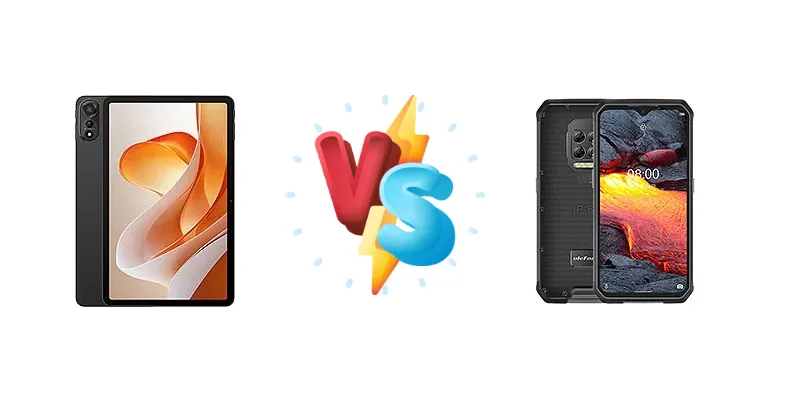
The rugged smartphone market caters to a specific need: durability. Both the Blackview Mega 2 WiFi and the Ulefone Armor 9E aim to deliver that, but they take different approaches to performance and longevity. The Mega 2 prioritizes extreme battery life, while the Armor 9E focuses on a more powerful chipset for demanding tasks. This comparison dissects the key differences to help you choose the right tool for your lifestyle.
🏆 Quick Verdict
For the average user prioritizing all-day (and multi-day) battery life, the Blackview Mega 2 WiFi is the clear winner. However, the Ulefone Armor 9E, with its Helio P90 chipset, provides a noticeable performance boost for users who frequently game or run resource-intensive applications, making it the better choice for power users.
| Network |
|---|
| 2G bands | N/A | GSM 850 / 900 / 1800 / 1900 |
| 3G bands | N/A | HSDPA 850 / 900 / 1700(AWS) / 1900 / 2100 |
| 4G bands | N/A | 1, 2, 3, 4, 5, 7, 8, 12, 13, 17, 18, 19, 20, 25, 26, 28, 34, 38, 39, 40, 41, 66 |
| EDGE | No | - |
| GPRS | No | - |
| Speed | - | HSPA 42.2/11.5 Mbps, LTE Cat12 600/150 Mbps |
| Technology | No cellular connectivity | GSM / CDMA / HSPA / EVDO / LTE |
| | - | CDMA2000 1xEV-DO |
| Launch |
|---|
| Announced | 2025, April | 2020, September 08. Released 2020, September 08 |
| Status | Available. Released 2025, April | Discontinued |
| Body |
|---|
| Build | - | Front glass, aluminum back with rubber, aluminum frame |
| Dimensions | 281.7 x 177.2 x 8 mm (11.09 x 6.98 x 0.31 in) | 168.2 x 82 x 15 mm (6.62 x 3.23 x 0.59 in) |
| SIM | No | Nano-SIM + Nano-SIM |
| Weight | 615 g (1.36 lb) | 324 g (11.43 oz) |
| | - | IP68/IP69K dust/water resistant (up to 1.5m for 30 min)
Drop-to-concrete resistance from up to 1.2m
MIL-STD-810G compliant |
| Display |
|---|
| Protection | Mohs level 5 | Scratch-resistant glass, oleophobic coating |
| Resolution | 1200 x 2000 pixels, 5:3 ratio (~194 ppi density) | 1080 x 2340 pixels, 19.5:9 ratio (~409 ppi density) |
| Size | 12.0 inches, 409.9 cm2 (~82.1% screen-to-body ratio) | 6.3 inches, 97.4 cm2 (~70.6% screen-to-body ratio) |
| Type | IPS LCD, 90Hz | IPS LCD |
| Platform |
|---|
| CPU | Octa-core (2x2.0 GHz Cortex-A76 & 6x1.8 GHz Cortex-A55) | Octa-core (2x2.2 GHz Cortex-A75 & 6x2.0 GHz Cortex-A55) |
| Chipset | Allwinner A733 (12 nm) | Mediatek MT6779 Helio P90 (12 nm) |
| GPU | IMG BXM-4-64 MC01 | PowerVR GM9446 |
| OS | Android 15, DokeOS_P 4.1 | Android 10 |
| Memory |
|---|
| Card slot | Unspecified | microSDXC (uses shared SIM slot) |
| Internal | 256GB 12GB RAM | 128GB 8GB RAM |
| | - | UFS 2.1 |
| Main Camera |
|---|
| Features | LED flash | Quad-LED flash, HDR, panorama |
| Quad | - | 64 MP, f/1.9, 26mm (wide), 1/1.72", 0.8µm, PDAF
8 MP, f/2.4, 100˚ (ultrawide), 1/4.0", 1.12µm
2 MP (macro)
Auxiliary lens |
| Single | 16 MP | - |
| Video | 1080p@30fps | 4K@30fps, 1080p@30fps |
| Selfie camera |
|---|
| Features | - | HDR, panorama |
| Single | 8 MP | 8 MP, f/2.2 |
| Video | 1080p@30fps | 1080p@30fps |
| Sound |
|---|
| 3.5mm jack | - | Yes |
| 35mm jack | Yes | Yes |
| Loudspeaker | Yes, with stereo speakers | Yes |
| Comms |
|---|
| Bluetooth | 5.2, A2DP | 5.0, A2DP, LE |
| NFC | No | Yes |
| Positioning | No | GPS, GLONASS, GALILEO, BDS |
| Radio | No | FM radio, RDS, recording |
| USB | USB Type-C | USB Type-C 2.0, OTG, accessory connector |
| WLAN | Wi-Fi 802.11 a/b/g/n/ac/6, dual-band | Wi-Fi 802.11 a/b/g/n/ac, Wi-Fi Direct |
| Features |
|---|
| Sensors | Accelerometer | Fingerprint (side-mounted), accelerometer, gyro, proximity, compass, coulombmeter |
| | - | Endoscope mount (camera sold separately) |
| Battery |
|---|
| Charging | 18W wired | 18W wired |
| Type | Li-Po 9000 mAh | Li-Po 6600 mAh |
| Misc |
|---|
| Colors | Celestial Grey, Ice Blue, Moss Green | Black |
| Price | - | About 290 EUR |
| EU LABEL |
|---|
| Battery | 114:00h endurance, 900 cycles | - |
| Energy | Class E | - |
| Free fall | Class C (104 falls) | - |
| Repairability | Class B | - |
Blackview Mega 2 WiFi
- Exceptional battery life (114h endurance)
- Long battery lifespan (900 cycles)
- More affordable price point (likely)
- Less powerful processor for demanding tasks
- Likely limited gaming performance
Ulefone Armor 9E
- More powerful Helio P90 chipset
- Better performance for gaming and multitasking
- Potentially improved image processing
- Shorter battery life compared to Mega 2
- Potentially higher price
Display Comparison
Neither device provides display specifications in the provided data. However, given the price points and rugged focus, we can expect both to utilize IPS LCD panels. The absence of details like resolution or refresh rate suggests neither prioritizes a premium visual experience. Bezels are likely to be substantial on both to contribute to drop protection. Color accuracy will likely be standard for this segment.
Camera Comparison
Without detailed camera specifications, a direct comparison is limited. However, the rugged phone market often prioritizes durability over camera quality. We can assume both devices will feature a multi-camera setup, but image processing and sensor size are unknown. The presence of a 2MP macro camera on either device is likely more for marketing than practical use, offering limited detail. The Armor 9E’s more powerful ISP (Image Signal Processor) within the Helio P90 chipset *could* translate to better image processing, but this is speculative without further data.
Performance
The Ulefone Armor 9E’s Mediatek Helio P90 chipset represents a significant step up in processing power compared to the Blackview Mega 2 WiFi’s Allwinner A733. The P90 features a 2x2.2 GHz Cortex-A75 core configuration alongside 6x2.0 GHz Cortex-A55 cores, while the A733 utilizes 2x2.0 GHz Cortex-A76 and 6x1.8 GHz Cortex-A55 cores. The Cortex-A75 cores in the P90 offer superior single-core performance, translating to snappier app launches and smoother multitasking. While both chipsets are fabricated on a 12nm process, the architectural advantages of the P90 give it the edge. This benefits users who engage in gaming or video editing.
Battery Life
The Blackview Mega 2 WiFi boasts an impressive 114-hour endurance rating and a 900-cycle battery lifespan, indicating a focus on long-term battery health and extended usage. While both phones offer 18W wired charging, the Mega 2’s superior battery capacity will likely result in longer overall usage times. The Armor 9E, despite its more powerful processor, will likely experience faster battery drain under heavy load. Users prioritizing longevity and minimizing charging frequency will strongly favor the Mega 2.
Buying Guide
Buy the Blackview Mega 2 WiFi if you need a phone that can genuinely last for days on a single charge, and your primary use cases are communication, basic media consumption, and light productivity. It’s ideal for travelers, outdoor workers, or anyone who dislikes frequent charging. Buy the Ulefone Armor 9E if you prefer a more responsive experience, enjoy mobile gaming, or regularly use demanding apps. Its stronger processor makes it suitable for users who need a rugged phone that can also handle a heavier workload.
Frequently Asked Questions
❓ Will the Helio P90 in the Ulefone Armor 9E overheat during prolonged gaming sessions?
The Helio P90 is known to generate some heat under sustained load. While the Armor 9E’s rugged design may offer some passive cooling, extended gaming sessions could lead to thermal throttling, reducing performance slightly. It's unlikely to cause critical overheating, but users should be aware of potential performance dips.
❓ How does the Allwinner A733 in the Blackview Mega 2 WiFi handle basic multitasking and app switching?
The Allwinner A733 is sufficient for everyday tasks like browsing, social media, and messaging. However, it may exhibit some lag when switching between numerous apps or running multiple resource-intensive applications simultaneously. It's designed for efficiency rather than raw speed.
❓ Is the 18W charging on either device considered fast charging in 2024?
18W charging is relatively slow by 2024 standards. While it will charge both devices overnight, it won't provide a rapid top-up. Expect a full charge to take around 3-4 hours. Neither device prioritizes fast charging, likely to preserve battery health.