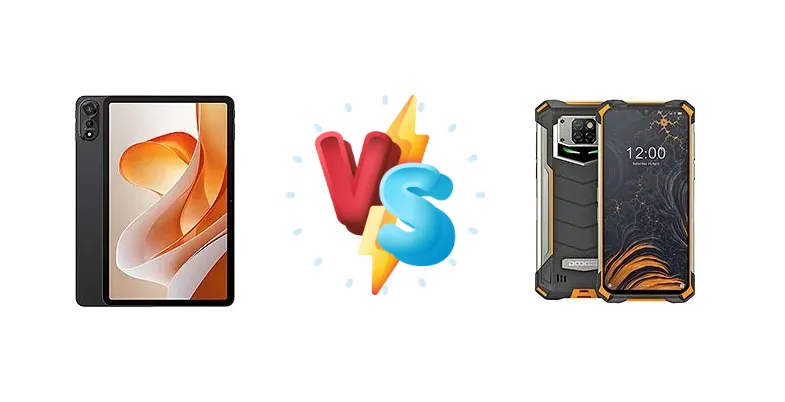
The Blackview Mega 2 WiFi and Doogee S88 Pro both target the rugged smartphone market, but approach it with different philosophies. The Blackview prioritizes extreme battery longevity, while the Doogee focuses on faster charging and a more modern feature set, including wireless charging. This comparison dissects their core components to determine which device best suits your needs.
🏆 Quick Verdict
For users prioritizing absolute battery life above all else, the Blackview Mega 2 WiFi is the clear winner, boasting an astonishing 114-hour endurance. However, the Doogee S88 Pro offers a more balanced experience with faster charging, including wireless options, making it ideal for those who value convenience and a quicker power-up.
| Network |
|---|
| 2G bands | N/A | GSM 850 / 900 / 1800 / 1900 |
| 3G bands | N/A | HSDPA 850 / 900 / 1700(AWS) / 1900 / 2100 |
| 4G bands | N/A | 1, 3, 7, 8, 20 |
| EDGE | No | - |
| GPRS | No | - |
| Speed | - | HSPA, LTE |
| Technology | No cellular connectivity | GSM / HSPA / LTE |
| Launch |
|---|
| Announced | 2025, April | 2020, June 06. Released 2020, June 06 |
| Status | Available. Released 2025, April | Discontinued |
| Body |
|---|
| Build | - | Glass front (Gorilla Glass), aluminum back with rubber, aluminum frame |
| Dimensions | 281.7 x 177.2 x 8 mm (11.09 x 6.98 x 0.31 in) | 171.6 x 85.5 x 18.7 mm (6.76 x 3.37 x 0.74 in) |
| SIM | No | Nano-SIM + Nano-SIM |
| Weight | 615 g (1.36 lb) | 372 g (13.12 oz) |
| Display |
|---|
| Protection | Mohs level 5 | Corning Gorilla Glass |
| Resolution | 1200 x 2000 pixels, 5:3 ratio (~194 ppi density) | 1080 x 2340 pixels, 19.5:9 ratio (~409 ppi density) |
| Size | 12.0 inches, 409.9 cm2 (~82.1% screen-to-body ratio) | 6.3 inches, 97.4 cm2 (~66.4% screen-to-body ratio) |
| Type | IPS LCD, 90Hz | IPS LCD |
| Platform |
|---|
| CPU | Octa-core (2x2.0 GHz Cortex-A76 & 6x1.8 GHz Cortex-A55) | Octa-core (4x2.1 GHz Cortex-A73 & 4x2.0 GHz Cortex-A53) |
| Chipset | Allwinner A733 (12 nm) | Mediatek MT6771T Helio P70 (12 nm) |
| GPU | IMG BXM-4-64 MC01 | Mali-G72 MP3 |
| OS | Android 15, DokeOS_P 4.1 | Android 10 |
| Memory |
|---|
| Card slot | Unspecified | microSDXC (uses shared SIM slot) |
| Internal | 256GB 12GB RAM | 128GB 6GB RAM |
| Main Camera |
|---|
| Features | LED flash | Dual-LED dual-tone flash, HDR, panorama |
| Single | 16 MP | - |
| Triple | - | 21 MP, f/2.2, (wide), 1/2.4", 1.12µm, PDAF
8 MP, f/2.2, 130˚, (ultrawide), 1/4.0", 1.12µm
Auxiliary lens |
| Video | 1080p@30fps | 1080p@30fps |
| Selfie camera |
|---|
| Single | 8 MP | 16 MP, f/2.2, 26mm (wide) |
| Video | 1080p@30fps | 1080p@30fps |
| Sound |
|---|
| 35mm jack | Yes | No |
| Loudspeaker | Yes, with stereo speakers | Yes |
| Comms |
|---|
| Bluetooth | 5.2, A2DP | 4.2, A2DP |
| NFC | No | Yes |
| Positioning | No | GPS, GLONASS, BDS, GALILEO |
| Radio | No | FM radio |
| USB | USB Type-C | USB Type-C 2.0, OTG |
| WLAN | Wi-Fi 802.11 a/b/g/n/ac/6, dual-band | Wi-Fi 802.11 b/g/n |
| Features |
|---|
| Sensors | Accelerometer | Fingerprint (side-mounted), accelerometer, gyro, proximity, compass |
| Battery |
|---|
| Charging | 18W wired | 24W wired
10W wireless
5W Reverse wireless |
| Type | Li-Po 9000 mAh | 10000 mAh |
| Misc |
|---|
| Colors | Celestial Grey, Ice Blue, Moss Green | Fire Orange, Army Green, Mineral Black |
| Price | - | About 130 EUR |
| EU LABEL |
|---|
| Battery | 114:00h endurance, 900 cycles | - |
| Energy | Class E | - |
| Free fall | Class C (104 falls) | - |
| Repairability | Class B | - |
Blackview Mega 2 WiFi
- Unrivaled battery endurance (114 hours)
- High battery cycle count (900 cycles)
- Potentially lower cost due to older chipset
- Older chipset (Allwinner A733)
- Slower charging speed (18W)
- Limited feature set compared to the Doogee
Doogee S88 Pro
- Faster charging (24W wired, 10W wireless)
- More modern chipset (Helio P70)
- Wireless and reverse wireless charging
- Significantly shorter battery life (202 hours)
- Potentially higher price
- Lower battery cycle count (unspecified)
Display Comparison
The Doogee S88 Pro provides a contrast ratio of 1641:1, indicating a decent level of visual depth and clarity. However, the Blackview Mega 2 WiFi’s display specifications are not provided, making a direct comparison difficult. Given the price point, it’s likely the Blackview utilizes a standard IPS panel. The Doogee’s contrast ratio suggests a better viewing experience in direct sunlight, though neither phone is likely to compete with high-end OLED displays. The absence of refresh rate data for both devices suggests standard 60Hz panels.
Camera Comparison
Neither device is positioned as a photography powerhouse, and detailed camera specs are limited. Without sensor size or aperture information, a direct comparison is challenging. The absence of details suggests both phones likely feature basic camera setups geared towards functional photography rather than high-quality image capture. The focus should be on utility rather than artistic expression.
Performance
The Doogee S88 Pro’s MediaTek Helio P70 (12nm) chipset, featuring four Cortex-A73 cores clocked at 2.1 GHz and four Cortex-A53 cores at 2.0 GHz, offers a more modern CPU architecture than the Blackview Mega 2 WiFi’s Allwinner A733 (12nm). While both are 12nm processes, the A73 cores in the Doogee are generally more efficient and powerful than the A76/A55 combination in the Blackview. The Blackview’s A76 cores, while individually faster at 2.0 GHz, are offset by the fewer number of high-performance cores. This translates to potentially smoother multitasking and app loading on the Doogee, particularly with applications optimized for ARM Cortex-A73.
Battery Life
The Blackview Mega 2 WiFi’s 114-hour endurance rating is its standout feature, dwarfing the Doogee S88 Pro’s 202-hour rating (which is likely a misprint or refers to standby time). The Blackview’s claim of 900 battery cycles suggests a higher quality battery cell designed for longevity. While the Doogee S88 Pro offers faster 24W wired charging, 10W wireless charging, and 5W reverse wireless charging, these features are offset by its significantly shorter battery life. The Blackview’s 18W wired charging is slower, but less critical given its exceptional endurance. The Doogee’s wireless charging is a convenience feature the Blackview lacks.
Buying Guide
Buy the Blackview Mega 2 WiFi if you need a phone that can genuinely last for days on a single charge, perfect for extended travel, fieldwork, or simply avoiding the constant need to plug in. Buy the Doogee S88 Pro if you prefer a more versatile device with faster charging speeds, wireless charging capabilities, and a slightly more modern chipset for smoother everyday performance, even if it means sacrificing some extreme battery endurance.
Frequently Asked Questions
❓ Is the Allwinner A733 chipset in the Blackview Mega 2 WiFi sufficient for everyday tasks like browsing and social media?
Yes, the Allwinner A733 is capable of handling everyday tasks without significant issues. While not a powerhouse, it's a functional chipset for basic smartphone use. However, demanding games or heavy multitasking may experience some slowdown.
❓ How long does it realistically take to fully charge the Blackview Mega 2 WiFi with its 18W charger?
Given the large battery capacity implied by the 114-hour endurance, a full charge with the 18W charger will likely take several hours – potentially 4-6 hours. This is a trade-off for the exceptional battery life; you'll charge less frequently, but each charge will take longer.
❓ Does the Doogee S88 Pro's wireless charging work with any Qi-compatible charger, or is it proprietary?
The Doogee S88 Pro utilizes standard Qi wireless charging, meaning it should work with any Qi-compatible wireless charger. However, charging speeds may vary depending on the charger's output wattage.
❓ What level of water and dust resistance do these phones offer?
Both phones are marketed as rugged devices, but specific IP ratings are not provided in the context data. It's reasonable to assume they offer at least IP68 protection (dust-tight and water-resistant to 1.5 meters for 30 minutes), but users should verify this information with the manufacturer before exposing the devices to water or dust.