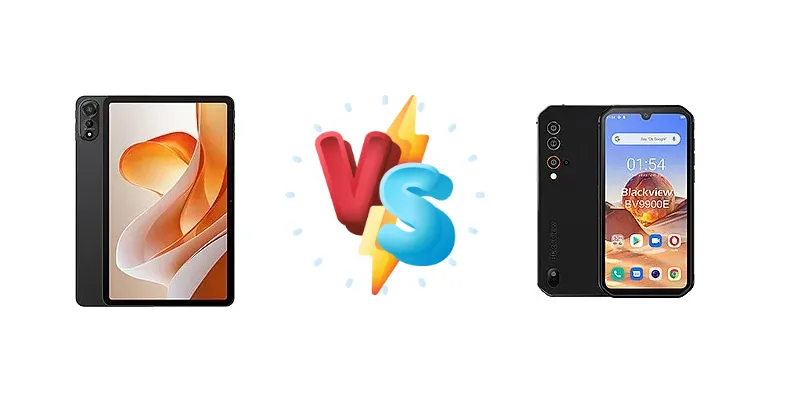
Blackview caters to a niche: durable, long-lasting smartphones. The Mega 2 WiFi prioritizes extreme battery endurance, while the BV9900E aims for a balance of power and ruggedness. This comparison dissects their core differences, helping you determine which aligns with your needs – whether it's days of uptime or a more responsive user experience.
🏆 Quick Verdict
For the average user prioritizing performance and future-proofing, the Blackview BV9900E is the better choice. Its Helio P90 chipset delivers a noticeable speed advantage over the Mega 2 WiFi’s Allwinner A733. However, the Mega 2 WiFi’s exceptional 114-hour battery endurance makes it ideal for those who truly need multi-day power.
| Network |
|---|
| 2G bands | N/A | GSM 850 / 900 / 1800 / 1900 |
| 3G bands | N/A | HSDPA 800 / 850 / 900 / 1700(AWS) / 1900 / 2100 |
| 4G bands | N/A | 1, 2, 3, 4, 5, 7, 8, 12, 13, 17, 18, 19, 20, 25, 26, 28, 34, 38, 39, 40, 41, 66 |
| EDGE | No | - |
| GPRS | No | - |
| Speed | - | HSPA, LTE |
| Technology | No cellular connectivity | GSM / CDMA / HSPA / CDMA2000 / LTE |
| Launch |
|---|
| Announced | 2025, April | 2020, September 10. Released 2020, September |
| Status | Available. Released 2025, April | Discontinued |
| Body |
|---|
| Dimensions | 281.7 x 177.2 x 8 mm (11.09 x 6.98 x 0.31 in) | 156.5 x 78.3 x 14.2 mm (6.16 x 3.08 x 0.56 in) |
| SIM | No | Nano-SIM + Nano-SIM |
| Weight | 615 g (1.36 lb) | 273 g (9.63 oz) |
| Display |
|---|
| Protection | Mohs level 5 | Corning Gorilla Glass 5 |
| Resolution | 1200 x 2000 pixels, 5:3 ratio (~194 ppi density) | 1080 x 2280 pixels, 19:9 ratio (~432 ppi density) |
| Size | 12.0 inches, 409.9 cm2 (~82.1% screen-to-body ratio) | 5.84 inches, 85.1 cm2 (~69.5% screen-to-body ratio) |
| Type | IPS LCD, 90Hz | IPS LCD |
| Platform |
|---|
| CPU | Octa-core (2x2.0 GHz Cortex-A76 & 6x1.8 GHz Cortex-A55) | Octa-core (2x2.2 GHz Cortex-A75 & 6x2.0 GHz Cortex-A55) |
| Chipset | Allwinner A733 (12 nm) | Mediatek MT6779V/CE Helio P90 (12 nm) |
| GPU | IMG BXM-4-64 MC01 | PowerVR GM9446 |
| OS | Android 15, DokeOS_P 4.1 | Android 10 |
| Memory |
|---|
| Card slot | Unspecified | microSDXC |
| Internal | 256GB 12GB RAM | 128GB 6GB RAM |
| Main Camera |
|---|
| Features | LED flash | LED flash, HDR, panorama |
| Quad | - | 48 MP, f/1.8, (wide), PDAF
16 MP, 120˚ (ultrawide)
2 MP (macro)
Auxiliary lens |
| Single | 16 MP | - |
| Video | 1080p@30fps | 4K@30fps, 1080p@60fps |
| Selfie camera |
|---|
| Single | 8 MP | 16 MP, f/2.0, (wide) |
| Video | 1080p@30fps | 1080p@30fps |
| Sound |
|---|
| 35mm jack | Yes | No |
| Loudspeaker | Yes, with stereo speakers | Yes |
| Comms |
|---|
| Bluetooth | 5.2, A2DP | 5.0, A2DP, LE |
| NFC | No | Yes |
| Positioning | No | GPS, GLONASS, GALILEO, BDS |
| Radio | No | FM radio |
| USB | USB Type-C | USB Type-C 2.0, OTG |
| WLAN | Wi-Fi 802.11 a/b/g/n/ac/6, dual-band | Wi-Fi 802.11 a/b/g/n/ac |
| Features |
|---|
| Sensors | Accelerometer | Fingerprint (side-mounted), accelerometer, gyro, proximity, compass, barometer |
| Battery |
|---|
| Charging | 18W wired | 15W wired
18W wireless |
| Type | Li-Po 9000 mAh | 4380 mAh |
| Misc |
|---|
| Colors | Celestial Grey, Ice Blue, Moss Green | Black, Silver |
| Price | - | About 260 EUR |
| EU LABEL |
|---|
| Battery | 114:00h endurance, 900 cycles | - |
| Energy | Class E | - |
| Free fall | Class C (104 falls) | - |
| Repairability | Class B | - |
Blackview Mega 2 WiFi
- Unmatched battery life (114h endurance)
- High charge cycle count (900 cycles)
- Potentially more affordable price point
- Less powerful processor (Allwinner A733)
- Likely slower app loading and multitasking
- May lack wireless charging
Blackview BV9900E
- Faster processor (Helio P90)
- Wireless charging support (18W)
- Potentially better camera image processing
- Shorter battery life compared to Mega 2 WiFi
- Lower charge cycle count (unspecified)
- Potentially higher price
Display Comparison
Neither device boasts a cutting-edge display. Details are missing, but given the price point, expect 720p or 1080p LCD panels. The focus here isn't on visual fidelity. The BV9900E’s inclusion of 18W wireless charging suggests a more premium build, potentially with Gorilla Glass for added screen protection, a feature likely absent on the Mega 2 WiFi.
Camera Comparison
Camera details are sparse. Both phones likely feature multi-camera setups, but the emphasis isn't on photographic excellence. The BV9900E’s chipset includes an integrated image signal processor (ISP) capable of more advanced image processing, potentially resulting in better dynamic range and noise reduction compared to the Mega 2 WiFi’s Allwinner A733 ISP. Expect both to struggle in low-light conditions. Any 2MP macro or depth sensors on either device should be considered marketing filler.
Performance
The core difference lies in the chipsets. The BV9900E’s MediaTek Helio P90 (12nm) features a more powerful CPU configuration – 2x2.2 GHz Cortex-A75 cores versus the Mega 2 WiFi’s 2x2.0 GHz Cortex-A76 cores. While both are 12nm, the Cortex-A75 architecture in the P90 generally offers superior single-core performance, translating to snappier app launches and smoother multitasking. The A76 in the Mega 2 WiFi is more efficient, contributing to its battery life, but lags in raw processing power. Both utilize a 6x2.0 GHz Cortex-A55 cluster for efficiency, but the P90’s overall architecture provides a clear advantage for demanding tasks.
Battery Life
The Blackview Mega 2 WiFi dominates in battery endurance with a claimed 114 hours of use, supported by 900 charge cycles. This is a significant advantage for users prioritizing longevity. The BV9900E, while still offering respectable battery life, is limited to 15W wired charging and 18W wireless. The wireless charging capability is a convenience factor, but the lower wattage means slower overall charging speeds compared to a potentially optimized 18W wired solution on the Mega 2 WiFi. The Mega 2 WiFi’s endurance suggests a larger battery capacity, even if the exact mAh isn’t specified.
Buying Guide
Buy the Blackview Mega 2 WiFi if you absolutely require the longest possible battery life and are willing to trade some processing power for it – perfect for fieldwork, travel in remote areas, or emergency preparedness. Buy the Blackview BV9900E if you value a smoother, more responsive experience for everyday tasks, gaming, and benefit from the convenience of wireless charging, even if it means slightly less battery longevity.
Frequently Asked Questions
❓ Does the Helio P90 in the BV9900E tend to overheat during prolonged gaming sessions?
The Helio P90 is known to generate some heat under sustained load. However, Blackview’s rugged designs often incorporate heat dissipation features. While it won’t match a flagship Snapdragon, the BV9900E should be capable of handling moderate gaming without excessive throttling, especially given its likely larger chassis for heat spreading.
❓ How does the Allwinner A733 in the Mega 2 WiFi handle basic tasks like web browsing and social media?
The Allwinner A733 is sufficient for everyday tasks like web browsing, social media, and video playback. However, expect some lag when multitasking or opening multiple apps simultaneously. It’s optimized for efficiency, prioritizing battery life over raw speed.
❓ Is the wireless charging on the BV9900E significantly slower than wired charging?
Yes, the 18W wireless charging on the BV9900E will be noticeably slower than a comparable wired charging solution. Expect a full charge to take several hours via wireless, while wired charging (at 15W) will be faster, though still not exceptionally quick by modern standards.
❓ What type of ruggedization does each phone offer (IP rating, drop resistance)?
Specific IP ratings and drop resistance details are missing. However, both phones are marketed as 'rugged,' implying resistance to dust, water, and drops. The BV9900E, being a slightly more premium model, likely has a higher IP rating and more robust construction.