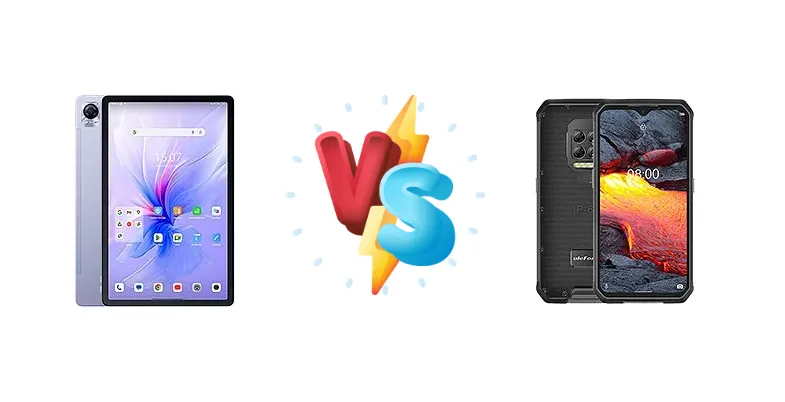
The rugged smartphone market offers durability, but often at the cost of performance. Both the Blackview Mega 1 and Ulefone Armor 9E aim to bridge that gap, but they take different approaches. The Mega 1 leverages a newer, more efficient chipset, while the Armor 9E relies on a slightly older, but still capable, processor. This comparison will dissect the key differences to determine which device delivers the best experience for your needs.
🏆 Quick Verdict
For the average user prioritizing performance and future-proofing, the Blackview Mega 1 is the better choice. Its Mediatek Helio G99 chipset, built on a 6nm process, offers a noticeable efficiency and performance advantage over the Ulefone Armor 9E’s 12nm Helio P90, despite the similar CPU core counts. The faster 33W charging is also a significant benefit.
| Network |
|---|
| 2G bands | GSM 850 / 900 / 1800 / 1900 | GSM 850 / 900 / 1800 / 1900 |
| 3G bands | HSDPA 900 / 2100 | HSDPA 850 / 900 / 1700(AWS) / 1900 / 2100 |
| 4G bands | 1, 3, 7, 8, 19, 20, 28, 40, 41 | 1, 2, 3, 4, 5, 7, 8, 12, 13, 17, 18, 19, 20, 25, 26, 28, 34, 38, 39, 40, 41, 66 |
| Speed | HSPA, LTE | HSPA 42.2/11.5 Mbps, LTE Cat12 600/150 Mbps |
| Technology | GSM / HSPA / LTE | GSM / CDMA / HSPA / EVDO / LTE |
| | - | CDMA2000 1xEV-DO |
| Launch |
|---|
| Announced | 2024, March | 2020, September 08. Released 2020, September 08 |
| Status | Available. Released 2024, March | Discontinued |
| Body |
|---|
| Build | - | Front glass, aluminum back with rubber, aluminum frame |
| Dimensions | 268.7 x 169 x 7.6 mm (10.58 x 6.65 x 0.30 in) | 168.2 x 82 x 15 mm (6.62 x 3.23 x 0.59 in) |
| SIM | Nano-SIM + Nano-SIM | Nano-SIM + Nano-SIM |
| Weight | 528 g (1.16 lb) | 324 g (11.43 oz) |
| | - | IP68/IP69K dust/water resistant (up to 1.5m for 30 min)
Drop-to-concrete resistance from up to 1.2m
MIL-STD-810G compliant |
| Display |
|---|
| Protection | - | Scratch-resistant glass, oleophobic coating |
| Resolution | 1200 x 2000 pixels, 5:3 ratio (~203 ppi density) | 1080 x 2340 pixels, 19.5:9 ratio (~409 ppi density) |
| Size | 11.5 inches, 376.4 cm2 (~82.9% screen-to-body ratio) | 6.3 inches, 97.4 cm2 (~70.6% screen-to-body ratio) |
| Type | IPS LCD, 120Hz, 400 nits | IPS LCD |
| Platform |
|---|
| CPU | Octa-core (2x2.2 GHz Cortex-A76 & 6x2.0 GHz Cortex-A55) | Octa-core (2x2.2 GHz Cortex-A75 & 6x2.0 GHz Cortex-A55) |
| Chipset | Mediatek Helio G99 (6 nm) | Mediatek MT6779 Helio P90 (12 nm) |
| GPU | Mali-G57 MC2 | PowerVR GM9446 |
| OS | Android 13, DokeOS_P 4.0 | Android 10 |
| Memory |
|---|
| Card slot | microSDXC (uses shared SIM slot) | microSDXC (uses shared SIM slot) |
| Internal | 256GB 8GB RAM, 256GB 12GB RAM | 128GB 8GB RAM |
| | - | UFS 2.1 |
| Main Camera |
|---|
| Features | LED flash | Quad-LED flash, HDR, panorama |
| Quad | - | 64 MP, f/1.9, 26mm (wide), 1/1.72", 0.8µm, PDAF
8 MP, f/2.4, 100˚ (ultrawide), 1/4.0", 1.12µm
2 MP (macro)
Auxiliary lens |
| Single | 50 MP, (wide), 1/2.76", 0.64µm | - |
| Video | 1440p@30fps, 1080p@30fps | 4K@30fps, 1080p@30fps |
| Selfie camera |
|---|
| Features | - | HDR, panorama |
| Single | 13 MP | 8 MP, f/2.2 |
| Video | 1080p@30fps | 1080p@30fps |
| Sound |
|---|
| 3.5mm jack | - | Yes |
| 35mm jack | No | Yes |
| Loudspeaker | Yes, with stereo speakers (4 speakers) | Yes |
| Comms |
|---|
| Bluetooth | 5.1, A2DP, LE | 5.0, A2DP, LE |
| NFC | No | Yes |
| Positioning | GPS, GLONASS, GALILEO, BDS | GPS, GLONASS, GALILEO, BDS |
| Radio | FM radio | FM radio, RDS, recording |
| USB | USB Type-C, OTG | USB Type-C 2.0, OTG, accessory connector |
| WLAN | Wi-Fi 802.11 a/b/g/n/ac, dual-band | Wi-Fi 802.11 a/b/g/n/ac, Wi-Fi Direct |
| Features |
|---|
| Sensors | Fingerprint (top-mounted), accelerometer, proximity (accessories only), gyro | Fingerprint (side-mounted), accelerometer, gyro, proximity, compass, coulombmeter |
| | - | Endoscope mount (camera sold separately) |
| Battery |
|---|
| Charging | 33W wired | 18W wired |
| Type | 8800 mAh | Li-Po 6600 mAh |
| Misc |
|---|
| Colors | Space Grey, Sky Blue, Dreamy Purple | Black |
| Price | - | About 290 EUR |
Blackview Mega 1
- More efficient and powerful Mediatek Helio G99 chipset
- Faster 33W wired charging
- Likely better sustained performance due to 6nm process
- Rugged phone design may add bulk
- Camera specs unknown, potential for average image quality
Ulefone Armor 9E
- Proven and reliable Mediatek Helio P90 platform
- Rugged design for durability
- Potentially lower price point
- Slower 18W wired charging
- Less efficient 12nm process, potential for throttling
- Older chipset may struggle with demanding apps
Display Comparison
Neither device’s display specifications are provided, so a direct comparison is limited. However, given the Armor 9E’s older chipset, it’s likely to have a less efficient panel. The Mega 1’s newer processor could potentially drive a higher refresh rate display more effectively, though this is speculative. Rugged phones often prioritize durability over display quality, so expect both to have practical, rather than exceptional, screens.
Camera Comparison
Without specific camera sensor details, a detailed comparison is impossible. However, rugged phones often prioritize practicality over camera prowess. It’s reasonable to assume both devices will feature a multi-camera setup, but image quality will likely be adequate rather than exceptional. The G99’s ISP (Image Signal Processor) in the Mega 1 is likely more advanced, potentially leading to better image processing and low-light performance, but this is dependent on the actual sensors used.
Performance
The core difference lies in the chipsets. The Blackview Mega 1’s Mediatek Helio G99 (6nm) is a significant upgrade over the Ulefone Armor 9E’s Helio P90 (12nm). The 6nm process node allows for greater transistor density and improved power efficiency, translating to better sustained performance and less heat generation. While both CPUs feature a similar core configuration – 2x2.2 GHz Cortex-A76 and 6x2.0 GHz Cortex-A55 – the G99’s architecture benefits from newer optimizations. This means the Mega 1 will likely exhibit smoother multitasking, faster app loading times, and a more enjoyable gaming experience. The Armor 9E’s P90, while capable, will struggle more under sustained load.
Battery Life
Battery capacity isn’t specified for either device. However, the Blackview Mega 1’s 33W wired charging is a clear advantage over the Ulefone Armor 9E’s 18W charging. This faster charging speed will significantly reduce the time it takes to replenish the battery, making the Mega 1 more convenient for users who are frequently on the go. Even with a similar battery capacity, the G99’s superior power efficiency will likely result in longer real-world battery life for the Mega 1.
Buying Guide
Buy the Blackview Mega 1 if you need a rugged phone that can handle demanding tasks like gaming or video editing, and you value faster charging speeds. It’s ideal for users who want a phone that feels responsive and won’t struggle with newer apps. Buy the Ulefone Armor 9E if you prioritize a proven, reliable platform and are less concerned with pushing the limits of mobile performance. It’s a solid choice for basic smartphone use and outdoor activities where extreme processing power isn’t essential.
Frequently Asked Questions
❓ Will the Helio P90 in the Ulefone Armor 9E struggle with graphically intensive games like PUBG or Call of Duty?
The Helio P90 is capable of running these games, but you’ll likely need to lower the graphics settings to achieve a smooth frame rate. The 12nm process and older architecture mean it’s more prone to thermal throttling under sustained load, leading to performance drops during extended gaming sessions. The Blackview Mega 1’s Helio G99 will provide a significantly better gaming experience.
❓ How much faster is the 33W charging on the Blackview Mega 1 compared to the 18W charging on the Ulefone Armor 9E?
While exact charge times depend on battery capacity (which isn't specified), 33W charging will generally reduce the 0-100% charge time by approximately 30-50% compared to 18W. This means you can get a significant top-up in a shorter amount of time, which is particularly useful for a rugged phone that you might be using outdoors and away from power outlets.
❓ Are either of these phones likely to overheat during prolonged use, such as GPS navigation or video recording?
The Ulefone Armor 9E, with its 12nm Helio P90, is more susceptible to overheating under sustained load. The Blackview Mega 1’s 6nm Helio G99 is more power-efficient and will generate less heat, making it the better choice for tasks that require prolonged processing power.