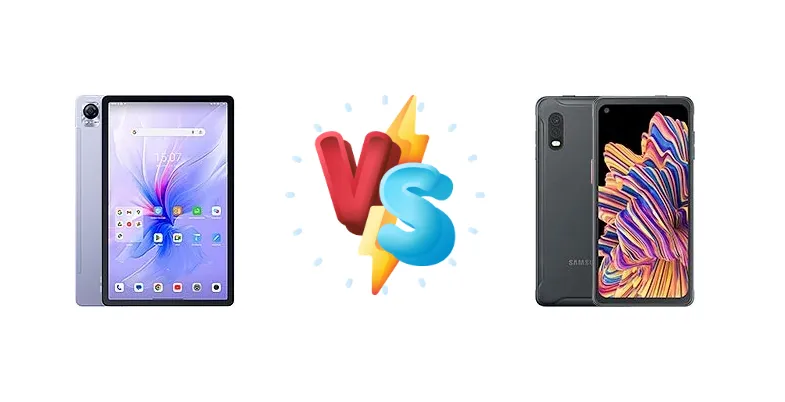
The rugged smartphone market caters to a specific need: durability. Both the Blackview Mega 1 and the Samsung Galaxy XCover Pro aim to deliver on that promise, but they take different approaches to performance and features. The Mega 1 focuses on modern chipset technology and faster charging, while the XCover Pro leverages Samsung’s brand recognition and a more established ecosystem. This comparison will dissect their key differences to determine which device offers the best value for demanding users.
🏆 Quick Verdict
For the average user prioritizing performance and charging speed, the Blackview Mega 1 emerges as the winner. Its Mediatek Helio G99 chipset, built on a 6nm process, offers a noticeable performance advantage over the Samsung Galaxy XCover Pro’s older 10nm Exynos 9611, and the 33W charging significantly reduces downtime. However, the XCover Pro’s Samsung ecosystem integration remains a strong draw for existing Samsung users.
| Network |
|---|
| 2G bands | GSM 850 / 900 / 1800 / 1900 | GSM 850 / 900 / 1800 / 1900 |
| 3G bands | HSDPA 900 / 2100 | HSDPA 850 / 900 / 1900 / 2100 - International |
| 4G bands | 1, 3, 7, 8, 19, 20, 28, 40, 41 | 1, 2, 3, 5, 7, 8, 20, 28, 38, 40, 41 - International |
| Speed | HSPA, LTE | HSPA 42.2/5.76 Mbps, LTE (3CA) Cat11 600/50 Mbps |
| Technology | GSM / HSPA / LTE | GSM / HSPA / LTE |
| | - | 1, 2, 3, 4, 5, 7, 12, 13, 14, 20, 29, 38, 40, 41, 66 - Canada |
| Launch |
|---|
| Announced | 2024, March | 2020, January |
| Status | Available. Released 2024, March | Available. Released 2020, January |
| Body |
|---|
| Dimensions | 268.7 x 169 x 7.6 mm (10.58 x 6.65 x 0.30 in) | 159.9 x 76.7 x 10 mm (6.30 x 3.02 x 0.39 in) |
| SIM | Nano-SIM + Nano-SIM | · Nano-SIM· Nano-SIM + Nano-SIM |
| Weight | 528 g (1.16 lb) | 218 g (7.69 oz) |
| | - | IP68 dust/water resistant (up to 1.5m for 35 min)
Drop-to-concrete resistance from up to 1.5m
MIL-STD-810G compliant*
*does not guarantee ruggedness or use in extreme conditions |
| Display |
|---|
| Protection | - | Corning Gorilla Glass 5 |
| Resolution | 1200 x 2000 pixels, 5:3 ratio (~203 ppi density) | 1080 x 2340 pixels, 19.5:9 ratio (~409 ppi density) |
| Size | 11.5 inches, 376.4 cm2 (~82.9% screen-to-body ratio) | 6.3 inches, 97.4 cm2 (~79.4% screen-to-body ratio) |
| Type | IPS LCD, 120Hz, 400 nits | IPS LCD |
| Platform |
|---|
| CPU | Octa-core (2x2.2 GHz Cortex-A76 & 6x2.0 GHz Cortex-A55) | Octa-core (4x2.3 GHz Cortex-A73 & 4x1.7 GHz Cortex-A53) |
| Chipset | Mediatek Helio G99 (6 nm) | Exynos 9611 (10 nm) |
| GPU | Mali-G57 MC2 | Mali-G72 MP3 |
| OS | Android 13, DokeOS_P 4.0 | Android 10, upgradable to Android 13, One UI 5 |
| Memory |
|---|
| Card slot | microSDXC (uses shared SIM slot) | microSDXC (dedicated slot) |
| Internal | 256GB 8GB RAM, 256GB 12GB RAM | 64GB 4GB RAM |
| Main Camera |
|---|
| Dual | - | 25 MP, f/1.7, 26mm (wide), PDAF
8 MP, f/2.2, 123˚ (ultrawide), 1/4.0", 1.12µm |
| Features | LED flash | Dual-LED flash, HDR, panorama |
| Single | 50 MP, (wide), 1/2.76", 0.64µm | - |
| Video | 1440p@30fps, 1080p@30fps | 1080p@30fps |
| Selfie camera |
|---|
| Features | - | HDR |
| Single | 13 MP | 13 MP, f/2.0, (wide), 1/3.1", 1.12µm |
| Video | 1080p@30fps | 1080p@30fps |
| Sound |
|---|
| 3.5mm jack | - | Yes |
| 35mm jack | No | Yes |
| Loudspeaker | Yes, with stereo speakers (4 speakers) | Yes |
| Comms |
|---|
| Bluetooth | 5.1, A2DP, LE | 5.0, A2DP, LE |
| NFC | No | Yes |
| Positioning | GPS, GLONASS, GALILEO, BDS | GPS, GLONASS, GALILEO, BDS |
| Radio | FM radio | FM radio (market/region dependent) |
| USB | USB Type-C, OTG | USB Type-C 2.0 |
| WLAN | Wi-Fi 802.11 a/b/g/n/ac, dual-band | Wi-Fi 802.11 a/b/g/n/ac/k/v/r, dual-band, Wi-Fi Direct |
| Features |
|---|
| Sensors | Fingerprint (top-mounted), accelerometer, proximity (accessories only), gyro | Fingerprint (side-mounted), accelerometer, gyro, proximity, compass |
| | - | ANT+ |
| Battery |
|---|
| Charging | 33W wired | 15W wired |
| Type | 8800 mAh | Li-Po 4050 mAh, removable |
| Misc |
|---|
| Colors | Space Grey, Sky Blue, Dreamy Purple | Black |
| Models | - | SM-G715FN/DS, SM-G715FN, SM-G715F, SM-G715W, SM-G715U, SM-G715U1 |
| Price | - | About 120 EUR |
| SAR EU | - | 0.47 W/kg (head) 1.23 W/kg (body) |
Blackview Mega 1
- More powerful and efficient Mediatek Helio G99 chipset
- Significantly faster 33W wired charging
- Likely better value for the performance offered
- Less established brand reputation
- Software support may be less extensive than Samsung
Samsung Galaxy XCover Pro
- Samsung ecosystem integration and software support
- Potential for enterprise features like Knox
- Established brand reputation for durability
- Older and less efficient Exynos 9611 chipset
- Slower 15W wired charging
- Potentially higher price for comparable performance
Display Comparison
Neither device boasts a cutting-edge display. While specific display specs (resolution, panel type) are missing for both, the focus is clearly on durability, not visual fidelity. The lack of information prevents a direct comparison of brightness or color accuracy. However, the XCover Pro’s history suggests a focus on outdoor visibility, a common requirement for rugged devices. The Mega 1’s display is likely optimized for power efficiency given the G99 chipset’s focus.
Camera Comparison
Without detailed camera specifications beyond the presence of cameras, a thorough comparison is difficult. However, the market positioning suggests the XCover Pro might prioritize image processing quality through Samsung’s software algorithms. The Mega 1 likely focuses on providing a functional camera system adequate for documentation and basic photography. The presence of a 2MP macro camera on either device is largely a marketing tactic, offering minimal practical benefit due to the small sensor size and limited resolution.
Performance
The core difference lies in the chipsets. The Blackview Mega 1’s Mediatek Helio G99 (6nm) is a significantly newer architecture than the Samsung Galaxy XCover Pro’s Exynos 9611 (10nm). The G99 utilizes Cortex-A76 cores clocked at 2.2 GHz, offering a substantial performance uplift over the XCover Pro’s Cortex-A73 cores at 2.3 GHz. The 6nm process node of the G99 also translates to improved thermal efficiency, reducing the likelihood of performance throttling during sustained workloads. While the XCover Pro’s CPU clock speed is higher, the architectural improvements and process node advantage of the G99 give the Mega 1 the edge in real-world performance. The G99’s GPU will also provide a better gaming experience.
Battery Life
Battery capacity is not specified for either device, making a direct mAh comparison impossible. However, the charging speeds are a clear differentiator. The Blackview Mega 1’s 33W wired charging is significantly faster than the Samsung Galaxy XCover Pro’s 15W charging. This means the Mega 1 will replenish its battery much quicker, reducing downtime. While a larger battery capacity on the XCover Pro could offset the slower charging, the G99’s efficiency likely means the Mega 1 can achieve comparable battery life with a smaller capacity.
Buying Guide
Buy the Blackview Mega 1 if you need a rugged phone with modern processing power for demanding tasks like gaming or running multiple apps, and if fast charging is a priority. You’ll benefit from a more responsive experience and less time tethered to a wall charger. Buy the Samsung Galaxy XCover Pro if you prefer the familiarity of the Samsung ecosystem, require compatibility with Samsung’s enterprise solutions (like Knox), and prioritize a brand with a long-standing reputation for software support, even if it means sacrificing some raw performance.
Frequently Asked Questions
❓ Does the Exynos 9611 in the Galaxy XCover Pro tend to overheat during prolonged use, like gaming?
The Exynos 9611, being a 10nm chip, is known to generate more heat than newer, more efficient chipsets. While Samsung’s thermal management is generally good, extended gaming sessions or demanding tasks could lead to noticeable throttling, reducing performance to prevent overheating. The Blackview Mega 1’s 6nm Helio G99 is less prone to this issue.
❓ Is the 33W charging on the Blackview Mega 1 truly faster in real-world use, or is it just a marketing number?
The 33W charging on the Mega 1 is a significant improvement over the XCover Pro’s 15W. While actual charging times depend on battery size and current charge level, you can expect the Mega 1 to charge from 0-100% considerably faster – likely in under 2 hours, compared to potentially 3+ hours for the XCover Pro. This makes a tangible difference in daily usability.
❓ How does the software support compare between Blackview and Samsung?
Samsung is renowned for its long-term software support, typically offering multiple years of Android updates and security patches for its devices. Blackview, as a smaller manufacturer, generally provides less extensive software support. While the Mega 1 will likely receive updates, they may be less frequent and for a shorter duration than those offered by Samsung.