
Blackview Mega 1 vs Nokia XR20: A Detailed Performance and Value Showdown
| Phones Images | |||||
|---|---|---|---|---|---|
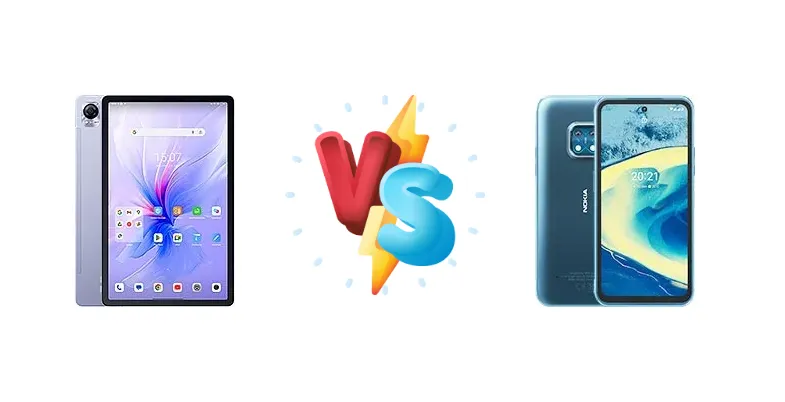
|
🏆 Quick Verdict
For users prioritizing gaming and demanding applications, the Blackview Mega 1 emerges as the winner thanks to its more powerful Helio G99 chipset. However, the Nokia XR20’s 5G connectivity, wireless charging, and ruggedized build make it a compelling choice for those valuing network speed and device longevity.
| PHONES | ||
|---|---|---|
| Phone Names | Blackview Mega 1 | Nokia XR20 |
| Network | ||
|---|---|---|
| 2G bands | GSM 850 / 900 / 1800 / 1900 | GSM 850 / 900 / 1800 / 1900 |
| 3G bands | HSDPA 900 / 2100 | HSDPA 850 / 900 / 1700(AWS) / 1900 / 2100 |
| 4G bands | 1, 3, 7, 8, 19, 20, 28, 40, 41 | 1, 2, 3, 4, 5, 7, 8, 12, 13, 14, 20, 25, 26, 28, 30, 38, 40, 41, 48, 66, 71 |
| 5G bands | - | 2, 5, 25, 38, 41, 48, 66, 77, 78 SA/NSA |
| Speed | HSPA, LTE | HSPA, LTE, 5G |
| Technology | GSM / HSPA / LTE | GSM / CDMA / HSPA / EVDO / LTE / 5G |
| - | CDMA2000 1xEV-DO | |
| Launch | ||
|---|---|---|
| Announced | 2024, March | 2021, July 27 |
| Status | Available. Released 2024, March | Available. Released 2021, August 04 |
| Body | ||
|---|---|---|
| Dimensions | 268.7 x 169 x 7.6 mm (10.58 x 6.65 x 0.30 in) | 171.6 x 81.5 x 10.6 mm (6.76 x 3.21 x 0.42 in) |
| SIM | Nano-SIM + Nano-SIM | · Nano-SIM· Nano-SIM + Nano-SIM |
| Weight | 528 g (1.16 lb) | 248 g (8.75 oz) |
| - | IP68 dust/water resistant (up to 1.5m for 60 min) Drop-to-concrete resistance from up to 1.8m MIL-STD-810H compliant | |
| Display | ||
|---|---|---|
| Protection | - | Corning Gorilla Glass Victus |
| Resolution | 1200 x 2000 pixels, 5:3 ratio (~203 ppi density) | 1080 x 2400 pixels, 20:9 ratio (~395 ppi density) |
| Size | 11.5 inches, 376.4 cm2 (~82.9% screen-to-body ratio) | 6.67 inches, 107.4 cm2 (~76.8% screen-to-body ratio) |
| Type | IPS LCD, 120Hz, 400 nits | IPS LCD, 550 nits |
| Platform | ||
|---|---|---|
| CPU | Octa-core (2x2.2 GHz Cortex-A76 & 6x2.0 GHz Cortex-A55) | Octa-core (2x2.0 GHz Kryo 460 & 6x1.8 GHz Kryo 460) |
| Chipset | Mediatek Helio G99 (6 nm) | Qualcomm SM4350 Snapdragon 480 5G (8 nm) |
| GPU | Mali-G57 MC2 | Adreno 619 |
| OS | Android 13, DokeOS_P 4.0 | Android 11, upgradable to Android 13 |
| Memory | ||
|---|---|---|
| Card slot | microSDXC (uses shared SIM slot) | microSDXC (uses shared SIM slot) |
| Internal | 256GB 8GB RAM, 256GB 12GB RAM | 64GB 4GB RAM, 128GB 6GB RAM |
| Main Camera | ||
|---|---|---|
| Dual | - | 48 MP, f/1.8, (wide), 1/2.25", 0.8µm, PDAF 13 MP, f/2.4, 123˚ (ultrawide), 1/3.0", 1.12µm |
| Features | LED flash | Zeiss optics, Dual-LED dual-tone flash, second LED flash, HDR, panorama |
| Single | 50 MP, (wide), 1/2.76", 0.64µm | 8 MP, f/2.0 (wide), 1/4.0", 1.12µm |
| Video | 1440p@30fps, 1080p@30fps | 1080p@30fps |
| Selfie camera | ||
|---|---|---|
| Single | 13 MP | 8 MP, f/2.0 (wide), 1/4.0", 1.12µm |
| Video | 1080p@30fps | 1080p@30fps |
| Sound | ||
|---|---|---|
| 3.5mm jack | - | Yes |
| 35mm jack | No | Yes |
| Loudspeaker | Yes, with stereo speakers (4 speakers) | Yes, with stereo speakers |
| Comms | ||
|---|---|---|
| Bluetooth | 5.1, A2DP, LE | 5.1, A2DP, LE, aptX Adaptive |
| NFC | No | Yes |
| Positioning | GPS, GLONASS, GALILEO, BDS | GPS (L1+L5), GLONASS, BDS, GALILEO, QZSS, NavIC |
| Radio | FM radio | Unspecified |
| USB | USB Type-C, OTG | USB Type-C 3.0 |
| WLAN | Wi-Fi 802.11 a/b/g/n/ac, dual-band | Wi-Fi 802.11 a/b/g/n/ac/6, dual-band, Wi-Fi Direct |
| Features | ||
|---|---|---|
| Sensors | Fingerprint (top-mounted), accelerometer, proximity (accessories only), gyro | Fingerprint (side-mounted), accelerometer, gyro, proximity, compass, barometer |
| Battery | ||
|---|---|---|
| Charging | 33W wired | 18W wired 15W wireless |
| Type | 8800 mAh | Li-Po 4630 mAh |
| Misc | ||
|---|---|---|
| Colors | Space Grey, Sky Blue, Dreamy Purple | Ultra Blue, Granite Gray |
| Models | - | TA-1368, TA-1362 |
| Price | - | About 270 EUR |
| SAR EU | - | 1.13 W/kg (head) 1.43 W/kg (body) |
Blackview Mega 1
- More powerful processor for gaming and multitasking
- Faster 33W wired charging
- Potentially better thermal management due to 6nm process
- Lacks 5G connectivity
- Likely less durable build quality
Nokia XR20
- 5G connectivity for faster data speeds
- Ruggedized design for enhanced durability
- Wireless charging for added convenience
- Less powerful processor for demanding tasks
- Slower 18W wired charging
Display Comparison
Neither device boasts a standout display. While specific display specs are missing, the focus here is on the underlying processors. The display quality will likely be similar, targeting the budget segment. Bezels are expected to be noticeable on both, and color accuracy will likely be adequate but not exceptional. The absence of high refresh rates on either device suggests a focus on power efficiency rather than visual fluidity.
Camera Comparison
Without detailed camera specs, a direct comparison is limited. However, the market positioning suggests both phones will feature competent but not class-leading camera systems. The focus will likely be on the main sensor, and any additional sensors (like the often-present 2MP macro) will be of limited utility. Image processing will likely differ, with Nokia traditionally favoring more natural tones and Blackview potentially leaning towards more vibrant, saturated images. The absence of OIS on either device suggests reliance on software stabilization.
Performance
The core difference lies in the chipsets. The Blackview Mega 1’s Mediatek Helio G99 (6nm) features a more powerful CPU configuration – 2x2.2 GHz Cortex-A76 cores alongside 6x2.0 GHz Cortex-A55 cores – compared to the Nokia XR20’s Qualcomm Snapdragon 480 5G (8nm) with 2x2.0 GHz Kryo 460 cores and 6x1.8 GHz Kryo 460 cores. The 6nm process of the G99 generally translates to better power efficiency and thermal performance at similar clock speeds. While the Snapdragon 480 offers 5G connectivity, the G99 provides a noticeable advantage in CPU-intensive tasks and gaming. The 8nm process of the Snapdragon 480 is larger, potentially leading to slightly higher power consumption under load.
Battery Life
The Blackview Mega 1’s 33W wired charging is significantly faster than the Nokia XR20’s 18W wired and 15W wireless charging. This means the Mega 1 will achieve a full charge much quicker. While battery capacity isn’t specified, the faster charging speed of the Blackview is a clear advantage for users who frequently need to top up their device. The Nokia XR20’s wireless charging offers convenience, but at a slower rate. The Snapdragon 480’s 8nm process *could* contribute to slightly better standby battery life, but the G99’s efficiency gains might offset this during active use.
Buying Guide
Buy the Blackview Mega 1 if you need a phone for mobile gaming, video editing, or running demanding apps, and fast charging is a priority. You'll benefit from the G99's superior CPU and GPU performance. Buy the Nokia XR20 if you prioritize 5G connectivity, a rugged and durable design for outdoor use, and the convenience of wireless charging. It’s the better option for users who need a reliable phone that can withstand harsh conditions.