
Blackview Hero 10 vs. Ulefone Armor 10 5G: A Rugged Showdown
| Phones Images | |||||
|---|---|---|---|---|---|
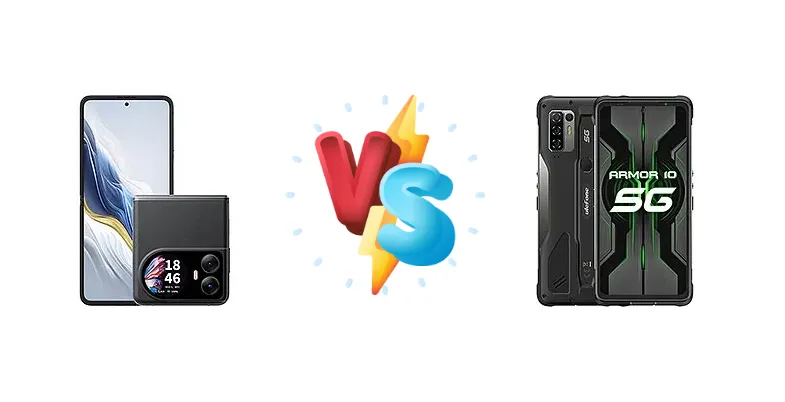
|
🏆 Quick Verdict
For the average user prioritizing all-day battery life and efficient performance, the Blackview Hero 10 emerges as the winner. Its Helio G99 chipset, coupled with exceptional 40:06h endurance, provides a more consistent experience than the Ulefone Armor 10 5G, despite the latter's 5G capabilities.
| PHONES | ||
|---|---|---|
| Phone Names | Blackview Hero 10 | Ulefone Armor 10 5G |
| Network | ||
|---|---|---|
| 2G bands | GSM 850 / 900 / 1800 / 1900 | GSM 850 / 900 / 1800 / 1900 |
| 3G bands | HSDPA 800 / 850 / 900 / 1700(AWS) / 1900 / 2100 | HSDPA 850 / 900 / 1700(AWS) / 1900 / 2100 |
| 4G bands | 1, 2, 3, 4, 5, 7, 8, 12, 17, 18, 19, 20, 26, 28, 38, 40, 41, 66 | 1, 2, 3, 4, 5, 7, 8, 12, 13, 17, 18, 19, 20, 25, 26, 28, 34, 38, 39, 40, 41, 66 |
| 5G bands | - | 1, 3, 41, 77, 78, 79 SA/NSA |
| Speed | HSPA, LTE | HSPA, LTE, 5G |
| Technology | GSM / CDMA / HSPA / LTE | GSM / CDMA / HSPA / EVDO / LTE / 5G |
| - | CDMA2000 1xEV-DO | |
| Launch | ||
|---|---|---|
| Announced | 2024, May | 2020, November 17. Released 2020, December 07 |
| Status | Available. Released 2024, May | Discontinued |
| Body | ||
|---|---|---|
| Build | - | Front glass, aluminum back with rubber, aluminum frame |
| Dimensions | Unfolded: 169 x 75.5 x 8.1 mmFolded: 87 x 75.5 x 16.3 mm | 176.5 x 82.8 x 14.6 mm (6.95 x 3.26 x 0.57 in) |
| SIM | Nano-SIM + Nano-SIM | Nano-SIM + Nano-SIM |
| Weight | 198 g (6.98 oz) | 328 g (11.57 oz) |
| - | IP68 dust/water resistant (up to 1.5m for 30 min) Drop-to-concrete resistance from up to 1.2m MIL-STD-810G compliant | |
| Display | ||
|---|---|---|
| Protection | Mohs level 6 | Scratch-resistant glass, oleophobic coating |
| Resolution | 1080 x 2560 pixels (~403 ppi density) | 1080 x 2400 pixels, 20:9 ratio (~395 ppi density) |
| Size | 6.9 inches, 110.0 cm2 (~86.2% screen-to-body ratio) | 6.67 inches, 107.4 cm2 (~73.5% screen-to-body ratio) |
| Type | Foldable AMOLED, 1B colors, 1300 nits (peak) | IPS LCD |
| Platform | ||
|---|---|---|
| CPU | Octa-core (2x2.2 GHz Cortex-A76 & 6x2.0 GHz Cortex-A55) | Octa-core (4x2.0 GHz Cortex-A76 & 4x2.0 GHz Cortex-A55) |
| Chipset | Mediatek Helio G99 (6 nm) | Mediatek Dimensity 800 (7 nm) |
| GPU | Mali-G57 MC2 | Mali-G57 MP4 |
| OS | Android 13, DokeOS 4 | Android 10, planned upgrade to Android 11 |
| Memory | ||
|---|---|---|
| Card slot | No | microSDXC (uses shared SIM slot) |
| Internal | 256GB 12GB RAM | 128GB 8GB RAM |
| Main Camera | ||
|---|---|---|
| Dual | 108 MP, f/1.9, (wide), 1/1.67" , PDAF 8 MP, 120˚ (ultrawide) | - |
| Features | LED flash, HDR, panorama | LED flash, Panorama, HDR |
| Quad | - | 64 MP, f/1.9, 26mm (wide), 1/1.72", 0.8µm, PDAF 8 MP, f/2.2, 119˚ (ultrawide) 5 MP (macro) Auxiliary lens |
| Video | 1440p@30fps, 1080p@30fps | 4K@30fps, 1080p@30fps |
| Selfie camera | ||
|---|---|---|
| Single | 32 MP, f/2.5, (wide) | 16 MP, f/2.2 |
| Video | 1080p@30fps | 1080p@30fps |
| Sound | ||
|---|---|---|
| 3.5mm jack | - | Yes |
| 35mm jack | No | Yes |
| Loudspeaker | Yes, with stereo speakers | Yes |
| Comms | ||
|---|---|---|
| Bluetooth | Yes | 5.2, A2DP, LE |
| NFC | Yes | Yes |
| Positioning | GPS, GLONASS, GALILEO, BDS | GPS, GLONASS, GALILEO, BDS |
| Radio | No | FM radio, RDS, recording |
| USB | USB Type-C | USB Type-C 2.0, OTG |
| WLAN | Wi-Fi 802.11 a/b/g/n/ac, dual-band | Wi-Fi 802.11 a/b/g/n/ac, Wi-Fi Direct |
| Features | ||
|---|---|---|
| Sensors | Fingerprint (side-mounted), accelerometer, proximity | Fingerprint (side-mounted), accelerometer, gyro, proximity, compass, baroceptor, coulombmeter |
| Battery | ||
|---|---|---|
| Charging | 45W wired, 48% in 20 min | 15W wired 15W wireless |
| Type | 4000 mAh | Li-Po 5800 mAh |
| Misc | ||
|---|---|---|
| Colors | Black, Purple | Black |
| Price | About 600 EUR | About 420 EUR |
| EU LABEL | ||
|---|---|---|
| Battery | 40:06h endurance, 800 cycles | - |
| Energy | Class B | - |
| Free fall | Class D (56 falls) | - |
| Repairability | Class C | - |
Blackview Hero 10
- Exceptional battery life (40:06h endurance)
- More efficient chipset (Helio G99, 6nm)
- Faster wired charging (45W)
- Lacks 5G connectivity
- No wireless charging
Ulefone Armor 10 5G
- 5G connectivity
- Wireless charging support
- Potentially higher peak performance (Dimensity 800)
- Lower battery endurance (estimated)
- Slower charging speeds (15W)
- Less efficient chipset (Dimensity 800, 7nm)
Display Comparison
Display specifications are not provided, but given the market segment, both likely feature durable, if not cutting-edge, LCD panels. The focus here isn't on visual fidelity, but on visibility in direct sunlight and scratch resistance. The absence of details prevents a direct comparison, but rugged phones typically prioritize durability over display quality.
Camera Comparison
Camera details are absent, but in this price range, expectations should be tempered. Both phones likely feature a multi-camera setup with a primary sensor, an ultrawide, and potentially a macro lens. The quality will depend heavily on image processing algorithms. Without sensor size or aperture information, it’s difficult to assess which phone will deliver superior image quality, but the focus should be on reliable performance in various lighting conditions rather than flagship-level photography.
Performance
The core difference lies in the chipsets. The Blackview Hero 10’s Mediatek Helio G99 (6nm) is a newer design, offering a balance of power and efficiency. Its octa-core configuration (2x2.2 GHz Cortex-A76 & 6x2.0 GHz Cortex-A55) is optimized for gaming and multitasking. The Ulefone Armor 10 5G utilizes the older Mediatek Dimensity 800 (7nm). While the Dimensity 800 boasts a slightly different core arrangement (4x2.0 GHz Cortex-A76 & 4x2.0 GHz Cortex-A55), the 7nm process node is less efficient than the G99’s 6nm, potentially leading to more heat generation under sustained load. The G99’s architecture is geared towards sustained performance, while the Dimensity 800 may offer short bursts of higher performance but throttle more quickly.
Battery Life
Battery life is a significant differentiator. The Blackview Hero 10 boasts an impressive 40:06h endurance, suggesting a large battery capacity and efficient power management. This is a major advantage for users who need their phone to last through long days or extended trips. The Ulefone Armor 10 5G, while offering 15W wired and wireless charging, doesn’t provide endurance data. The slower charging speed of the Ulefone (48% in 20 minutes for the Blackview vs. unspecified for the Ulefone) combined with potentially lower endurance makes the Hero 10 the better choice for minimizing downtime.
Buying Guide
Buy the Blackview Hero 10 if you need a phone that will reliably last through multi-day trips or demanding work shifts, and you value efficient performance for everyday tasks. Buy the Ulefone Armor 10 5G if you absolutely require 5G connectivity and prefer the convenience of wireless charging, even if it means sacrificing some battery endurance and potentially experiencing more thermal throttling during extended use.