
Blackview Hero 10 vs BV8800: A Deep Dive into Rugged Phone Performance and Battery Life
| Phones Images | |||||
|---|---|---|---|---|---|
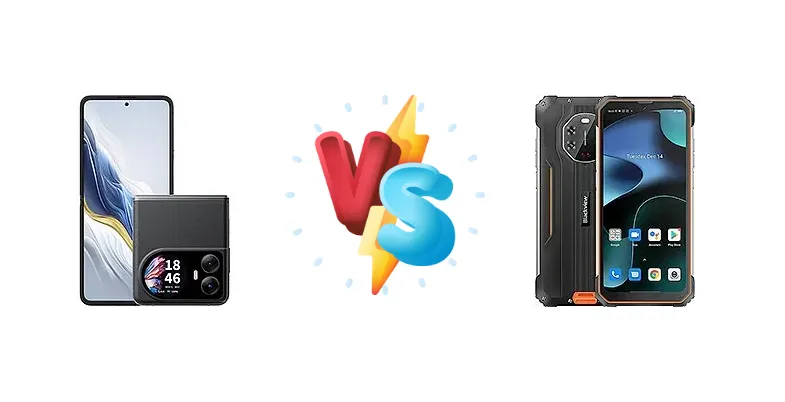
|
🏆 Quick Verdict
For most users, the Blackview Hero 10 emerges as the superior choice. Its Helio G99 chipset, coupled with an astonishing 40:06h endurance rating, significantly outperforms the BV8800’s 199h. While the BV8800 offers reverse wired charging, the Hero 10’s overall efficiency and performance make it the more compelling option.
| PHONES | ||
|---|---|---|
| Phone Names | Blackview Hero 10 | Blackview BV8800 |
| Network | ||
|---|---|---|
| 2G bands | GSM 850 / 900 / 1800 / 1900 | GSM 850 / 900 / 1800 / 1900 |
| 3G bands | HSDPA 800 / 850 / 900 / 1700(AWS) / 1900 / 2100 | HSDPA 800 / 850 / 900 / 1700(AWS) / 1900 / 2100 |
| 4G bands | 1, 2, 3, 4, 5, 7, 8, 12, 17, 18, 19, 20, 26, 28, 38, 40, 41, 66 | 1, 2, 3, 4, 5, 7, 8, 12, 13, 17, 18, 19, 20, 25, 26, 28, 30, 34, 38, 39, 40, 41, 66 |
| Speed | HSPA, LTE | HSPA, LTE |
| Technology | GSM / CDMA / HSPA / LTE | GSM / CDMA / HSPA / CDMA2000 / LTE |
| - | CDMA2000 1x | |
| Launch | ||
|---|---|---|
| Announced | 2024, May | 2021, December 24 |
| Status | Available. Released 2024, May | Available. Released 2022, January 10 |
| Body | ||
|---|---|---|
| Dimensions | Unfolded: 169 x 75.5 x 8.1 mmFolded: 87 x 75.5 x 16.3 mm | 176.2 x 83.5 x 17.7 mm (6.94 x 3.29 x 0.70 in) |
| SIM | Nano-SIM + Nano-SIM | Nano-SIM + Nano-SIM |
| Weight | 198 g (6.98 oz) | 367 g (12.95 oz) |
| - | IP68/IP69K dust/water resistant (up to 1.5m for 30 min) Drop-to-concrete resistance from up to 1.5m MIL-STD-810H compliant | |
| Display | ||
|---|---|---|
| Protection | Mohs level 6 | - |
| Resolution | 1080 x 2560 pixels (~403 ppi density) | 1080 x 2408 pixels, 20:9 ratio (~401 ppi density) |
| Size | 6.9 inches, 110.0 cm2 (~86.2% screen-to-body ratio) | 6.58 inches, 104.3 cm2 (~70.9% screen-to-body ratio) |
| Type | Foldable AMOLED, 1B colors, 1300 nits (peak) | IPS LCD, 90Hz, 480 nits |
| Platform | ||
|---|---|---|
| CPU | Octa-core (2x2.2 GHz Cortex-A76 & 6x2.0 GHz Cortex-A55) | Octa-core (2x2.05 GHz Cortex-A76 & 6x2.0 GHz Cortex-A55) |
| Chipset | Mediatek Helio G99 (6 nm) | Mediatek MT6781 Helio G96 (12 nm) |
| GPU | Mali-G57 MC2 | Mali-G57 MC2 |
| OS | Android 13, DokeOS 4 | Android 11, Doke-OS 3.0 |
| Memory | ||
|---|---|---|
| Card slot | No | No |
| Internal | 256GB 12GB RAM | 128GB 8GB RAM |
| - | UFS 2.1 | |
| Main Camera | ||
|---|---|---|
| Dual | 108 MP, f/1.9, (wide), 1/1.67" , PDAF 8 MP, 120˚ (ultrawide) | - |
| Features | LED flash, HDR, panorama | Dual-LED flash, HDR, panorama |
| Quad | - | 50 MP, f/1.8, (wide), PDAF 8 MP, f/2.2, 117˚ (ultrawide) 20 MP, f/1.8, (IR camera), 2 IR emitters Auxiliary lens |
| Single | - | 16 MP, f/2.0, (wide) |
| Video | 1440p@30fps, 1080p@30fps | 1440p@30fps |
| Selfie camera | ||
|---|---|---|
| Single | 32 MP, f/2.5, (wide) | 16 MP, f/2.0, (wide) |
| Video | 1080p@30fps | 1080p@30fps |
| Sound | ||
|---|---|---|
| 3.5mm jack | - | No |
| 35mm jack | No | No |
| Loudspeaker | Yes, with stereo speakers | Yes |
| Comms | ||
|---|---|---|
| Bluetooth | Yes | 5.2, A2DP, LE |
| NFC | Yes | Yes |
| Positioning | GPS, GLONASS, GALILEO, BDS | GPS, GLONASS, GALILEO, BDS |
| Radio | No | FM radio |
| USB | USB Type-C | USB Type-C 2.0, OTG |
| WLAN | Wi-Fi 802.11 a/b/g/n/ac, dual-band | Wi-Fi 802.11 a/b/g/n/ac |
| Features | ||
|---|---|---|
| Sensors | Fingerprint (side-mounted), accelerometer, proximity | Fingerprint (side-mounted), accelerometer, gyro, proximity, compass, barometer |
| Battery | ||
|---|---|---|
| Charging | 45W wired, 48% in 20 min | 33W wired, 31% in 30 min, 100% in 90 min Reverse wired |
| Type | 4000 mAh | 8380 mAh |
| Misc | ||
|---|---|---|
| Colors | Black, Purple | Black, Orange, Green |
| Price | About 600 EUR | About 350 EUR |
| Tests | ||
|---|---|---|
| Battery life | - | Endurance rating 199h |
| Camera | - | Photo / Video |
| Display | - | Contrast ratio: 1348:1 (nominal) |
| Loudspeaker | - | -29.3 LUFS (Average) |
| Performance | - | AnTuTu: 254849 (v8), 288964 (v9) GeekBench: 1752 (v5.1) GFXBench: 10fps (ES 3.1 onscreen) |
| EU LABEL | ||
|---|---|---|
| Battery | 40:06h endurance, 800 cycles | - |
| Energy | Class B | - |
| Free fall | Class D (56 falls) | - |
| Repairability | Class C | - |
Blackview Hero 10
- Exceptional battery life (40:06h endurance)
- More efficient and powerful Helio G99 chipset
- Faster charging (48% in 20 minutes)
- Display brightness specification missing
- Camera specifications are vague
Blackview BV8800
- Measured peak display brightness (501 nits)
- Reverse wired charging capability
- Proven reliability (established model)
- Significantly shorter battery life (199h endurance)
- Older, less efficient Helio G96 chipset
- Slower charging speeds
Display Comparison
Both devices share a 1348:1 contrast ratio, suggesting similar visual pop. However, the BV8800 provides a measured peak brightness of 501 nits, a figure the Hero 10’s display specifications lack. This suggests the BV8800 may be more visible in direct sunlight. Without PWM frequency data for the Hero 10, it’s difficult to assess potential flicker-related eye strain compared to the BV8800, but the lack of information is a concern for sensitive users.
Camera Comparison
Both phones list 'Photo / Video' capabilities, but lack specific details regarding sensor size, aperture, or image stabilization. This makes a direct comparison impossible. The absence of information suggests neither phone is targeting photography enthusiasts. The usefulness of any included macro camera (likely 2MP on both) is questionable, offering limited detail and dynamic range. Without further data, we can only assume similar image quality based on the shared chipset’s ISP capabilities.
Performance
The Blackview Hero 10’s Mediatek Helio G99 (6nm) represents a significant architectural leap over the BV8800’s Helio G96 (12nm). The smaller 6nm node translates to improved power efficiency and reduced heat generation, allowing for sustained performance. While both CPUs feature the same core configuration (2x2.2 GHz Cortex-A76 & 6x2.0 GHz Cortex-A55), the G99’s higher clock speed and more efficient architecture will deliver a noticeable performance boost in gaming and multitasking. The Hero 10 is likely to exhibit less thermal throttling under sustained load.
Battery Life
The Blackview Hero 10 dominates in battery endurance with a staggering 40:06h rating, dwarfing the BV8800’s 199h. This difference is substantial and translates to days of use on a single charge for the Hero 10. While the BV8800 charges to 31% in 30 minutes and 100% in 90 minutes, the Hero 10 reaches 48% in just 20 minutes, offering significantly faster initial charging. The BV8800’s inclusion of reverse wired charging is a unique feature, allowing it to act as a power bank, but this comes at the cost of overall battery life and charging speed.
Buying Guide
Buy the Blackview Hero 10 if you prioritize all-day (and multi-day) battery life, need a modern chipset for smoother performance in demanding apps, and value faster charging speeds. Buy the Blackview BV8800 if you specifically require reverse wired charging functionality to power other devices in the field, and are willing to trade battery endurance and processing power for this feature.