
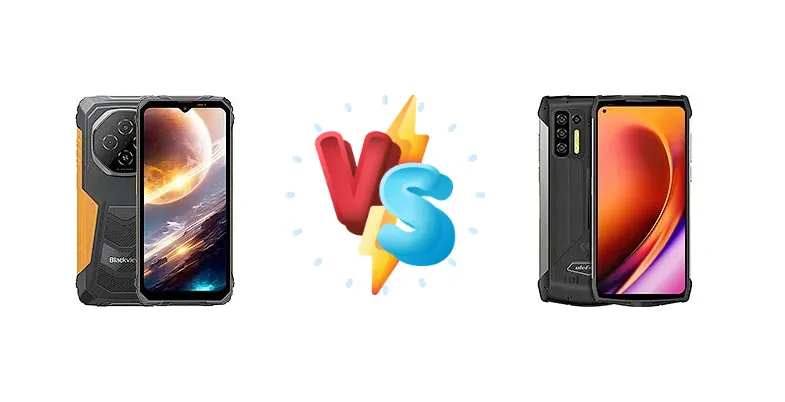
Blackview Fort 1 vs. Ulefone Power Armor 13: A Deep Dive into Rugged Phone Endurance
| Phones Images | |||||
|---|---|---|---|---|---|
|
🏆 Quick Verdict
For users prioritizing maximum uptime and long-term battery health, the Blackview Fort 1 is the clear winner. Its exceptional 97:15h endurance rating and 800 charge cycles significantly outperform the Ulefone Power Armor 13’s 296h rating. However, the Power Armor 13’s faster 33W charging and wireless charging capabilities offer convenience the Fort 1 lacks.
| PHONES | ||
|---|---|---|
| Phone Names | Blackview Fort 1 | Ulefone Power Armor 13 |
| Network | ||
|---|---|---|
| 2G bands | GSM 850 / 900 / 1800 / 1900 | GSM 850 / 900 / 1800 / 1900 |
| 3G bands | HSDPA 850 / 900 / 1700(AWS) / 1900 / 2100 | HSDPA 850 / 900 / 1700(AWS) / 1900 / 2100 |
| 4G bands | 1, 2, 3, 4, 5, 7, 8, 12, 13, 17, 19, 20, 26, 28, 40, 41, 66 | 1, 2, 3, 4, 5, 7, 8, 12, 13, 17, 18, 19, 20, 25, 26, 28, 38, 40, 66 |
| Speed | HSPA, LTE | HSPA 42.2/11.5 Mbps, LTE Cat12 600/150 Mbps |
| Technology | GSM / HSPA / LTE | GSM / HSPA / LTE |
| Launch | ||
|---|---|---|
| Announced | 2025, September | 2021, July 22 |
| Status | Available. Released 2025, September | Available. Released 2021, July 26 |
| Body | ||
|---|---|---|
| Dimensions | 176.2 x 80.1 x 17.5 mm (6.94 x 3.15 x 0.69 in) | 183.7 x 85.4 x 20.8 mm (7.23 x 3.36 x 0.82 in) |
| SIM | Nano-SIM + Nano-SIM | Nano-SIM + Nano-SIM |
| Weight | 390 g (13.76 oz) | 492 g (1.08 lb) |
| - | IP68 dust/water resistant (up to 1.5m for 30 min) Drop-to-concrete resistance from up to 1.2m MIL-STD-810G compliant | |
| Display | ||
|---|---|---|
| Protection | Panda Glass, Mohs level 8 | Corning Gorilla Glass 3 |
| Resolution | 720 x 1612 pixels, 20:9 ratio (~269 ppi density) | 1080 x 2400 pixels, 20:9 ratio (~386 ppi density) |
| Size | 6.56 inches, 103.4 cm2 (~73.2% screen-to-body ratio) | 6.81 inches, 112.0 cm2 (~71.4% screen-to-body ratio) |
| Type | IPS LCD, 90Hz, 450 nits | IPS LCD |
| Platform | ||
|---|---|---|
| CPU | Octa-core (2x1.8 GHz Cortex-A75 & 6x1.6 GHz Cortex-A55) | Octa-core (2x2.05 GHz Cortex-A76 & 6x2.0 GHz Cortex-A55) |
| Chipset | Unisoc T615 (12 nm) | Mediatek MT6785V/CD Helio G95 (12 nm) |
| GPU | Mali-G57 MP1 | Mali-G76 MC4 |
| OS | Android 15, DokeOS 4.2 | Android 11 |
| Memory | ||
|---|---|---|
| Card slot | microSDXC (dedicated slot) | microSDXC (uses shared SIM slot) |
| Internal | 128GB 4GB RAM, 256GB 6GB RAM | 256GB 8GB RAM |
| Main Camera | ||
|---|---|---|
| Dual | 16 MP, f/1.8, (wide), 1/3.06" Auxiliary lens | - |
| Features | LED flash, HDR, panorama | Quad-LED flash, HDR, panorama |
| Penta | - | 48 MP, f/1.8, 26mm (wide), 1/2.0", 0.8µm, PDAF 8 MP, f/2.2, (ultrawide) 2 MP (macro) Auxiliary lens |
| Video | 1080p@30fps | 4K@30fps, 1080p@30fps |
| Selfie camera | ||
|---|---|---|
| Features | HDR | HDR, panorama |
| Single | 8 MP, f/2.2, (wide), 1/5.0" | 16 MP, f/2.2 |
| Video | 1080p@30fps | 1080p@30fps |
| Sound | ||
|---|---|---|
| 3.5mm jack | - | Yes |
| 35mm jack | No | Yes |
| Loudspeaker | Yes | Yes |
| Comms | ||
|---|---|---|
| Bluetooth | 5.2, A2DP, LE | 5.0, A2DP, LE |
| NFC | Yes | Yes |
| Positioning | GPS, GLONASS, GALILEO, BDS | GPS, GLONASS, GALILEO, BDS |
| Radio | FM radio | FM radio, RDS, recording |
| USB | USB Type-C, OTG | - |
| WLAN | Wi-Fi 802.11 a/b/g/n/ac, dual-band | Wi-Fi 802.11 a/b/g/n/ac, dual-band |
| Features | ||
|---|---|---|
| Sensors | Fingerprint (side-mounted), accelerometer, proximity | Fingerprint (side-mounted), accelerometer, gyro, proximity, compass, baroceptor, coulombmeter |
| - | Infrared distance measure (error range: 1~20m, ±10mm; 20~40m, ±25mm) | |
| Battery | ||
|---|---|---|
| Charging | 18W wired 5W reverse wired | 33W wired 15W wireless 5W reverse wireless |
| Type | Li-Po 10000 mAh | Li-Po 13200 mAh |
| Misc | ||
|---|---|---|
| Colors | Black, Orange, Green | Black |
| Price | - | About 300 EUR |
| Tests | ||
|---|---|---|
| Battery life | - | Endurance rating 296h |
| Camera | - | Photo / Video |
| Display | - | Contrast ratio: 1306:1 (nominal) |
| Loudspeaker | - | -28.3 LUFS (Average) |
| Performance | - | AnTuTu: 294194 (v8), 351678 (v9) GeekBench: 1610 (v5.1) GFXBench: 18fps (ES 3.1 onscreen) |
| EU LABEL | ||
|---|---|---|
| Battery | 97:15h endurance, 800 cycles | - |
| Energy | Class B | - |
| Free fall | Class A (276 falls) | - |
| Repairability | Class B | - |
Blackview Fort 1
- Unmatched battery endurance (97:15h)
- Exceptional battery lifespan (800 charge cycles)
- Solid performance for everyday tasks
- Slower charging speeds (18W)
- Less powerful processor compared to the Power Armor 13
- Display specifications are unknown
Ulefone Power Armor 13
- Faster charging (33W wired, 15W wireless)
- More powerful Mediatek Helio G95 processor
- Decent display brightness (401 nits)
- Significantly lower battery endurance (296h)
- Battery lifespan likely shorter than the Fort 1
- Camera details are lacking
Display Comparison
The Ulefone Power Armor 13 provides a measured peak brightness of 401 nits and a 1306:1 contrast ratio. While the Blackview Fort 1’s display specifications are not provided, the Power Armor 13’s contrast ratio suggests a decent viewing experience. The 401 nits brightness is adequate for outdoor visibility, but not exceptional. Neither device is likely to feature advanced display technologies like LTPO, focusing instead on durability and power efficiency.
Camera Comparison
Both devices list 'Photo / Video' capabilities, but lack specific details. Without sensor size, aperture, or image processing information, a direct comparison is impossible. It’s reasonable to assume both phones will offer acceptable image quality in good lighting conditions, but likely struggle in low-light scenarios. The presence of a 2MP macro camera on either device is unlikely to significantly enhance the photographic experience, serving primarily as a marketing feature.
Performance
The Ulefone Power Armor 13 leverages the Mediatek Helio G95 chipset, featuring an octa-core CPU with 2x2.05 GHz Cortex-A76 and 6x2.0 GHz Cortex-A55 cores. This represents a significant performance advantage over the Blackview Fort 1’s Unisoc T615 (2x1.8 GHz Cortex-A75 & 6x1.6 GHz Cortex-A55). The G95’s Cortex-A76 cores offer superior single-core performance, translating to snappier app launches and smoother multitasking. While both chipsets are fabricated on a 12nm process, the G95’s architecture is more modern and efficient for demanding applications. The Fort 1 will handle everyday tasks adequately, but the Power Armor 13 is better suited for gaming and resource-intensive apps.
Battery Life
The Blackview Fort 1’s standout feature is its incredible 97:15h endurance rating and 800 charge cycles. This suggests the phone can operate for an exceptionally long time on a single charge and maintain battery health over an extended period. In contrast, the Ulefone Power Armor 13 offers a 296h endurance rating. While still respectable, it falls far short of the Fort 1. The Power Armor 13 compensates with faster charging: 33W wired, 15W wireless, and 5W reverse wireless, compared to the Fort 1’s 18W wired and 5W reverse wired. This means the Power Armor 13 can replenish its battery much quicker, but at the cost of overall longevity.
Buying Guide
Buy the Blackview Fort 1 if you need a phone that can reliably last for days on a single charge, especially in situations where access to power is limited. This is ideal for outdoor professionals, travelers, or anyone who simply wants to minimize charging frequency. Buy the Ulefone Power Armor 13 if you prefer a more balanced approach, valuing faster charging speeds (including wireless) and a more powerful processor for demanding tasks, even if it means slightly less overall battery endurance.