
Blackview Fort 1 vs BV9800 Pro: Which Rugged Phone Reigns Supreme?
| Phones Images | |||||
|---|---|---|---|---|---|
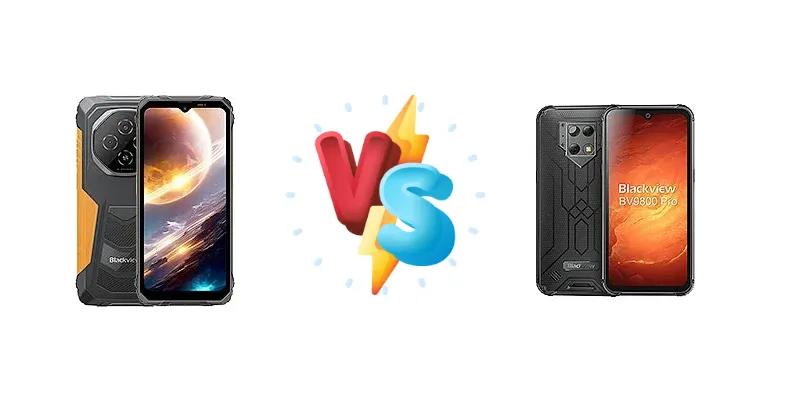
|
🏆 Quick Verdict
For the average user prioritizing longevity and reliable performance for everyday tasks, the Blackview Fort 1 is the better choice. Its exceptional 97:15h battery endurance and efficient Unisoc T615 chipset provide a worry-free experience. However, users demanding more processing power for demanding apps or gaming should lean towards the BV9800 Pro.
| PHONES | ||
|---|---|---|
| Phone Names | Blackview Fort 1 | Blackview BV9800 Pro |
| Network | ||
|---|---|---|
| 2G bands | GSM 850 / 900 / 1800 / 1900 | GSM 850 / 900 / 1800 / 1900 |
| 3G bands | HSDPA 850 / 900 / 1700(AWS) / 1900 / 2100 | HSDPA 800 / 850 / 900 / 1700(AWS) / 1900 / 2100 |
| 4G bands | 1, 2, 3, 4, 5, 7, 8, 12, 13, 17, 19, 20, 26, 28, 40, 41, 66 | 1, 2, 3, 4, 5, 6, 7, 8, 12, 13, 17, 18, 19, 20, 25, 26, 28, 34, 38, 39, 40, 41, 66 |
| Speed | HSPA, LTE | HSPA, LTE |
| Technology | GSM / HSPA / LTE | GSM / CDMA / HSPA / CDMA2000 / LTE |
| Launch | ||
|---|---|---|
| Announced | 2025, September | 2019, October 28. Released 2019, November |
| Status | Available. Released 2025, September | Discontinued |
| Body | ||
|---|---|---|
| Dimensions | 176.2 x 80.1 x 17.5 mm (6.94 x 3.15 x 0.69 in) | 168.5 x 81 x 14.8 mm (6.63 x 3.19 x 0.58 in) |
| SIM | Nano-SIM + Nano-SIM | Nano-SIM + Nano-SIM |
| Weight | 390 g (13.76 oz) | 322 g (11.36 oz) |
| Display | ||
|---|---|---|
| Protection | Panda Glass, Mohs level 8 | - |
| Resolution | 720 x 1612 pixels, 20:9 ratio (~269 ppi density) | 1080 x 2340 pixels, 19.5:9 ratio (~409 ppi density) |
| Size | 6.56 inches, 103.4 cm2 (~73.2% screen-to-body ratio) | 6.3 inches, 97.4 cm2 (~71.4% screen-to-body ratio) |
| Type | IPS LCD, 90Hz, 450 nits | IPS LCD |
| Platform | ||
|---|---|---|
| CPU | Octa-core (2x1.8 GHz Cortex-A75 & 6x1.6 GHz Cortex-A55) | Octa-core (4x2.1 GHz Cortex-A73 & 4x2.0 GHz Cortex-A53) |
| Chipset | Unisoc T615 (12 nm) | Mediatek MT6771V/CT Helio P70 (12 nm) |
| GPU | Mali-G57 MP1 | Mali-G72 MP3 |
| OS | Android 15, DokeOS 4.2 | Android 9.0 (Pie) |
| Memory | ||
|---|---|---|
| Card slot | microSDXC (dedicated slot) | microSDXC |
| Internal | 128GB 4GB RAM, 256GB 6GB RAM | 128GB 6GB RAM |
| Main Camera | ||
|---|---|---|
| Dual | 16 MP, f/1.8, (wide), 1/3.06" Auxiliary lens | - |
| Features | LED flash, HDR, panorama | Thermal imaging, LED flash |
| Triple | - | 48 MP, (wide), PDAF 5 MP, thermal assisted camera FLIR thermal camera (Lepton module) |
| Video | 1080p@30fps | 1080p@30fps |
| Selfie camera | ||
|---|---|---|
| Features | HDR | - |
| Single | 8 MP, f/2.2, (wide), 1/5.0" | 16 MP, f/2.0, (wide) |
| Video | 1080p@30fps | 1080p@30fps |
| Sound | ||
|---|---|---|
| 35mm jack | No | Yes |
| Loudspeaker | Yes | Yes |
| Comms | ||
|---|---|---|
| Bluetooth | 5.2, A2DP, LE | 4.1, A2DP |
| NFC | Yes | Yes |
| Positioning | GPS, GLONASS, GALILEO, BDS | GPS, GLONASS, GALILEO |
| Radio | FM radio | FM radio |
| USB | USB Type-C, OTG | USB Type-C 2.0, OTG |
| WLAN | Wi-Fi 802.11 a/b/g/n/ac, dual-band | Wi-Fi 802.11 a/b/g/n/ac |
| Features | ||
|---|---|---|
| Sensors | Fingerprint (side-mounted), accelerometer, proximity | Fingerprint (side-mounted), accelerometer, gyro, proximity, compass, barometer |
| Battery | ||
|---|---|---|
| Charging | 18W wired 5W reverse wired | 18W wired |
| Type | Li-Po 10000 mAh | 6580 mAh |
| Misc | ||
|---|---|---|
| Colors | Black, Orange, Green | Black, Orange |
| Price | - | About 340 EUR |
| EU LABEL | ||
|---|---|---|
| Battery | 97:15h endurance, 800 cycles | - |
| Energy | Class B | - |
| Free fall | Class A (276 falls) | - |
| Repairability | Class B | - |
Blackview Fort 1
- Exceptional battery life (97:15h endurance)
- More power-efficient chipset (Unisoc T615)
- 5W reverse wired charging
- Potentially better sustained performance due to thermal efficiency
- Less powerful CPU compared to the BV9800 Pro
- Display specifications unknown, potentially lower quality
Blackview BV9800 Pro
- More powerful CPU (Helio P70) for demanding tasks
- Faster app loading and multitasking
- Potentially better camera performance (speculation)
- Slightly older 'Pro' model may have some software optimizations
- Significantly shorter battery life compared to the Fort 1
- Less power-efficient chipset
- No reverse wired charging
Display Comparison
Neither device's display specifications are provided, so a direct comparison is limited. However, given the price points, we can assume both utilize IPS LCD panels. The BV9800 Pro, being the older model, may have slightly lower peak brightness. The Fort 1's focus on endurance suggests a potentially more power-efficient display panel, even if resolution and refresh rate are similar.
Camera Comparison
Camera specifications are absent, making a detailed comparison impossible. However, Blackview typically equips its rugged phones with serviceable, rather than flagship-level, cameras. We can infer that both phones likely feature a multi-camera setup with a primary sensor, an ultrawide, and potentially a depth or macro lens. The BV9800 Pro, being a slightly older 'Pro' model, *might* have a marginally better primary sensor, but image processing quality will likely be similar.
Performance
The core difference lies in the chipsets. The BV9800 Pro’s MediaTek Helio P70 (MT6771V/CT) features a more powerful CPU configuration – four Cortex-A73 cores clocked at 2.1 GHz versus the Fort 1’s two Cortex-A75 cores at 1.8 GHz. This translates to faster app loading times and smoother multitasking on the BV9800 Pro. However, the Unisoc T615 in the Fort 1, built on a 12nm process, is more power-efficient. The A75 cores in the Fort 1 are newer architecture, offering improved performance per watt compared to the A73 cores in the BV9800 Pro, mitigating some of the clock speed difference. The BV9800 Pro will likely excel in CPU-intensive tasks, while the Fort 1 prioritizes sustained performance and thermal management.
Battery Life
This is where the Fort 1 truly shines. Its 97:15h endurance rating is exceptional, indicating significantly longer usage between charges than the BV9800 Pro. While both phones offer 18W wired charging, the Fort 1’s larger battery capacity (unspecified, but implied to be substantial given the endurance) will take longer to fully charge. The Fort 1 also includes 5W reverse wired charging, a feature absent on the BV9800 Pro, allowing it to top up smaller devices like earbuds or smartwatches.
Buying Guide
Buy the Blackview Fort 1 if you need a phone that can genuinely last for days on a single charge, and your usage primarily involves communication, navigation, and light media consumption. It’s ideal for outdoor workers, travelers, or anyone who dislikes frequent charging. Buy the Blackview BV9800 Pro if you prefer a smoother experience with more demanding applications, and are willing to compromise on ultimate battery life for increased processing capability. This phone is better suited for users who enjoy mobile gaming or frequently multitask.