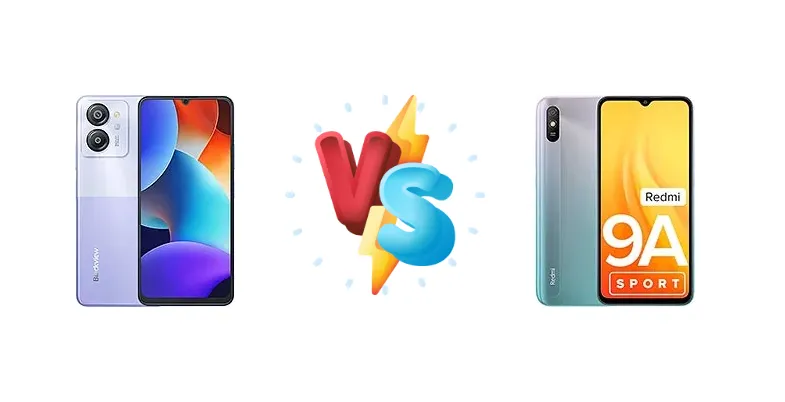
The sub-$150 smartphone market is fiercely competitive. Both the Blackview Color 8 and Xiaomi Redmi 9A Sport aim to deliver essential smartphone functionality at an incredibly accessible price point. However, they take different approaches to achieving this, primarily through their chipset choices. This comparison dissects those differences and determines which device offers the best overall experience.
🏆 Quick Verdict
For most users, the Blackview Color 8 emerges as the stronger choice. Its Unisoc Tiger T616 chipset, featuring Cortex-A75 cores, provides a noticeable performance advantage over the Redmi 9A Sport’s Helio G25, especially in multitasking and demanding applications. While the Redmi 9A Sport offers a familiar Xiaomi software experience, the Color 8’s superior processing power justifies its slight price premium.
| Network |
|---|
| 2G bands | GSM 850 / 900 / 1800 / 1900 | GSM 850 / 900 / 1800 / 1900 |
| 3G bands | HSDPA 900 / 2100 - International | HSDPA 850 / 900 / 2100 |
| 4G bands | 1, 3, 7, 8, 19, 20, 28, 40, 41 - International | 1, 3, 5, 8, 40, 41 |
| Speed | HSPA, LTE | HSPA, LTE |
| Technology | GSM / HSPA / LTE | GSM / HSPA / LTE |
| Launch |
|---|
| Announced | 2024, January | 2021, September 28 |
| Status | Available. Released 2024, January | Available. Released 2021, September 28 |
| Body |
|---|
| Dimensions | 167.8 x 77.4 x 9.1 mm (6.61 x 3.05 x 0.36 in) | 164.9 x 77.1 x 9 mm (6.49 x 3.04 x 0.35 in) |
| SIM | Nano-SIM + Nano-SIM | Nano-SIM + Nano-SIM |
| Weight | 214 g (7.55 oz) | 194 g (6.84 oz) |
| | - | Water-repellent coating |
| Display |
|---|
| Resolution | 720 x 1600 pixels, 20:9 ratio (~260 ppi density) | 720 x 1600 pixels, 20:9 ratio (~269 ppi density) |
| Size | 6.75 inches, 110.0 cm2 (~84.7% screen-to-body ratio) | 6.53 inches, 102.9 cm2 (~81.0% screen-to-body ratio) |
| Type | IPS LCD, 90Hz, 450 nits (typ) | IPS LCD, 400 nits (typ) |
| Platform |
|---|
| CPU | Octa-core (2x2.0 GHz Cortex-A75 & 6x1.8 GHz Cortex-A55) | Octa-core (4x2.0 GHz Cortex-A53 & 4x1.5 GHz Cortex-A53) |
| Chipset | Unisoc Tiger T616 (12 nm) | Mediatek MT6762G Helio G25 (12 nm) |
| GPU | Mali-G57 MP1 | PowerVR GE8320 |
| OS | Android 13, Doke OS 4.0 | Android 10, MIUI 12 |
| Memory |
|---|
| Card slot | microSDXC (dedicated slot) | microSDXC (dedicated slot) |
| Internal | 256GB 8GB RAM | 32GB 2GB RAM, 32GB 3GB RAM |
| | - | eMMC 5.1 |
| Main Camera |
|---|
| Dual | 50 MP, (wide), 1/2.76, 0.64µm, PDAF
Secondary unspecified camera | - |
| Features | LED flash, HDR, panorama | LED flash, HDR |
| Single | - | 13 MP, f/2.2, 28mm (wide), 1.0µm, PDAF |
| Video | 1080p@30fps | 1080p@30/60fps |
| Selfie camera |
|---|
| Features | - | HDR |
| Single | 8 MP, (wide), 1/4.0, 1.12µm | 5 MP, f/2.2, (wide), 1.12µm |
| Video | 1080p@30fps | 1080p@30fps |
| Sound |
|---|
| 3.5mm jack | - | Yes |
| 35mm jack | Yes | Yes |
| Loudspeaker | Yes | Yes |
| Comms |
|---|
| Bluetooth | 5.0, A2DP, LE | 5.0, A2DP, LE |
| NFC | No | No |
| Positioning | GPS, GLONASS, GALILEO, BDS | GPS, GLONASS, BDS |
| Radio | FM radio | FM radio |
| USB | USB Type-C, OTG | microUSB 2.0, OTG |
| WLAN | Wi-Fi 802.11 a/b/g/n/ac, dual-band | Wi-Fi 802.11 a/b/g/n, Wi-Fi Direct |
| Features |
|---|
| Sensors | Fingerprint (side-mounted), accelerometer, proximity | Accelerometer, proximity |
| Battery |
|---|
| Charging | 18W wired | 10W wired |
| Type | 6000 mAh | Li-Po 5000 mAh |
| Misc |
|---|
| Colors | Ash Gray, Ripple Blue, Wisteria Purple | Carbon Black, Coral Green, Metallic Blue |
| Price | About 150 EUR | About 100 EUR |
Blackview Color 8
- Superior processor performance with Cortex-A75 cores
- Faster 18W wired charging
- Potentially better image processing due to chipset
- Less established brand recognition
- Software updates may be less frequent
Xiaomi Redmi 9A Sport
- Familiar MIUI software experience
- Strong brand reputation and support
- Generally lower price point
- Significantly weaker processor performance
- Slower 10W charging
- May struggle with multitasking and demanding apps
Display Comparison
Neither device boasts a standout display. Both utilize standard LCD panels, and detailed specifications like resolution and brightness are not provided. However, the focus should be on the processing power needed to drive more complex display features. The Color 8’s more capable chipset suggests it could handle higher refresh rates (if supported, which is unknown) with less strain, potentially leading to smoother animations. Bezels are likely comparable given the price bracket, and color accuracy is expected to be basic on both.
Camera Comparison
Camera performance is likely to be similar on both devices, given the focus on cost reduction. Without detailed sensor information, it’s difficult to make definitive claims. However, the processing capabilities of the Unisoc T616 in the Color 8 *could* translate to slightly better image processing, particularly in low-light conditions. Expect basic image quality suitable for social media sharing, but not professional-grade photography. The presence of a 2MP macro lens on either device is largely a marketing gimmick and unlikely to deliver significant value.
Performance
This is where the Color 8 truly differentiates itself. The Unisoc Tiger T616 features two Cortex-A75 cores clocked at 2.0 GHz, paired with six Cortex-A55 cores. This architecture is significantly more powerful than the Redmi 9A Sport’s Helio G25, which utilizes four Cortex-A53 cores at 2.0 GHz and four more at 1.5 GHz. The A75 cores offer a substantial IPC (Instructions Per Clock) improvement over the A53, resulting in faster app loading times and smoother multitasking. While both chipsets are built on a 12nm process, the architectural advantage of the T616 is undeniable. The Redmi 9A Sport will likely struggle with more demanding applications and heavier multitasking loads.
Battery Life
Both devices offer adequate battery life for basic usage. The Redmi 9A Sport’s 10W charging is significantly slower than the Color 8’s 18W charging. This means the Color 8 will reach a full charge much faster, reducing downtime. While battery capacity isn’t specified, the more efficient Unisoc T616 in the Color 8 may also contribute to slightly longer battery life, even with similar capacity, due to reduced power consumption during typical tasks.
Buying Guide
Buy the Blackview Color 8 if you prioritize responsiveness and the ability to handle multiple apps simultaneously, or if you occasionally engage in light gaming. Its more powerful processor will translate to a smoother daily experience. Buy the Xiaomi Redmi 9A Sport if you are deeply embedded in the Xiaomi ecosystem and value its MIUI software features, or if your usage is limited to basic tasks like calls, texts, and light social media browsing. The Redmi 9A Sport offers a familiar and streamlined experience for minimalists.
Frequently Asked Questions
❓ Will the Redmi 9A Sport struggle with popular apps like Facebook and WhatsApp over time?
While the Redmi 9A Sport can handle basic apps like Facebook and WhatsApp initially, the Helio G25’s limited processing power may lead to slowdowns and lag as apps are updated and become more resource-intensive. The Blackview Color 8’s Unisoc T616 offers more headroom for future app updates and sustained performance.
❓ Is the 18W charging on the Blackview Color 8 a significant advantage in real-world use?
Yes, the 18W charging is a noticeable improvement. A full charge will take considerably less time compared to the Redmi 9A Sport’s 10W charging, minimizing downtime and ensuring you can quickly get back to using your phone. Expect a roughly 30-50% faster charge time.
❓ Can either of these phones handle basic mobile games like PUBG Mobile or Call of Duty Mobile?
Both phones can *run* these games, but the experience will differ drastically. The Redmi 9A Sport will likely require the lowest graphics settings and may still experience significant frame drops. The Blackview Color 8, with its more powerful processor, will offer a smoother experience at medium settings, though it’s still not ideal for demanding mobile gaming.