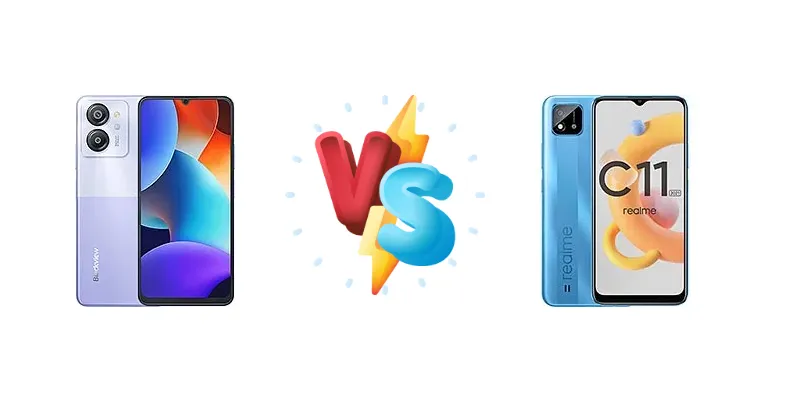
The sub-$150 smartphone market is fiercely competitive. Both the Blackview Color 8 and the Realme C11 (2021) aim to deliver essential smartphone functionality at an accessible price. However, they take different approaches to achieving this, with significant differences in chipset architecture and charging capabilities. This comparison will dissect these differences to determine which device offers the best value for budget-conscious consumers.
🏆 Quick Verdict
For most users, the Blackview Color 8 emerges as the stronger choice. Its Unisoc Tiger T616 chipset, built on a more modern 12nm process, provides a noticeable performance advantage over the Realme C11 (2021)'s older 28nm Unisoc SC9863A. The faster 18W charging also significantly improves usability, making the Color 8 a more compelling daily driver.
| Network |
|---|
| 2G bands | GSM 850 / 900 / 1800 / 1900 | GSM 850 / 900 / 1800 / 1900 |
| 3G bands | HSDPA 900 / 2100 - International | HSDPA 850 / 900 / 1900 / 2100 |
| 4G bands | 1, 3, 7, 8, 19, 20, 28, 40, 41 - International | 1, 3, 5, 8, 38, 40, 41 |
| Speed | HSPA, LTE | HSPA, LTE |
| Technology | GSM / HSPA / LTE | GSM / HSPA / LTE |
| Launch |
|---|
| Announced | 2024, January | 2021, June 28 |
| Status | Available. Released 2024, January | Available. Released 2021, June 28 |
| Body |
|---|
| Build | - | Glass front, plastic frame, plastic back |
| Dimensions | 167.8 x 77.4 x 9.1 mm (6.61 x 3.05 x 0.36 in) | 165.2 x 76.4 x 8.9 mm (6.50 x 3.01 x 0.35 in) |
| SIM | Nano-SIM + Nano-SIM | Nano-SIM + Nano-SIM |
| Weight | 214 g (7.55 oz) | 190 g (6.70 oz) |
| | - | Splash resistant design |
| Display |
|---|
| Resolution | 720 x 1600 pixels, 20:9 ratio (~260 ppi density) | 720 x 1600 pixels, 20:9 ratio (~269 ppi density) |
| Size | 6.75 inches, 110.0 cm2 (~84.7% screen-to-body ratio) | 6.52 inches, 102.6 cm2 (~81.3% screen-to-body ratio) |
| Type | IPS LCD, 90Hz, 450 nits (typ) | IPS LCD, 400 nits (typ) |
| Platform |
|---|
| CPU | Octa-core (2x2.0 GHz Cortex-A75 & 6x1.8 GHz Cortex-A55) | Octa-core (4x1.6 GHz Cortex-A55 & 4x1.2 GHz Cortex-A55) |
| Chipset | Unisoc Tiger T616 (12 nm) | Unisoc SC9863A (28 nm) |
| GPU | Mali-G57 MP1 | IMG8322 |
| OS | Android 13, Doke OS 4.0 | Android 11, Realme Go UI |
| Memory |
|---|
| Card slot | microSDXC (dedicated slot) | microSDXC (dedicated slot) |
| Internal | 256GB 8GB RAM | 32GB 2GB RAM, 64GB 4GB RAM |
| | - | eMMC 5.1 |
| Main Camera |
|---|
| Dual | 50 MP, (wide), 1/2.76, 0.64µm, PDAF
Secondary unspecified camera | - |
| Features | LED flash, HDR, panorama | LED flash, HDR, panorama |
| Single | - | 8 MP, f/2.0, (wide), AF |
| Video | 1080p@30fps | 1080p@30fps |
| Selfie camera |
|---|
| Features | - | HDR, panorama |
| Single | 8 MP, (wide), 1/4.0, 1.12µm | 5 MP, f/2.2, (wide) |
| Video | 1080p@30fps | 1080p@30fps |
| Sound |
|---|
| 3.5mm jack | - | Yes |
| 35mm jack | Yes | Yes |
| Loudspeaker | Yes | Yes |
| Comms |
|---|
| Bluetooth | 5.0, A2DP, LE | 4.2, A2DP |
| NFC | No | No |
| Positioning | GPS, GLONASS, GALILEO, BDS | GPS, GLONASS, GALILEO, BDS |
| Radio | FM radio | Unspecified |
| USB | USB Type-C, OTG | microUSB 2.0, OTG |
| WLAN | Wi-Fi 802.11 a/b/g/n/ac, dual-band | Wi-Fi 802.11 b/g/n |
| Features |
|---|
| Sensors | Fingerprint (side-mounted), accelerometer, proximity | Accelerometer, gyro, proximity, compass |
| Battery |
|---|
| Charging | 18W wired | 10W wired
Reverse wired |
| Type | 6000 mAh | 5000 mAh |
| Misc |
|---|
| Colors | Ash Gray, Ripple Blue, Wisteria Purple | Cool Blue, Cool Grey |
| Models | - | RMX3231 |
| Price | About 150 EUR | About 80 EUR |
Blackview Color 8
- Faster processor for smoother performance
- More efficient 12nm chipset
- Significantly faster 18W charging
- May lack reverse charging functionality
- Specific battery capacity unknown
Realme C11 (2021)
- Reverse wired charging for accessories
- Potentially lower price point
- Simple and easy-to-use interface
- Slower and less efficient processor
- 28nm chipset prone to throttling
- Slow 10W charging
Display Comparison
Neither device boasts a standout display. Both likely utilize IPS LCD panels, common in this price bracket. However, detailed specs like resolution and peak brightness are missing. The focus here is on internal components. The display quality will likely be similar, adequate for basic viewing but not ideal for media consumption. Bezels are expected to be substantial on both devices, reflecting their budget positioning.
Camera Comparison
Camera performance is likely to be similar, with both phones probably featuring a primary sensor paired with basic auxiliary lenses. Without specific sensor details, it’s difficult to make a definitive judgment. However, the processing capabilities of the T616 in the Color 8 may offer slightly better image quality due to its more powerful CPU. The Realme C11’s camera system is likely optimized for basic point-and-shoot photography, while the Color 8 might offer a bit more flexibility in post-processing.
Performance
The core difference lies in the chipsets. The Blackview Color 8’s Unisoc Tiger T616 (12nm) features a more modern architecture with 2x 2.0 GHz Cortex-A75 cores and 6x 1.8 GHz Cortex-A55 cores. This contrasts sharply with the Realme C11 (2021)’s Unisoc SC9863A (28nm) which uses 4x 1.6 GHz Cortex-A55 and 4x 1.2 GHz Cortex-A55 cores. The 12nm process node of the T616 is significantly more efficient, leading to better performance and thermal management. The A75 cores in the Color 8 provide a substantial boost in single-core performance, crucial for app responsiveness. The older, less efficient 28nm SC9863A in the C11 will struggle with demanding tasks and likely exhibit more noticeable throttling under sustained load.
Battery Life
While battery capacity isn't specified, the charging speeds are a key differentiator. The Blackview Color 8 supports 18W wired charging, significantly faster than the Realme C11 (2021)’s 10W charging. This translates to a much quicker 0-100% charge time for the Color 8. The Realme C11 does offer reverse wired charging, allowing it to act as a power bank for other devices, a niche feature that may appeal to some users, but it doesn't compensate for the slower overall charging speed.
Buying Guide
Buy the Blackview Color 8 if you prioritize performance for multitasking, light gaming, and smoother app operation. It’s ideal for users who want a phone that feels responsive and charges quickly. Buy the Realme C11 (2021) if your primary needs are basic communication – calls, texts, and very light app usage – and you value the convenience of reverse wired charging for accessories, even at the cost of slower overall performance and charging speeds.
Frequently Asked Questions
❓ Will the Unisoc Tiger T616 in the Blackview Color 8 handle popular games like PUBG Mobile?
The Unisoc Tiger T616 is capable of running PUBG Mobile, but you'll likely need to lower the graphics settings to medium or low to achieve a playable frame rate. The chipset isn't designed for high-end gaming, but it provides a better experience than the SC9863A in the Realme C11 (2021).
❓ How much faster is the 18W charging on the Blackview Color 8 compared to the 10W charging on the Realme C11 (2021)?
The 18W charging on the Color 8 will significantly reduce charging times. While exact figures depend on battery capacity, expect a 0-100% charge to take roughly 2-3 hours on the Color 8, compared to 4-5 hours on the C11 (2021). This makes a substantial difference for users who need to quickly top up their battery.
❓ Is the reverse charging feature on the Realme C11 (2021) useful for everyday use?
The reverse charging feature is a niche convenience. It's useful for charging accessories like Bluetooth headphones or a smartwatch in a pinch, but the slow 10W output means it's not practical for quickly charging larger devices like another smartphone.