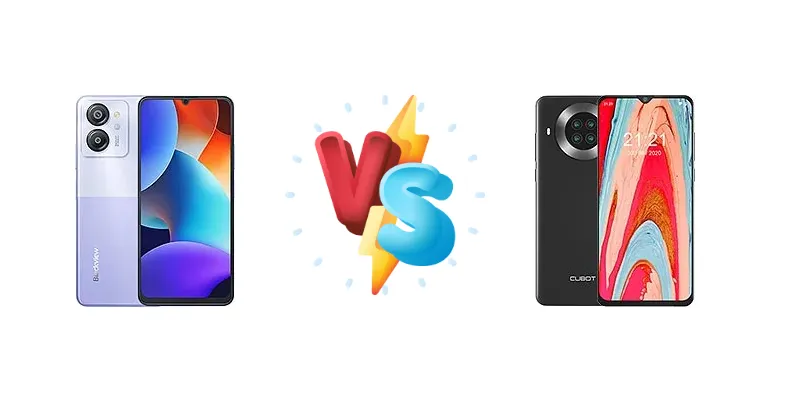
The Blackview Color 8 and Cubot Note 20 Pro represent a competitive segment of the smartphone market – affordable devices aiming to deliver essential functionality. Both utilize 12nm process technology, but diverge in their chipset choices, impacting performance and efficiency. This comparison dissects the key differences between the Unisoc Tiger T616-powered Color 8 and the MediaTek Helio P60-equipped Note 20 Pro, helping you determine which best suits your needs.
🏆 Quick Verdict
For the average user prioritizing sustained performance and a slightly more modern architecture, the Blackview Color 8 emerges as the better choice. While both phones offer similar value, the Unisoc Tiger T616’s Cortex-A75 cores provide a noticeable edge in CPU-intensive tasks compared to the older Cortex-A73 cores found in the Cubot Note 20 Pro.
| Network |
|---|
| 2G bands | GSM 850 / 900 / 1800 / 1900 | GSM 850 / 900 / 1800 / 1900 |
| 3G bands | HSDPA 900 / 2100 - International | HSDPA 900 / 2100 |
| 4G bands | 1, 3, 7, 8, 19, 20, 28, 40, 41 - International | 1, 3, 7, 8, 19, 20 |
| Speed | HSPA, LTE | HSPA, LTE |
| Technology | GSM / HSPA / LTE | GSM / HSPA / LTE |
| Launch |
|---|
| Announced | 2024, January | 2020. Released 2020 |
| Status | Available. Released 2024, January | Discontinued |
| Body |
|---|
| Dimensions | 167.8 x 77.4 x 9.1 mm (6.61 x 3.05 x 0.36 in) | 162.8 x 75.4 x 9.1 mm (6.41 x 2.97 x 0.36 in) |
| SIM | Nano-SIM + Nano-SIM | Nano-SIM + Nano-SIM |
| Weight | 214 g (7.55 oz) | 200 g (7.05 oz) |
| Display |
|---|
| Resolution | 720 x 1600 pixels, 20:9 ratio (~260 ppi density) | 720 x 1600 pixels, 20:9 ratio (~270 ppi density) |
| Size | 6.75 inches, 110.0 cm2 (~84.7% screen-to-body ratio) | 6.5 inches, 102.0 cm2 (~83.1% screen-to-body ratio) |
| Type | IPS LCD, 90Hz, 450 nits (typ) | IPS LCD |
| Platform |
|---|
| CPU | Octa-core (2x2.0 GHz Cortex-A75 & 6x1.8 GHz Cortex-A55) | Octa-core (4x2.0 GHz Cortex-A73 & 4x2.0 GHz Cortex-A53) |
| Chipset | Unisoc Tiger T616 (12 nm) | Mediatek MT6771 Helio P60 (12 nm) |
| GPU | Mali-G57 MP1 | Mali-G72 MP3 |
| OS | Android 13, Doke OS 4.0 | Android 10 |
| Memory |
|---|
| Card slot | microSDXC (dedicated slot) | microSDXC (dedicated slot) |
| Internal | 256GB 8GB RAM | 128GB 8GB RAM |
| Main Camera |
|---|
| Dual | 50 MP, (wide), 1/2.76, 0.64µm, PDAF
Secondary unspecified camera | - |
| Features | LED flash, HDR, panorama | LED flash |
| Quad | - | 12 MP, (wide), 1/2.9", AF
20 MP, (depth), 1/2.78"
Auxiliary lenses |
| Video | 1080p@30fps | Yes |
| Selfie camera |
|---|
| Single | 8 MP, (wide), 1/4.0, 1.12µm | 8 MP |
| Video | 1080p@30fps | Yes |
| Sound |
|---|
| 35mm jack | Yes | Yes |
| Loudspeaker | Yes | Yes |
| Comms |
|---|
| Bluetooth | 5.0, A2DP, LE | 4.2, A2DP |
| NFC | No | Yes |
| Positioning | GPS, GLONASS, GALILEO, BDS | GPS |
| Radio | FM radio | Unspecified |
| USB | USB Type-C, OTG | microUSB, OTG |
| WLAN | Wi-Fi 802.11 a/b/g/n/ac, dual-band | Wi-Fi 802.11 a/b/g/n |
| Features |
|---|
| Sensors | Fingerprint (side-mounted), accelerometer, proximity | Accelerometer, gyro, proximity, compass |
| Battery |
|---|
| Charging | 18W wired | - |
| Type | 6000 mAh | 4200 mAh, removable |
| Misc |
|---|
| Colors | Ash Gray, Ripple Blue, Wisteria Purple | Black, Blue, Green |
| Price | About 150 EUR | - |
Blackview Color 8
- More modern CPU architecture (Cortex-A75)
- Potentially better sustained performance
- Likely more efficient power consumption
- Limited information available on display quality
- Camera specs are unknown
Cubot Note 20 Pro
- Potentially lower price point
- Adequate for basic smartphone tasks
- 18W fast charging
- Older CPU architecture (Cortex-A73)
- May struggle with demanding apps and multitasking
- Limited information available on display quality
Display Comparison
Neither device’s display specifications are provided, so a direct comparison is limited. However, given their price points, both likely utilize IPS LCD panels. The user experience will likely hinge on resolution and brightness, which are unknown. Bezels are likely comparable, reflecting the budget nature of both devices. Color accuracy is also an unknown, but likely optimized for vibrant visuals rather than professional color grading.
Camera Comparison
Without detailed camera specifications, a comprehensive comparison is impossible. However, it’s reasonable to assume both phones feature a multi-camera setup geared towards general photography. The absence of information regarding sensor size and aperture makes it difficult to assess image quality. Given the market segment, image processing will likely prioritize scene optimization over natural color reproduction. The presence of a 2MP macro camera on either device is likely more for marketing than practical use, offering limited detail and quality.
Performance
The core difference lies in the chipsets. The Blackview Color 8’s Unisoc Tiger T616 features two Cortex-A75 cores clocked at 2.0 GHz, paired with six Cortex-A55 cores at 1.8 GHz. This architecture provides a stronger peak performance compared to the Cubot Note 20 Pro’s MediaTek Helio P60, which utilizes four Cortex-A73 cores at 2.0 GHz and four Cortex-A53 cores at 2.0 GHz. While both are octa-core CPUs built on a 12nm process, the A75 cores in the T616 offer a significant IPC (Instructions Per Clock) advantage. This translates to faster app loading times and smoother multitasking for the Color 8. The Helio P60, while still capable, is an older design and will show its age in demanding scenarios.
Battery Life
Both devices feature 18W wired charging, suggesting similar charging speeds. Without knowing the battery capacity of each phone, it’s difficult to determine which offers better battery life. However, the more efficient Unisoc Tiger T616 in the Blackview Color 8 *could* translate to slightly longer runtimes, even with a comparable battery capacity, due to its optimized power consumption.
Buying Guide
Buy the Blackview Color 8 if you need a phone for everyday tasks, moderate multitasking, and occasional gaming, benefiting from the newer CPU architecture. Buy the Cubot Note 20 Pro if you prioritize a potentially lower price point and are primarily focused on basic smartphone functions like calling, texting, and light social media use, accepting a slight performance trade-off.
Frequently Asked Questions
❓ Will the Cubot Note 20 Pro struggle with graphically intensive games like PUBG Mobile?
The Helio P60 in the Cubot Note 20 Pro is capable of running PUBG Mobile, but you’ll likely need to lower the graphics settings to achieve a playable frame rate. The older CPU and GPU may result in stuttering and frame drops during intense gameplay, especially on higher settings. The Blackview Color 8, with its newer Unisoc T616, will offer a smoother experience.
❓ Is the Unisoc Tiger T616 a reliable processor for long-term use?
Unisoc has significantly improved its processor designs in recent years. The Tiger T616 is a relatively recent chip and offers a good balance of performance and efficiency. While it may not compete with flagship Snapdragon processors, it’s a reliable choice for everyday tasks and moderate use, and should provide a satisfactory experience for several years.
❓ How does the 12nm process node affect battery life on both devices?
A 12nm process node is relatively standard for budget smartphones. While newer process nodes (like 6nm or 4nm) offer better power efficiency, 12nm is still acceptable. The Unisoc Tiger T616 in the Blackview Color 8 is likely to be slightly more efficient due to its newer architecture, potentially leading to marginally better battery life compared to the Helio P60 in the Cubot Note 20 Pro, assuming similar battery capacities.