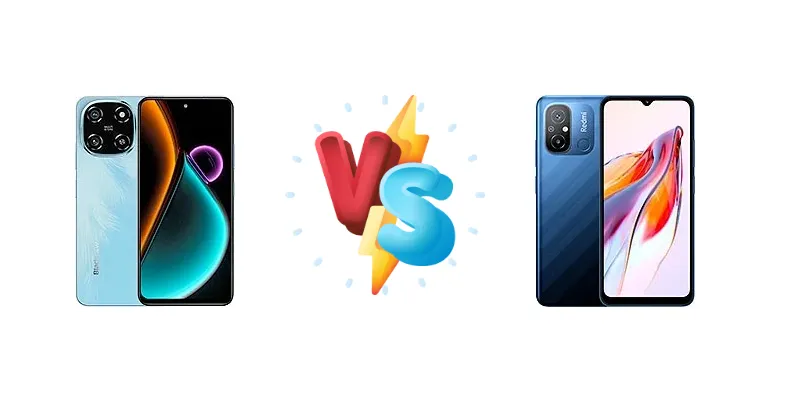
The Blackview Color 6 and Xiaomi Redmi 12C represent compelling options in the ultra-budget smartphone space. Both leverage Mediatek's Helio series chipsets, but diverge significantly in battery endurance and charging speed. This comparison dissects these differences, helping you determine which device best suits your needs.
🏆 Quick Verdict
For users prioritizing longevity and sustained use, the Blackview Color 6 emerges as the winner. Its exceptional 48:35h battery endurance, coupled with 800 charge cycles, significantly outweighs the Redmi 12C's slower 10W charging, making it ideal for heavy users and those away from power outlets.
| Network |
|---|
| 2G bands | GSM 850 / 900 / 1800 / 1900 | GSM 850 / 900 / 1800 / 1900 |
| 3G bands | HSDPA 900 / 2100 | HSDPA 850 / 900 / 2100 |
| 4G bands | 1, 3, 7, 8, 19, 20, 28, 40, 41 | 1, 3, 5, 7, 8, 20, 28, 38, 40, 41 - International |
| Speed | HSPA, LTE | HSPA, LTE |
| Technology | GSM / HSPA / LTE | GSM / CDMA / HSPA / EVDO / LTE |
| | - | CDMA2000 1xEV-DO |
| Launch |
|---|
| Announced | 2025, September | 2022, December 31 |
| Status | Available. Released 2025, September | Available. Released 2023, January 01 |
| Body |
|---|
| Dimensions | 165.7 x 76.5 x 8.7 mm (6.52 x 3.01 x 0.34 in) | 168.8 x 76.4 x 8.8 mm (6.65 x 3.01 x 0.35 in) |
| SIM | Nano-SIM + Nano-SIM | Nano-SIM + Nano-SIM |
| Weight | 199.4 g (7.05 oz) | 192 g (6.77 oz) |
| Display |
|---|
| Protection | Panda Glass, Mohs level 7 | - |
| Resolution | 720 x 1604 pixels, 20:9 ratio (~264 ppi density) | 720 x 1650 pixels (~268 ppi density) |
| Size | 6.67 inches, 107.2 cm2 (~84.6% screen-to-body ratio) | 6.71 inches, 106.5 cm2 (~82.6% screen-to-body ratio) |
| Type | IPS LCD, 90Hz, 650 nits | IPS LCD, 500 nits (typ) |
| Platform |
|---|
| CPU | Octa-core (2x2.0 GHz Cortex-A75 & 6x1.8 GHz Cortex-A55) | Octa-core (2x2.0 GHz Cortex-A75 & 6x1.8 GHz Cortex-A55) |
| Chipset | Mediatek Helio G81 (12 nm) | Mediatek MT6769Z Helio G85 (12 nm) |
| GPU | Mali-G52 MC2 | Mali-G52 MC2 |
| OS | Android 15, DokeOS 4.1 | Android 12, MIUI 13 |
| Memory |
|---|
| Card slot | microSDXC (dedicated slot) | microSDXC (dedicated slot) |
| Internal | 128GB 8GB RAM, 256GB 8GB RAM | 32GB 2GB RAM, 32GB 3GB RAM, 32GB 4GB RAM, 64GB 3GB RAM, 64GB 4GB RAM, 128GB 3GB RAM, 128GB 4GB RAM, 128GB 6GB RAM |
| | - | eMMC 5.1 |
| Main Camera |
|---|
| Dual | - | 50 MP, (wide), PDAF
0.08 MP (depth) |
| Features | LED flash, HDR, panorama | LED flash, HDR |
| Single | 50 MP, f/1.8, (wide), 1/2.76", PDAF | 50 MP, f/1.8, (wide), 1/2.76", PDAF
Auxiliary lens |
| Video | 1080p@30fps | 1080p@30fps |
| Selfie camera |
|---|
| Features | HDR | - |
| Single | 13 MP, f/2.0, (wide), 1/4.0" | 5 MP, f/2.2, (wide) |
| Video | 1080p@30fps | 1080p@30fps |
| Sound |
|---|
| 3.5mm jack | - | Yes |
| 35mm jack | Yes | Yes |
| Loudspeaker | Yes, with stereo speakers | Yes |
| Comms |
|---|
| Bluetooth | 5.0, A2DP, LE | 5.1, A2DP, LE |
| NFC | No | Yes (market/region dependent) |
| Positioning | GPS, GLONASS, GALILEO, BDS | GPS, GLONASS, BDS, GALILEO |
| Radio | FM radio | FM radio |
| USB | USB Type-C | microUSB 2.0 |
| WLAN | Wi-Fi 802.11 a/b/g/n/ac, dual-band | Wi-Fi 802.11 a/b/g/n/ac, dual-band, Wi-Fi Direct |
| Features |
|---|
| Sensors | Fingerprint (side-mounted), accelerometer, proximity | Fingerprint (rear-mounted), accelerometer |
| | - | Virtual proximity sensing |
| Battery |
|---|
| Charging | 18W wired | 10W wired |
| Type | Li-Po 5000 mAh | Li-Po 5000 mAh |
| Misc |
|---|
| Colors | Midnight Black, Celestial Blue, Snowy White | Graphite Gray, Ocean Blue, Mint Green, Lavender Purple |
| Models | - | 22120RN86G, 22120RN86I, 22126RN91Y, 2212ARNC4L |
| Price | € 109.99 / $ 95.70 / £ 114.99 | £ 132.99 / € 107.41 |
| SAR | - | 1.08 W/kg (head) 0.64 W/kg (body) |
| SAR EU | - | 0.98 W/kg (head) 0.99 W/kg (body) |
| EU LABEL |
|---|
| Battery | 48:35h endurance, 800 cycles | - |
| Energy | Class B | - |
| Free fall | Class C (156 falls) | - |
| Repairability | Class C | - |
Blackview Color 6
- Exceptional battery life (48:35h endurance)
- Faster 18W charging
- Longer battery lifespan (800 charge cycles)
- Chipset is slightly older generation
- Camera specs are unknown
Xiaomi Redmi 12C
- Slightly newer chipset (Helio G85)
- Potentially lower price point
- Commonly features a 50MP main camera
- Significantly slower 10W charging
- Lower battery endurance
- Likely shorter battery lifespan
Display Comparison
Neither device boasts a standout display. Both likely utilize LCD panels common in this price bracket. Detailed specs like resolution and peak brightness are missing, but the focus here is on internal components. The absence of high refresh rates is expected, prioritizing battery life over visual fluidity.
Camera Comparison
Camera details are sparse, but it's safe to assume both phones feature basic camera setups geared towards casual photography. Without sensor size or aperture information, a direct comparison is difficult. The Redmi 12C often includes a 50MP main sensor, while the Color 6's main sensor resolution is unknown. The presence of a 2MP macro lens on both devices is largely a marketing tactic, offering limited practical benefit due to the low resolution and fixed focus. Image processing will likely be the differentiating factor, but without sample images, it's impossible to assess.
Performance
Both the Blackview Color 6 and Xiaomi Redmi 12C are powered by octa-core CPUs featuring the same core configuration: 2x2.0 GHz Cortex-A75 and 6x1.8 GHz Cortex-A55. However, the chipset differs – the Color 6 uses the Mediatek Helio G81 (12nm), while the Redmi 12C employs the Helio G85 (also 12nm). While the G85 is technically newer, the performance difference is minimal in real-world usage. Both chips are capable of handling everyday tasks and light gaming. The G81's efficiency, however, may contribute to the Color 6's superior battery life. Neither device is expected to excel in graphically demanding applications.
Battery Life
This is where the Blackview Color 6 truly shines. Its reported 48:35h endurance is exceptional for a budget smartphone, indicating significantly better power efficiency than the Redmi 12C. This advantage is likely due to a combination of chipset optimization and potentially a more efficient display panel. Furthermore, the Color 6 boasts 800 charge cycles, suggesting a longer lifespan before significant battery degradation. The Redmi 12C's 10W charging is considerably slower than the Color 6's 18W charging, meaning longer wait times to replenish the battery. While the Redmi 12C's battery capacity is unknown, the slower charging and likely lower endurance make the Color 6 the clear winner for power users.
Buying Guide
Buy the Blackview Color 6 if you need a phone that can reliably last through a full day – and beyond – of heavy use, and if you value long-term battery health. Buy the Xiaomi Redmi 12C if you prioritize a slightly newer chipset (though performance is comparable) and are comfortable with more frequent charging, or if the price difference is substantial.
Frequently Asked Questions
❓ How much faster is the 18W charging on the Blackview Color 6 compared to the 10W charging on the Redmi 12C?
While a precise time difference depends on battery capacity (which is unknown for the Redmi 12C), 18W charging will significantly reduce charging times. Expect the Color 6 to reach full charge considerably faster, potentially shaving off an hour or more compared to the Redmi 12C.
❓ Will I notice a performance difference between the Helio G81 in the Blackview Color 6 and the Helio G85 in the Xiaomi Redmi 12C during everyday tasks?
No, you likely won't notice a significant performance difference during typical usage like browsing, social media, or messaging. Both chipsets are designed for similar tasks and offer comparable performance. The difference will only be apparent in demanding games or applications.
❓ What does '800 charge cycles' mean for the Blackview Color 6's battery lifespan?
800 charge cycles indicate the number of times the battery can be fully charged and discharged before experiencing significant degradation in capacity. This suggests the Color 6's battery is designed for long-term reliability and will retain a higher percentage of its original capacity after extended use compared to phones with lower cycle counts.