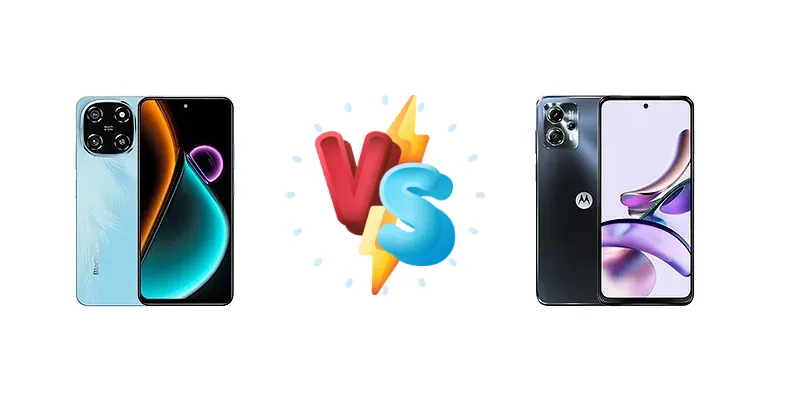
The Blackview Color 6 and Motorola Moto G13 represent compelling options in the ultra-competitive budget smartphone space. Both leverage Mediatek's Helio series chipsets, but diverge in battery endurance and charging capabilities. This comparison dissects their specifications to determine which device delivers the best overall experience for the price-conscious consumer.
🏆 Quick Verdict
For users prioritizing maximum battery life and longevity, the Blackview Color 6 emerges as the winner. Its impressive 48:35h endurance and 800-cycle battery rating outweigh the Moto G13’s slightly faster 20W charging, making it ideal for heavy users and those seeking a phone that lasts.
| Network |
|---|
| 2G bands | GSM 850 / 900 / 1800 / 1900 | GSM 850 / 900 / 1800 / 1900 |
| 3G bands | HSDPA 900 / 2100 | HSDPA 850 / 900 / 1900 / 2100 |
| 4G bands | 1, 3, 7, 8, 19, 20, 28, 40, 41 | 1, 2, 3, 5, 7, 8, 20, 38, 40, 41 |
| Speed | HSPA, LTE | HSPA, LTE |
| Technology | GSM / HSPA / LTE | GSM / HSPA / LTE |
| Launch |
|---|
| Announced | 2025, September | 2023, January 24 |
| Status | Available. Released 2025, September | Available. Released 2023, January 24 |
| Body |
|---|
| Build | - | Glass front, plastic frame, plastic back |
| Dimensions | 165.7 x 76.5 x 8.7 mm (6.52 x 3.01 x 0.34 in) | 162.7 x 74.7 x 8.2 mm (6.41 x 2.94 x 0.32 in) |
| SIM | Nano-SIM + Nano-SIM | · Nano-SIM· Nano-SIM + Nano-SIM |
| Weight | 199.4 g (7.05 oz) | 183.5 g (6.49 oz) |
| | - | Water-resistant design |
| Display |
|---|
| Protection | Panda Glass, Mohs level 7 | Panda glass |
| Resolution | 720 x 1604 pixels, 20:9 ratio (~264 ppi density) | 720 x 1600 pixels, 20:9 ratio (~270 ppi density) |
| Size | 6.67 inches, 107.2 cm2 (~84.6% screen-to-body ratio) | 6.5 inches, 102.0 cm2 (~83.9% screen-to-body ratio) |
| Type | IPS LCD, 90Hz, 650 nits | IPS LCD, 90Hz, 400 nits (peak) |
| Platform |
|---|
| CPU | Octa-core (2x2.0 GHz Cortex-A75 & 6x1.8 GHz Cortex-A55) | Octa-core (2x2.0 GHz Cortex-A75 & 6x1.8 GHz Cortex-A55) |
| Chipset | Mediatek Helio G81 (12 nm) | Mediatek MT6769Z Helio G85 (12 nm) |
| GPU | Mali-G52 MC2 | Mali-G52 MC2 |
| OS | Android 15, DokeOS 4.1 | Android 13 |
| Memory |
|---|
| Card slot | microSDXC (dedicated slot) | microSDXC (dedicated slot) |
| Internal | 128GB 8GB RAM, 256GB 8GB RAM | 64GB 4GB RAM, 128GB 4GB RAM |
| Main Camera |
|---|
| Features | LED flash, HDR, panorama | LED flash, HDR, panorama |
| Single | 50 MP, f/1.8, (wide), 1/2.76", PDAF | - |
| Triple | - | 50 MP, f/1.8, (wide), 0.64µm, PDAF
2 MP (macro)
Auxiliary lens |
| Video | 1080p@30fps | 1080p@30fps |
| Selfie camera |
|---|
| Features | HDR | - |
| Single | 13 MP, f/2.0, (wide), 1/4.0" | 8 MP, f/2.0, (wide), 1/4.0", 1.12µm |
| Video | 1080p@30fps | 1080p@30fps |
| Sound |
|---|
| 3.5mm jack | - | Yes |
| 35mm jack | Yes | Yes |
| Loudspeaker | Yes, with stereo speakers | Yes, with stereo speakers |
| Comms |
|---|
| Bluetooth | 5.0, A2DP, LE | 5.1, A2DP, LE |
| NFC | No | Yes (market/region dependent) |
| Positioning | GPS, GLONASS, GALILEO, BDS | GPS, GLONASS, GALILEO |
| Radio | FM radio | Unspecified |
| USB | USB Type-C | USB Type-C 2.0 |
| WLAN | Wi-Fi 802.11 a/b/g/n/ac, dual-band | Wi-Fi 802.11 a/b/g/n/ac, dual-band |
| Features |
|---|
| Sensors | Fingerprint (side-mounted), accelerometer, proximity | Fingerprint (side-mounted), accelerometer, gyro, proximity |
| Battery |
|---|
| Charging | 18W wired | 20W or 10W wired |
| Type | Li-Po 5000 mAh | Li-Po 5000 mAh |
| Misc |
|---|
| Colors | Midnight Black, Celestial Blue, Snowy White | Matte Charcoal, Blue Lavender, Rose Gold |
| Price | € 109.99 / $ 95.70 / £ 114.99 | About 160 EUR |
| EU LABEL |
|---|
| Battery | 48:35h endurance, 800 cycles | - |
| Energy | Class B | - |
| Free fall | Class C (156 falls) | - |
| Repairability | Class C | - |
Blackview Color 6
- Exceptional battery life (48:35h endurance)
- High battery cycle count (800 cycles) for longevity
- Capable Helio G81 processor for everyday tasks
- Slower charging speed (18W)
- Likely basic camera system
Motorola Moto G13
- Faster charging (20W)
- Established Motorola brand reputation
- Slightly more powerful GPU (Helio G85)
- Significantly lower battery endurance (estimated)
- Potentially lower battery longevity
Display Comparison
Neither device boasts a standout display. Both likely utilize LCD panels, common in this price bracket. Detailed specs like peak brightness and color gamut coverage are unavailable, but we can assume similar performance. The focus here isn't on visual fidelity, but rather functional usability.
Camera Comparison
Camera performance is likely to be similar, relying heavily on software processing. Without detailed sensor information, it's difficult to make a definitive judgment. Both phones likely feature a primary sensor paired with auxiliary lenses of limited utility. Image quality will be acceptable in good lighting conditions, but expect struggles in low-light scenarios. The absence of Optical Image Stabilization (OIS) on either device further limits low-light capabilities.
Performance
Both the Blackview Color 6 and Motorola Moto G13 are powered by octa-core CPUs featuring the same core configuration: 2x2.0 GHz Cortex-A75 and 6x1.8 GHz Cortex-A55. However, the chipset differs – the Color 6 uses the Mediatek Helio G81 (12nm), while the Moto G13 employs the Helio G85 (also 12nm). While the G85 generally offers a slight GPU performance edge, the real-world difference will be minimal for everyday tasks. Both will handle social media, browsing, and light gaming adequately. Thermal management will likely be similar, given the comparable chipsets and power draw.
Battery Life
This is where the Blackview Color 6 truly shines. Its reported 48:35h endurance is significantly higher than what we'd expect from a phone in this price range, suggesting efficient power management. The 800 charge cycle rating indicates the battery will retain a higher percentage of its original capacity after extended use compared to phones with fewer cycles. The Moto G13 offers 20W wired charging (or 10W depending on the charger), which is faster than the Color 6’s 18W, but the difference in charging speed is less impactful than the Color 6’s superior overall endurance.
Buying Guide
Buy the Blackview Color 6 if you need a phone that can reliably last through two full days of moderate use, or if you value long-term battery health thanks to its 800 charge cycle rating. Buy the Motorola Moto G13 if you prioritize slightly quicker top-ups and prefer the established brand recognition of Motorola, accepting a trade-off in overall battery endurance.
Frequently Asked Questions
❓ How much faster is the 20W charging on the Moto G13 compared to the 18W charging on the Blackview Color 6?
While 20W is technically faster, the difference in charging time will likely be marginal – perhaps 15-20 minutes to fully charge. The Blackview Color 6’s significantly longer battery life means you’ll need to charge it less frequently, mitigating the slower charging speed.
❓ What does '800 charge cycles' mean for the Blackview Color 6's battery health?
A charge cycle is completed when you've used 100% of the battery capacity. The Blackview Color 6 is rated for 800 full charge cycles before significant degradation. This means the battery is designed to maintain a higher percentage of its original capacity after extended use compared to phones with lower cycle ratings.
❓ Will either phone struggle with demanding games like PUBG Mobile?
Both the Helio G81 and G85 are entry-level gaming chipsets. While they can run PUBG Mobile, you’ll likely need to lower graphics settings to achieve a smooth frame rate. Expect some frame drops during intense action sequences.