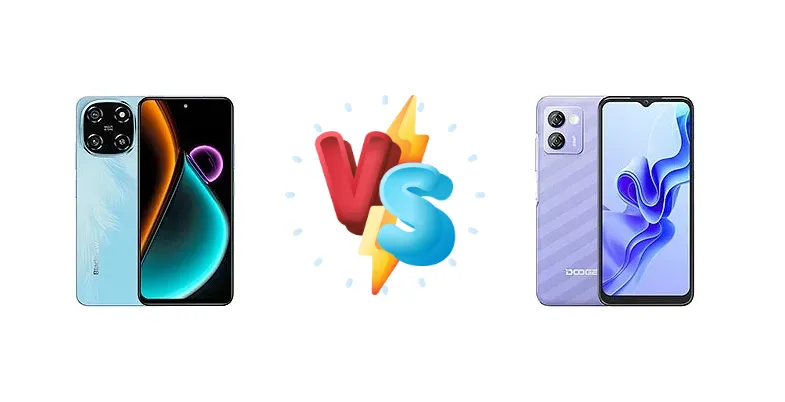
The Blackview Color 6 and Doogee N50 Pro represent a growing trend: capable smartphones at incredibly accessible price points. Both aim to deliver essential features without breaking the bank, but they take different approaches to achieving this. This comparison dissects their core components to determine which offers the best value for your money, focusing on performance and longevity.
🏆 Quick Verdict
For the average user prioritizing responsiveness and sustained performance, the Blackview Color 6 is the better choice. Its Mediatek Helio G81 chipset, featuring more powerful Cortex-A75 cores, provides a noticeable advantage in everyday tasks and light gaming, despite both phones sharing the same 18W charging.
| Network |
|---|
| 2G bands | GSM 850 / 900 / 1800 / 1900 | GSM 850 / 900 / 1800 / 1900 |
| 3G bands | HSDPA 900 / 2100 | HSDPA 850 / 900 / 1700(AWS) / 1900 / 2100 |
| 4G bands | 1, 3, 7, 8, 19, 20, 28, 40, 41 | 1, 2, 3, 4, 5, 7, 8, 12, 17, 19, 20, 28, 34, 38, 39, 40, 41 |
| Speed | HSPA, LTE | HSPA, LTE |
| Technology | GSM / HSPA / LTE | GSM / HSPA / LTE |
| Launch |
|---|
| Announced | 2025, September | 2023, October |
| Status | Available. Released 2025, September | Available. Released 2023, November |
| Body |
|---|
| Dimensions | 165.7 x 76.5 x 8.7 mm (6.52 x 3.01 x 0.34 in) | 165.8 x 76.2 x 9.1 mm (6.53 x 3.00 x 0.36 in) |
| SIM | Nano-SIM + Nano-SIM | Nano-SIM + Nano-SIM |
| Weight | 199.4 g (7.05 oz) | - |
| Display |
|---|
| Protection | Panda Glass, Mohs level 7 | - |
| Resolution | 720 x 1604 pixels, 20:9 ratio (~264 ppi density) | 720 x 1600 pixels, 20:9 ratio (~269 ppi density) |
| Size | 6.67 inches, 107.2 cm2 (~84.6% screen-to-body ratio) | 6.52 inches, 102.6 cm2 (~81.2% screen-to-body ratio) |
| Type | IPS LCD, 90Hz, 650 nits | IPS LCD, 390 nits (peak) |
| Platform |
|---|
| CPU | Octa-core (2x2.0 GHz Cortex-A75 & 6x1.8 GHz Cortex-A55) | Octa-core (2x1.6 GHz Cortex-A75 & 6x1.6 GHz Cortex-A55) |
| Chipset | Mediatek Helio G81 (12 nm) | Unisoc T606 (12 nm) |
| GPU | Mali-G52 MC2 | Mali-G57 MP1 |
| OS | Android 15, DokeOS 4.1 | Android 13 |
| Memory |
|---|
| Card slot | microSDXC (dedicated slot) | microSDXC (uses shared SIM slot) |
| Internal | 128GB 8GB RAM, 256GB 8GB RAM | 256GB 8GB RAM |
| Main Camera |
|---|
| Dual | - | 50 MP, f/1.8, (wide), PDAF
2 MP (macro) |
| Features | LED flash, HDR, panorama | Triple-LED flash, HDR, panorama |
| Single | 50 MP, f/1.8, (wide), 1/2.76", PDAF | - |
| Video | 1080p@30fps | Yes |
| Selfie camera |
|---|
| Features | HDR | - |
| Single | 13 MP, f/2.0, (wide), 1/4.0" | 8 MP, f/1.8, (wide) |
| Video | 1080p@30fps | Yes |
| Sound |
|---|
| 35mm jack | Yes | Yes |
| Loudspeaker | Yes, with stereo speakers | Yes |
| Comms |
|---|
| Bluetooth | 5.0, A2DP, LE | 5.0, A2DP, LE |
| NFC | No | No |
| Positioning | GPS, GLONASS, GALILEO, BDS | GPS, GLONASS, BDS, GALILEO |
| Radio | FM radio | FM radio |
| USB | USB Type-C | USB Type-C 2.0, OTG |
| WLAN | Wi-Fi 802.11 a/b/g/n/ac, dual-band | Wi-Fi 802.11 a/b/g/n/ac, dual-band |
| Features |
|---|
| Sensors | Fingerprint (side-mounted), accelerometer, proximity | Fingerprint (side-mounted), accelerometer, proximity, compass |
| Battery |
|---|
| Charging | 18W wired | 18W wired |
| Type | Li-Po 5000 mAh | 4200 mAh |
| Misc |
|---|
| Colors | Midnight Black, Celestial Blue, Snowy White | Black, Purple, Green |
| Price | € 109.99 / $ 95.70 / £ 114.99 | About 110 EUR |
| EU LABEL |
|---|
| Battery | 48:35h endurance, 800 cycles | - |
| Energy | Class B | - |
| Free fall | Class C (156 falls) | - |
| Repairability | Class C | - |
Blackview Color 6
- Stronger CPU performance with the Helio G81
- Impressive battery endurance (48:35h)
- Potentially longer battery lifespan (800 cycles)
- 18W charging is relatively slow
- Display specifications are unknown, likely basic
Doogee N50 Pro
- Potentially lower price point
- Acceptable performance for basic tasks
- 18W charging is standard for the segment
- Weaker CPU performance with the Unisoc T606
- Battery endurance is unknown, likely lower than Color 6
Display Comparison
Both devices lack detailed display specifications in the provided data. However, given their price bracket, we can expect both to utilize IPS LCD panels. The absence of information regarding resolution, refresh rate, or brightness suggests neither prioritizes a premium visual experience. Bezels are likely to be substantial on both, and color accuracy will likely be standard for this segment.
Camera Comparison
Without detailed camera specifications, a direct comparison is limited. It’s safe to assume both phones feature a multi-camera setup geared towards basic photography. The absence of information regarding sensor size, aperture, or optical image stabilization (OIS) suggests neither will excel in low-light conditions. Any 2MP macro or depth sensors are likely to offer minimal benefit, serving primarily as marketing features. Image processing will likely be software-driven, with the quality heavily reliant on the chipset’s ISP capabilities – favoring the Blackview Color 6 due to its more powerful processor.
Performance
The core difference lies in the chipset: the Blackview Color 6 boasts the Mediatek Helio G81, while the Doogee N50 Pro uses the Unisoc T606. While both are 12nm chips, the Helio G81’s CPU configuration – 2x2.0 GHz Cortex-A75 & 6x1.8 GHz Cortex-A55 – provides a clear advantage over the N50 Pro’s 2x1.6 GHz Cortex-A75 & 6x1.6 GHz Cortex-A55. The higher clock speeds on the A75 cores translate to faster processing for demanding tasks. This difference will be most noticeable when launching apps, browsing the web with multiple tabs, or playing graphically intensive games. The Helio G81 also generally benefits from better GPU performance, further enhancing the gaming experience.
Battery Life
The Blackview Color 6 claims an impressive 48 hours and 35 minutes of endurance, alongside a stated 800 charge cycles. While the Doogee N50 Pro’s battery capacity isn’t specified, both phones share the same 18W wired charging. The Color 6’s endurance rating suggests optimized power management and a potentially larger battery capacity. The 800 charge cycle claim indicates a focus on long-term battery health, suggesting the phone is designed to retain its capacity over extended use. Both 18W charging speeds are relatively slow by modern standards, meaning a full charge will likely take over two hours.
Buying Guide
Buy the Blackview Color 6 if you need a phone that feels snappy during daily use, handles multitasking efficiently, and offers a slightly better gaming experience. It’s ideal for users who frequently switch between apps or enjoy casual mobile games. Buy the Doogee N50 Pro if you prioritize a potentially lower price point and are primarily focused on basic smartphone functions like calling, texting, and light social media browsing, accepting a trade-off in processing power.
Frequently Asked Questions
❓ Will the Unisoc T606 in the Doogee N50 Pro struggle with multitasking?
Yes, the Unisoc T606 is a more basic chipset. While it can handle a few apps simultaneously, expect noticeable slowdowns when switching between multiple demanding applications or running resource-intensive tasks in the background. The Blackview Color 6’s Helio G81 is significantly better equipped for multitasking.
❓ How does the 800 charge cycle claim on the Blackview Color 6 translate to real-world use?
The 800 charge cycle claim suggests the battery is designed to retain at least 80% of its original capacity after 800 full charge-discharge cycles. This means the battery should remain usable for a longer period compared to phones with lower-quality batteries, potentially extending the phone's overall lifespan.
❓ Is the 18W charging on either phone fast enough for quick top-ups?
No, 18W charging is relatively slow by today's standards. Expect a full charge to take over two hours. It's sufficient for overnight charging, but not ideal for quickly topping up the battery during short breaks. Neither phone prioritizes fast charging.