
Blackview BV9200 vs Nokia XR20: The Ultimate Rugged Phone Comparison
| Phones Images | |||||
|---|---|---|---|---|---|
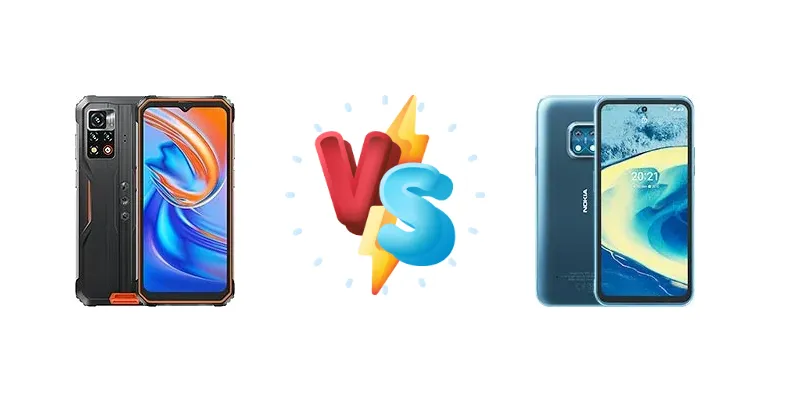
|
🏆 Quick Verdict
The Blackview BV9200 offers significantly faster charging and a more powerful chipset, making it ideal for performance-focused users. However, the Nokia XR20 boasts a more established brand reputation, 5G connectivity, and a robust build quality, appealing to those prioritizing reliability and longevity.
| PHONES | ||
|---|---|---|
| Phone Names | Blackview BV9200 | Nokia XR20 |
| Network | ||
|---|---|---|
| 2G bands | GSM 850 / 900 / 1800 / 1900 | GSM 850 / 900 / 1800 / 1900 |
| 3G bands | HSDPA 850 / 900 / 1700(AWS) / 1900 / 2100 | HSDPA 850 / 900 / 1700(AWS) / 1900 / 2100 |
| 4G bands | 1, 2, 3, 4, 5, 7, 8, 12, 13, 17, 18, 19, 20, 25, 26, 28, 34, 38, 39, 40, 41, 66 | 1, 2, 3, 4, 5, 7, 8, 12, 13, 14, 20, 25, 26, 28, 30, 38, 40, 41, 48, 66, 71 |
| 5G bands | - | 2, 5, 25, 38, 41, 48, 66, 77, 78 SA/NSA |
| Speed | HSPA, LTE | HSPA, LTE, 5G |
| Technology | GSM / CDMA / HSPA / LTE | GSM / CDMA / HSPA / EVDO / LTE / 5G |
| CDMA 800 / 1900 | CDMA2000 1xEV-DO | |
| Launch | ||
|---|---|---|
| Announced | 2022, December 28 | 2021, July 27 |
| Status | Available. Released 2023, January 09 | Available. Released 2021, August 04 |
| Body | ||
|---|---|---|
| Dimensions | 174.5 x 81.8 x 13.6 mm (6.87 x 3.22 x 0.54 in) | 171.6 x 81.5 x 10.6 mm (6.76 x 3.21 x 0.42 in) |
| SIM | Nano-SIM + Nano-SIM | · Nano-SIM· Nano-SIM + Nano-SIM |
| Weight | 310 g (10.93 oz) | 248 g (8.75 oz) |
| IP68/IP69K dust/water resistant (up to 1.5m for 30 min) Drop-to-concrete resistance from up to 1.8m MIL-STD-810H compliant | IP68 dust/water resistant (up to 1.5m for 60 min) Drop-to-concrete resistance from up to 1.8m MIL-STD-810H compliant | |
| Display | ||
|---|---|---|
| Protection | Corning Gorilla Glass 5 | Corning Gorilla Glass Victus |
| Resolution | 1080 x 2408 pixels, 20:9 ratio (~400 ppi density) | 1080 x 2400 pixels, 20:9 ratio (~395 ppi density) |
| Size | 6.6 inches, 104.9 cm2 (~73.5% screen-to-body ratio) | 6.67 inches, 107.4 cm2 (~76.8% screen-to-body ratio) |
| Type | IPS LCD, 120Hz | IPS LCD, 550 nits |
| Platform | ||
|---|---|---|
| CPU | Octa-core (2x2.05 GHz Cortex-A76 & 6x2.0 GHz Cortex-A55) | Octa-core (2x2.0 GHz Kryo 460 & 6x1.8 GHz Kryo 460) |
| Chipset | Mediatek MT6781 Helio G96 (12 nm) | Qualcomm SM4350 Snapdragon 480 5G (8 nm) |
| GPU | Mali-G52 MC2 | Adreno 619 |
| OS | Android 12, Doke-OS 3.1 | Android 11, upgradable to Android 13 |
| Memory | ||
|---|---|---|
| Card slot | microSDXC (dedicated slot) | microSDXC (uses shared SIM slot) |
| Internal | 256GB 8GB RAM | 64GB 4GB RAM, 128GB 6GB RAM |
| UFS 2.1 | - | |
| Main Camera | ||
|---|---|---|
| Dual | - | 48 MP, f/1.8, (wide), 1/2.25", 0.8µm, PDAF 13 MP, f/2.4, 123˚ (ultrawide), 1/3.0", 1.12µm |
| Features | LED flash, HDR, panorama | Zeiss optics, Dual-LED dual-tone flash, second LED flash, HDR, panorama |
| Single | 16 MP, (wide), 1/3", 1.0µm | 8 MP, f/2.0 (wide), 1/4.0", 1.12µm |
| Triple | 50 MP, f/1.8, (wide), 1/2.76", 0.64µm, PDAF 8 MP, f/1.8, 120˚, (ultrawide), AF Auxiliary lens | - |
| Video | 1440p@30fps, 1080p@30fps | 1080p@30fps |
| Selfie camera | ||
|---|---|---|
| Single | 16 MP, f/2.0, (wide), 1/3", 1.0µm | 8 MP, f/2.0 (wide), 1/4.0", 1.12µm |
| Video | 1080p | 1080p@30fps |
| Sound | ||
|---|---|---|
| 3.5mm jack | No | Yes |
| 35mm jack | No | Yes |
| Loudspeaker | Yes, with dual speakers | Yes, with stereo speakers |
| Comms | ||
|---|---|---|
| Bluetooth | 5.2, A2DP, LE | 5.1, A2DP, LE, aptX Adaptive |
| NFC | Yes | Yes |
| Positioning | GPS, GLONASS, GALILEO, BDS | GPS (L1+L5), GLONASS, BDS, GALILEO, QZSS, NavIC |
| Radio | FM radio | Unspecified |
| USB | USB Type-C, OTG | USB Type-C 3.0 |
| WLAN | Wi-Fi 802.11 a/b/g/n/ac, dual-band | Wi-Fi 802.11 a/b/g/n/ac/6, dual-band, Wi-Fi Direct |
| Features | ||
|---|---|---|
| Sensors | Fingerprint (side-mounted), accelerometer, gyro, proximity, compass, barometer | Fingerprint (side-mounted), accelerometer, gyro, proximity, compass, barometer |
| Battery | ||
|---|---|---|
| Charging | 66W wired 30W wireless | 18W wired 15W wireless |
| Type | 5000 mAh | Li-Po 4630 mAh |
| Misc | ||
|---|---|---|
| Colors | Black, Orange, Green | Ultra Blue, Granite Gray |
| Models | - | TA-1368, TA-1362 |
| Price | About 200 EUR | About 270 EUR |
| SAR EU | - | 1.13 W/kg (head) 1.43 W/kg (body) |
Blackview BV9200
- Faster Charging (66W wired, 30W wireless)
- More Powerful Chipset (Helio G96)
- Brighter & Higher Contrast Display
- Likely Higher Resolution Camera
- Less Established Brand Reputation
- Potentially Less Software Support
- Design may be less refined
Nokia XR20
- 5G Connectivity
- Strong Brand Reputation (Nokia)
- Durable Build Quality
- Likely Longer Software Support
- Slower Charging (18W wired, 15W wireless)
- Less Powerful Chipset (Snapdragon 480 5G)
- Less Bright Display
- Lower Resolution Camera (likely)
Display Comparison
The Blackview BV9200 boasts a higher contrast ratio (1423:1) and a brighter display (481 nits) compared to the Nokia XR20. While the XR20's display is perfectly adequate, the BV9200 offers a more visually immersive experience, especially outdoors. Both phones feature durable displays, though specific protection ratings (e.g., Gorilla Glass version) are not explicitly stated for either.
Camera Comparison
Camera specs are not fully detailed for both devices. However, the BV9200 generally features a higher resolution main camera (likely 64MP vs XR20's 13MP). Image quality will depend on software processing, but the BV9200 likely offers more detail in well-lit conditions. Both phones likely offer decent front-facing cameras for video calls.
Performance
Here, the Blackview BV9200 takes a clear lead. Its Mediatek Helio G96 chipset is considerably more powerful than the Nokia XR20's Snapdragon 480 5G. Expect smoother multitasking, faster app loading times, and better gaming performance on the BV9200. The XR20's performance is adequate for everyday tasks, but it will struggle with demanding applications.
Battery Life
Both phones offer substantial battery capacities (likely around 5000mAh). However, the BV9200's 66W wired charging and 30W wireless charging significantly outperform the XR20's 18W wired and 15W wireless charging. Expect much faster charging times with the BV9200.
Buying Guide
The Blackview BV9200 is a great choice for users who prioritize performance, fast charging, and a vibrant display. The Nokia XR20 is best suited for those seeking a dependable, 5G-enabled rugged phone with a strong brand reputation and a focus on durability and software support.