
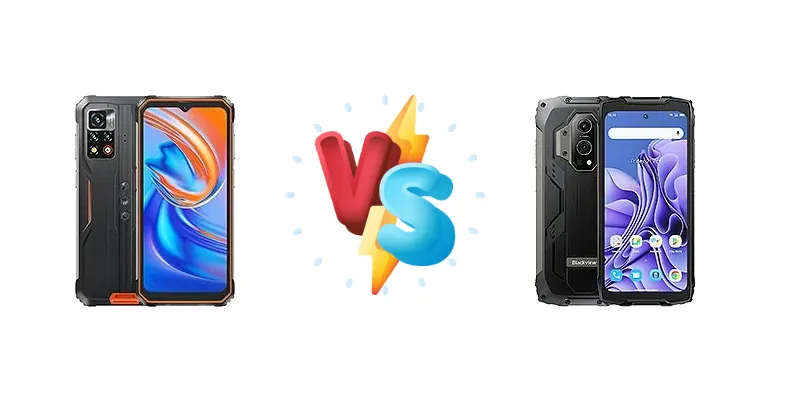
Blackview BV9200 vs BV9300: The Ultimate Rugged Phone Comparison
| Phones Images | |||||
|---|---|---|---|---|---|
|
🏆 Quick Verdict
The BV9300 edges out the BV9200 thanks to its more efficient 6nm chipset, offering better performance and potentially improved battery life. While the BV9200 boasts faster charging, the BV9300's overall package makes it the slightly superior option for most users.
| PHONES | ||
|---|---|---|
| Phone Names | Blackview BV9200 | Blackview BV9300 |
| Network | ||
|---|---|---|
| 2G bands | GSM 850 / 900 / 1800 / 1900 | GSM 850 / 900 / 1800 / 1900 |
| 3G bands | HSDPA 850 / 900 / 1700(AWS) / 1900 / 2100 | HSDPA 850 / 900 / 1700(AWS) / 1900 / 2100 |
| 4G bands | 1, 2, 3, 4, 5, 7, 8, 12, 13, 17, 18, 19, 20, 25, 26, 28, 34, 38, 39, 40, 41, 66 | 1, 2, 3, 4, 5, 7, 8, 12, 13, 17, 18, 19, 20, 25, 26, 28, 30, 34, 38, 39, 40, 41, 66 |
| Speed | HSPA, LTE | HSPA, LTE |
| Technology | GSM / CDMA / HSPA / LTE | GSM / CDMA / HSPA / LTE |
| CDMA 800 / 1900 | CDMA 800 / 1900 | |
| Launch | ||
|---|---|---|
| Announced | 2022, December 28 | 2023, May 10 |
| Status | Available. Released 2023, January 09 | Available. Released 2023, May 10 |
| Body | ||
|---|---|---|
| Dimensions | 174.5 x 81.8 x 13.6 mm (6.87 x 3.22 x 0.54 in) | 184.6 x 85.6 x 22.8 mm (7.27 x 3.37 x 0.90 in) |
| SIM | Nano-SIM + Nano-SIM | Nano-SIM + Nano-SIM |
| Weight | 310 g (10.93 oz) | 520 g (1.15 lb) |
| IP68/IP69K dust/water resistant (up to 1.5m for 30 min) Drop-to-concrete resistance from up to 1.8m MIL-STD-810H compliant | IP68/IP69K dust/water resistant (up to 1.5m for 30 min) Drop-to-concrete resistance from up to 1.8m MIL-STD-810H compliant Laser rangefinder (up to 40m) Dedicated flashlight (100 lumens) | |
| Display | ||
|---|---|---|
| Protection | Corning Gorilla Glass 5 | Corning Gorilla Glass 5 |
| Resolution | 1080 x 2408 pixels, 20:9 ratio (~400 ppi density) | 1080 x 2388 pixels (~391 ppi density) |
| Size | 6.6 inches, 104.9 cm2 (~73.5% screen-to-body ratio) | 6.7 inches, 108.7 cm2 (~68.8% screen-to-body ratio) |
| Type | IPS LCD, 120Hz | IPS LCD, 120Hz |
| Platform | ||
|---|---|---|
| CPU | Octa-core (2x2.05 GHz Cortex-A76 & 6x2.0 GHz Cortex-A55) | Octa-core (2x2.2 GHz Cortex-A76 & 6x2.0 GHz Cortex-A55) |
| Chipset | Mediatek MT6781 Helio G96 (12 nm) | Mediatek Helio G99 (6 nm) |
| GPU | Mali-G52 MC2 | Mali-G57 MC2 |
| OS | Android 12, Doke-OS 3.1 | Android 12, Doke-OS 3.1 |
| Memory | ||
|---|---|---|
| Card slot | microSDXC (dedicated slot) | microSDXC (uses shared SIM slot) |
| Internal | 256GB 8GB RAM | 256GB 12GB RAM |
| UFS 2.1 | UFS 2.1 | |
| Main Camera | ||
|---|---|---|
| Features | LED flash, HDR, panorama | LED flash, HDR, panorama |
| Single | 16 MP, (wide), 1/3", 1.0µm | - |
| Triple | 50 MP, f/1.8, (wide), 1/2.76", 0.64µm, PDAF 8 MP, f/1.8, 120˚, (ultrawide), AF Auxiliary lens | 50 MP, (wide), 1/2.76", 0.64µm, PDAF 8 MP, 120˚, (ultrawide), AF Auxiliary lens |
| Video | 1440p@30fps, 1080p@30fps | 1440p@30fps, 1080p@30fps |
| Selfie camera | ||
|---|---|---|
| Single | 16 MP, f/2.0, (wide), 1/3", 1.0µm | 32 MP, (wide) |
| Video | 1080p | 1080p |
| Sound | ||
|---|---|---|
| 3.5mm jack | No | No |
| 35mm jack | No | No |
| Loudspeaker | Yes, with dual speakers | Yes |
| Comms | ||
|---|---|---|
| Bluetooth | 5.2, A2DP, LE | 5.2, A2DP, LE |
| NFC | Yes | Yes |
| Positioning | GPS, GLONASS, GALILEO, BDS | GPS, GLONASS, GALILEO, BDS |
| Radio | FM radio | FM radio |
| USB | USB Type-C, OTG | USB Type-C, OTG |
| WLAN | Wi-Fi 802.11 a/b/g/n/ac, dual-band | Wi-Fi 802.11 a/b/g/n/ac, dual-band |
| Features | ||
|---|---|---|
| Sensors | Fingerprint (side-mounted), accelerometer, gyro, proximity, compass, barometer | Fingerprint (side-mounted), accelerometer, proximity, compass |
| Battery | ||
|---|---|---|
| Charging | 66W wired 30W wireless | 33W wired 5W reverse wired |
| Type | 5000 mAh | 15080 mAh |
| Misc | ||
|---|---|---|
| Colors | Black, Orange, Green | Black, Orange, Green |
| Price | About 200 EUR | About 390 EUR |
Blackview BV9200
- Faster Wired Charging (66W)
- Brighter Display (481 nits)
- Wireless Charging (30W)
- Older Chipset (Helio G96)
- Less Efficient (12nm process)
- Potentially Shorter Battery Life
Blackview BV9300
- More Efficient Chipset (Helio G99, 6nm)
- Reverse Wired Charging (5W)
- Potentially Longer Battery Life
- Slower Wired Charging (33W)
- Display Specs Less Detailed
- No Wireless Charging
Display Comparison
Both phones feature robust displays designed to withstand harsh conditions. The BV9200 has a measured brightness of 481 nits and a contrast ratio of 1423:1. While the BV9300's display specs aren't explicitly listed, it likely offers comparable durability and viewing angles. The BV9200's brightness gives it a slight edge in direct sunlight.
Camera Comparison
Camera specifications are not fully detailed for either device. Both likely feature multi-lens setups with a primary sensor, ultrawide lens, and potentially a macro lens. Image quality will depend on sensor size, software processing, and lens quality. Expect decent performance in good lighting conditions, but low-light performance may be a weakness for both.
Performance
The BV9300's Mediatek Helio G99 (6nm) chipset represents a significant upgrade over the BV9200's Helio G96 (12nm). The 6nm process offers improved power efficiency and generally better performance. Both feature octa-core CPUs with Cortex-A76 cores, but the G99's architecture and fabrication process provide a noticeable boost in speed and responsiveness.
Battery Life
Both phones offer substantial battery capacity (likely around 6000mAh, based on typical Blackview rugged phones). The BV9200 has 66W wired charging and 30W wireless charging, while the BV9300 offers 33W wired charging and 5W reverse wired charging. The BV9200's faster charging is a clear advantage, but the BV9300's more efficient chipset could result in longer battery life overall.
Buying Guide
The Blackview BV9200 is ideal for users prioritizing fast charging and a slightly brighter display. The BV9300 is a better fit for those seeking enhanced performance, improved efficiency, and reverse charging capabilities, even if it means slightly slower wired charging.