
Blackview BV8800 vs Xiaomi Redmi Note 12 Pro: A Head-to-Head Showdown
| Phones Images | |||||
|---|---|---|---|---|---|
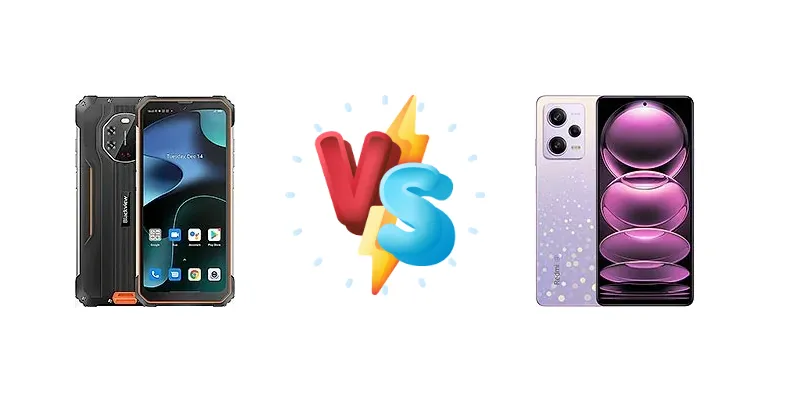
|
🏆 Quick Verdict
The Xiaomi Redmi Note 12 Pro offers a more polished overall experience with a brighter display, faster charging, and a more modern chipset. However, the Blackview BV8800’s incredible battery life and rugged design make it a compelling choice for those needing a durable device for demanding environments.
| PHONES | ||
|---|---|---|
| Phone Names | Blackview BV8800 | Xiaomi Redmi Note 12 Pro |
| Network | ||
|---|---|---|
| 2G bands | GSM 850 / 900 / 1800 / 1900 | GSM 850 / 900 / 1800 / 1900 |
| 3G bands | HSDPA 800 / 850 / 900 / 1700(AWS) / 1900 / 2100 | HSDPA 800 / 850 / 900 / 1900 / 2100 |
| 4G bands | 1, 2, 3, 4, 5, 7, 8, 12, 13, 17, 18, 19, 20, 25, 26, 28, 30, 34, 38, 39, 40, 41, 66 | 1, 2, 3, 4, 5, 7, 8, 12, 13, 17, 18, 19, 20, 26, 28, 32, 38, 40, 41, 66 - International |
| 5G bands | - | 1, 3, 5, 7, 8, 20, 28, 38, 40, 41, 66, 77, 78 SA/NSA - International |
| Speed | HSPA, LTE | HSPA, LTE, 5G |
| Technology | GSM / CDMA / HSPA / CDMA2000 / LTE | GSM / CDMA / HSPA / EVDO / LTE / 5G |
| CDMA2000 1x | 1, 3, 5, 8, 28, 38, 41, 77, 78 SA/NSA - China | |
| Launch | ||
|---|---|---|
| Announced | 2021, December 24 | 2022, October 27 |
| Status | Available. Released 2022, January 10 | Available. Released 2022, November 01 |
| Body | ||
|---|---|---|
| Build | - | Glass front (Gorilla Glass 5), glass back, plastic frame |
| Dimensions | 176.2 x 83.5 x 17.7 mm (6.94 x 3.29 x 0.70 in) | 163 x 76 x 8 mm (6.42 x 2.99 x 0.31 in) |
| SIM | Nano-SIM + Nano-SIM | Nano-SIM + Nano-SIM |
| Weight | 367 g (12.95 oz) | 187 g (6.60 oz) |
| IP68/IP69K dust/water resistant (up to 1.5m for 30 min) Drop-to-concrete resistance from up to 1.5m MIL-STD-810H compliant | IP53, dust and splash resistant | |
| Display | ||
|---|---|---|
| Protection | - | Corning Gorilla Glass 5 |
| Resolution | 1080 x 2408 pixels, 20:9 ratio (~401 ppi density) | 1080 x 2400 pixels, 20:9 ratio (~395 ppi density) |
| Size | 6.58 inches, 104.3 cm2 (~70.9% screen-to-body ratio) | 6.67 inches, 107.4 cm2 (~86.7% screen-to-body ratio) |
| Type | IPS LCD, 90Hz, 480 nits | AMOLED, 1B colors, 120Hz, Dolby Vision, HDR10+, 500 nits (typ), 900 nits (HBM) |
| Platform | ||
|---|---|---|
| CPU | Octa-core (2x2.05 GHz Cortex-A76 & 6x2.0 GHz Cortex-A55) | Octa-core (2x2.6 GHz Cortex-A78 & 6x2.0 GHz Cortex-A55) |
| Chipset | Mediatek MT6781 Helio G96 (12 nm) | Mediatek Dimensity 1080 (6 nm) |
| GPU | Mali-G57 MC2 | Mali-G68 MC4 |
| OS | Android 11, Doke-OS 3.0 | Android 12, MIUI 13 |
| Memory | ||
|---|---|---|
| Card slot | No | No |
| Internal | 128GB 8GB RAM | 128GB 6GB RAM, 128GB 8GB RAM, 256GB 8GB RAM, 256GB 12GB RAM |
| UFS 2.1 | UFS 2.2 | |
| Main Camera | ||
|---|---|---|
| Features | Dual-LED flash, HDR, panorama | Dual-LED dual-tone flash, HDR, panorama |
| Quad | 50 MP, f/1.8, (wide), PDAF 8 MP, f/2.2, 117˚ (ultrawide) 20 MP, f/1.8, (IR camera), 2 IR emitters Auxiliary lens | - |
| Single | 16 MP, f/2.0, (wide) | - |
| Triple | - | 50 MP, f/1.9, 24mm (wide), 1/1.56", 1.0µm, PDAF, OIS 8 MP, f/2.2, 120˚ (ultrawide), 1/4.0", 1.12µm 2 MP (macro) |
| Video | 1440p@30fps | 4K@30fps, 1080p@30/60/120fps, 720p@960fps |
| Selfie camera | ||
|---|---|---|
| Features | - | HDR |
| Single | 16 MP, f/2.0, (wide) | 16 MP, f/2.5, (wide), 1/3.06", 1.0µm |
| Video | 1080p@30fps | 1080p@30/60fps |
| Sound | ||
|---|---|---|
| 3.5mm jack | No | Yes |
| 35mm jack | No | Yes |
| Loudspeaker | Yes | Yes, with stereo speakers |
| - | 24-bit/192kHz audio | |
| Comms | ||
|---|---|---|
| Bluetooth | 5.2, A2DP, LE | 5.2, A2DP, LE |
| Infrared port | - | Yes |
| NFC | Yes | Yes (market/region dependent) |
| Positioning | GPS, GLONASS, GALILEO, BDS | GPS (L1), GLONASS (G1), BDS (B1I+B1c), GALILEO (E1), QZSS (L1) |
| Radio | FM radio | No |
| USB | USB Type-C 2.0, OTG | USB Type-C 2.0, OTG |
| WLAN | Wi-Fi 802.11 a/b/g/n/ac | Wi-Fi 802.11 a/b/g/n/ac/6, dual-band, Wi-Fi Direct |
| Features | ||
|---|---|---|
| Sensors | Fingerprint (side-mounted), accelerometer, gyro, proximity, compass, barometer | Fingerprint (side-mounted), accelerometer, gyro, proximity, compass |
| Battery | ||
|---|---|---|
| Charging | 33W wired, 31% in 30 min, 100% in 90 min Reverse wired | 67W wired, PD3.0, 50% in 15 min, 100% in 46 min |
| Type | 8380 mAh | Li-Po 5000 mAh |
| Misc | ||
|---|---|---|
| Colors | Black, Orange, Green | Frosted Blue (Sky Blue), Onyx Black (Midnight Black), Polar White, Stardust Purple |
| Models | - | 22101316C, 22101316I, 23013RK75C, 22101316G |
| Price | About 350 EUR | € 148.54 / $ 142.17 / £ 149.99 / ₹ 19,999 |
| SAR | - | 1.09 W/kg (head) 1.06 W/kg (body) |
| SAR EU | - | 0.99 W/kg (head) 0.99 W/kg (body) |
| Tests | ||
|---|---|---|
| Battery life | Endurance rating 199h | Endurance rating 97h |
| Camera | Photo / Video | Photo / Video |
| Display | Contrast ratio: 1348:1 (nominal) | Contrast ratio: Infinite (nominal) |
| Loudspeaker | -29.3 LUFS (Average) | -26.6 LUFS (Good) |
| Performance | AnTuTu: 254849 (v8), 288964 (v9) GeekBench: 1752 (v5.1) GFXBench: 10fps (ES 3.1 onscreen) | AnTuTu: 490526 (v9) GeekBench: 2209 (v5.1), 2372 (v6) GFXBench: 22fps (ES 3.1 onscreen) |
Blackview BV8800
- Exceptional battery life (199h endurance)
- Rugged and durable design
- Reverse wired charging
- Good contrast ratio display
- Lower performance chipset
- Less bright display
- Camera likely inferior to Redmi
- Bulkier design
Xiaomi Redmi Note 12 Pro
- Brighter and more vibrant display
- Faster charging (67W)
- More powerful chipset (Dimensity 1080)
- Better camera system (expected)
- Shorter battery life compared to BV8800
- Less rugged design
- Contrast ratio claim potentially misleading
Display Comparison
The Redmi Note 12 Pro boasts a significantly brighter display at 890 nits compared to the BV8800's 501 nits. While the BV8800's 1348:1 contrast ratio is impressive, the Redmi Note 12 Pro's 'infinite' contrast ratio (likely a marketing term) and higher brightness provide a more vibrant and easily viewable screen, especially outdoors. Color accuracy is likely better on the Redmi.
Camera Comparison
While both phones offer 'Photo / Video' capabilities, the Redmi Note 12 Pro is expected to have a superior camera system. The Redmi typically features a higher resolution main sensor and better image processing algorithms. The BV8800's camera is likely adequate for basic photography, but won't compete with the Redmi's capabilities.
Performance
The Redmi Note 12 Pro's Mediatek Dimensity 1080 chipset, built on a 6nm process, offers a noticeable performance advantage over the BV8800's Helio G96 (12nm). Expect smoother multitasking, faster app loading times, and better gaming performance on the Redmi. The Dimensity 1080's newer architecture also contributes to improved power efficiency.
Battery Life
The Blackview BV8800 shines in battery life, boasting an incredible endurance rating of 199 hours. This is significantly higher than the Redmi Note 12 Pro's 97-hour rating. While the Redmi offers faster charging (67W vs 33W), the BV8800's sheer battery capacity provides exceptional longevity.
Buying Guide
The Blackview BV8800 is ideal for outdoor enthusiasts, construction workers, or anyone needing a phone that can withstand drops, dust, and water. The Xiaomi Redmi Note 12 Pro is a great choice for everyday users who want a stylish phone with a good camera and performance at a reasonable price.